82 kilograms of meat and 492 bottles: customs fines
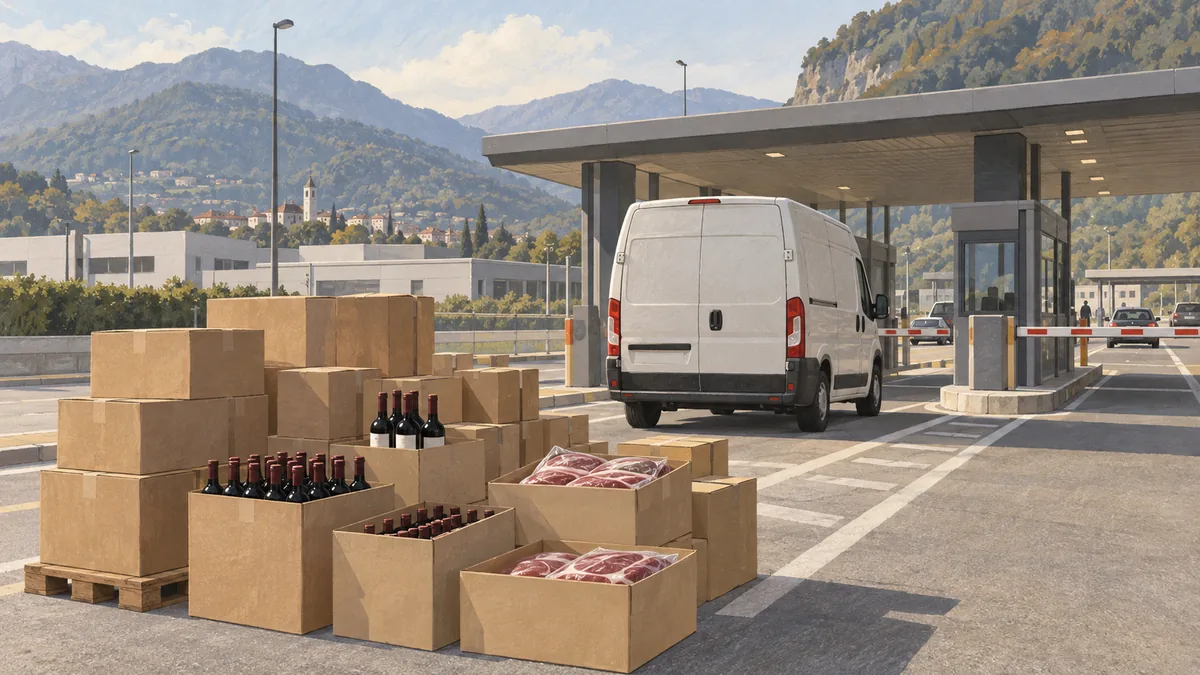
In Vacallo, 82 kilos of undeclared meat found In Stabio, 492 bottles of wine found The inspections took place on October 3 and 7 Fines and customs clearance
Context
TL;DR
- In Vacallo, 82 kilograms of undeclared meat were found
- In Stabio, 492 bottles of wine were found
- The checks took place on October 3 and 7
- Fines and customs clearance in both cases
Key facts
- Locations: Vacallo and Stabio
- Dates: October 3 and 7
- Meat: 82 kilos
- Wine: 492 bottles in 86 cartons
- Outcome: fines and customs clearance
On October 3, in Vacallo, a mobile check on entry into the country led to the stopping of a vehicle with Swiss plates. Three Romanian citizens were traveling aboard. Employees of the Federal Office for Customs and Border Security discovered 82 kilos of meat intended for personal consumption and being transported to inland Switzerland. The goods had not been properly declared at the border.
The first incident
The occupants were offered the possibility of clearing the goods through customs. However, they preferred to leave Swiss territory again, in accordance with the applicable procedures. The failure to declare nevertheless resulted in a fine.
A few hours later, the same vehicle was stopped again in Switzerland. Since the meat was already on Swiss territory, in addition to a new penalty, it had to be cleared through customs.
The check in Stabio
On October 7, in Stabio, a mobile check led to the stopping of a van with Swiss plates, driven by a Swiss citizen returning from Italy. Inside, officers found 86 cartons containing a total of 492 bottles of wine, which had not been declared when crossing the border.
The driver explained that the wine had been purchased in Italy for a private party in inland Switzerland, where he lives. The failure to declare resulted in a fine and customs clearance of the goods.
The two incidents were detected in the Mendrisiotto by employees of the UDSC. The first involved meat intended for private use and two stops, with departure from the territory followed by a subsequent internal check. The second concerned wine purchased in Italy, a check upon return and the need to clear the load through customs. In both cases, the issue was the failure to declare the goods at the border.
Operational details
The practical takeaway for those crossing
The two incidents make it possible to isolate a concrete point for those crossing the border with food or wine: the private use indicated by the people involved did not prevent a fine when the goods had not been declared. The meat was intended for private use; the wine had been purchased for a private party in inland Switzerland. In both cases, the personal destination did not settle the customs issue.
Neither the license plates nor residence ruled out the check. In the first incident, the vehicle had Swiss license plates and was carrying three Romanian citizens; in the second, the van had Swiss license plates and was driven by a Swiss citizen residing in inland Switzerland. The practical point, for a cross-border commuter, is that the check described by the source concerns the goods being transported and their declaration at the crossing.
| Incident | Goods | Element identified | Outcome |
|---|---|---|---|
| Vacallo | 82 kilograms of meat | Private use and failure to declare | Fine, followed by another penalty and customs clearance |
| Stabio | 492 bottles in 86 cartons | Purchase in Italy and failure to declare | Fine and customs clearance |
The difference between the two cases lies in the sequence, not in the administrative outcome. In Vacallo, the occupants were able to leave Swiss territory, but the subsequent stop required customs clearance for the meat already present in Switzerland. In Stabio, by contrast, the driver had to regularize the load after the check. The reader who needs to organize a crossing can consult the page on tempi di attesa ai valichi alongside this information, without confusing it with the customs procedure described in the two incidents.
Recommended tools
For an updated estimate, use the net salary calculator and the CHF-EUR exchange comparator.
Useful tools to protect your net income
To reduce FX leakage, compare CHF-EUR exchange options and banks for cross-border workers.
Key points
The procedure reconstructed from the checks
For anyone who has to cross the border with foodstuffs, the sequence to bear in mind based on the two cases is straightforward.
1. When crossing the border, the goods must be declared. In the two incidents, meat and wine had been brought in without a proper declaration. 2. If the possibility of clearing the goods through customs is offered, the source shows that this option can be chosen: in Vacallo, the occupants were given the opportunity to proceed, but they preferred to leave Swiss territory. 3. Leaving did not cancel the fine. A few hours later, the same vehicle was stopped inside Switzerland, and the meat, already in the country, had to be cleared through customs along with a new penalty. 4. When the inspection concerns an undeclared load still present on the vehicle, the outcome described includes a fine and customs clearance. That is what happened in Stabio with the van returning from Italy.
For a cross-border commuter, the point to apply to their own crossing is therefore limited to the goods being transported and the declaration at the border. The case also shows that a mobile inspection can take place on entry, as in Vacallo and Stabio, or inside Switzerland, as in the second stop in the first incident.
Before setting out
To identify the access route to the border crossing, one can consult mappa dei valichi; the inspection of the goods, however, remains the central point of the case. To explore a different topic, related to employment income, use calcolatore dello stipendio.
Source: comozero.it
Frequently Asked Questions
- How much meat was found in Vacallo?
- On October 3, during a mobile check upon entering the country, UDSC officers found 82 kilos of meat in a vehicle with Swiss plates. Three Romanian citizens were travelling on board. The meat was intended for private use and for inland Switzerland, but it had not been correctly declared at the border. The occupants then chose to leave Swiss territory.
- How many bottles of wine were discovered in Stabio?
- On October 7, in Stabio, a mobile check led to the discovery of 86 cartons containing a total of 492 bottles of wine. The van had Swiss plates and was driven by a Swiss citizen returning from Italy. The man stated that the wine was intended for a private party in inland Switzerland, where he resides. The goods had not been declared.
- What happened after the first check in Vacallo?
- The occupants were given the opportunity to clear the meat through customs, but they chose to leave Switzerland again. A fine was imposed for failing to declare it. A few hours later, the same vehicle was stopped inside the country: in addition to a new penalty, it was necessary to clear the meat through customs, as it was already in Switzerland.
- What consequences did the two cases have?
- In both incidents, a fine was imposed for failure to declare. In the case of the meat, after the second stop, it was necessary to clear the goods through customs because they were already in Switzerland. In the case of the wine, the driver had to arrange for customs clearance of the consignment consisting of 86 cartons and 492 bottles.
Related articles
- All articles: Border and customs
- Carne e vino non dichiarati nel Mendrisiotto
- Come funzionano le multe stradali svizzere per un residente italiano
- TILO Stabio-Malpensa: stop ai treni giugno 2026
- Multe per vignetta a Chiasso: 190 sanzioni in 4 giorni
- Federviti lancia risoluzione: vino ticinese prima scelta