Mendrisiotto, meat and wine not declared to customs
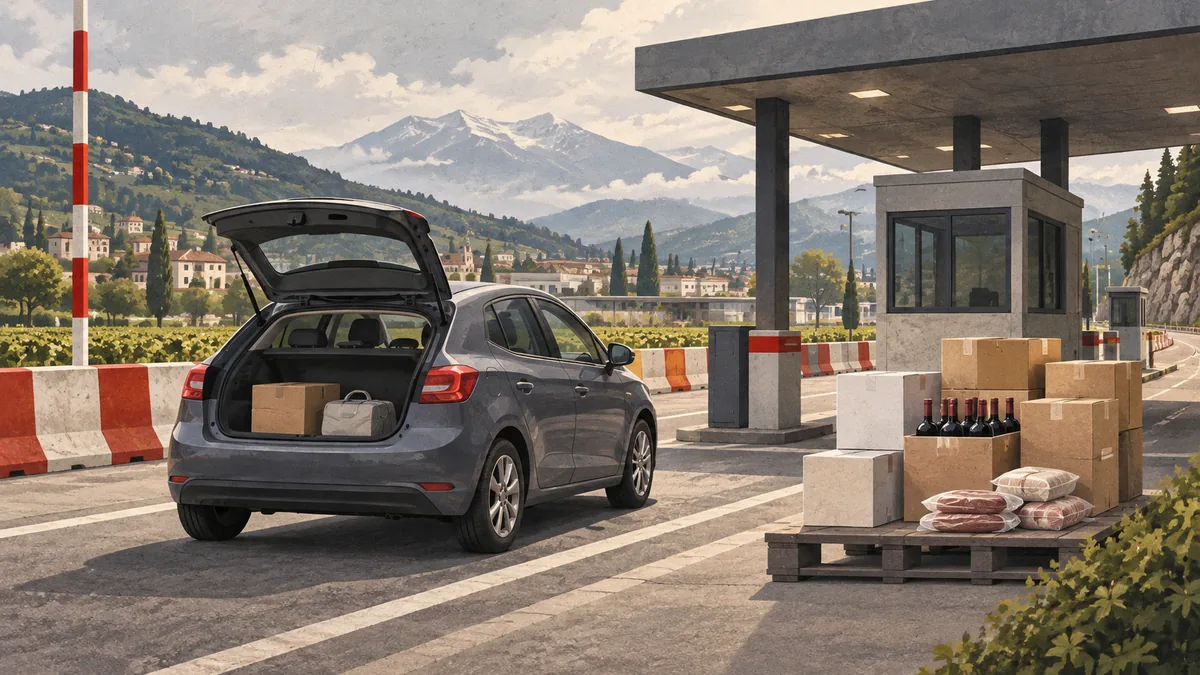
Vacallo: 82 kilos of meat found on October 3 Stabio: 492 bottles of wine found on October 7 In both cases, the customs declaration was missing The FOCBS
Context
TL;DR
- Vacallo: 82 kilos of meat found on October 3
- Stabio: 492 bottles of wine found on October 7
- In both cases, the customs declaration was missing
- The UDSC carried out both checks in Mendrisiotto
Key facts
- Authority → Federal Office for Customs and Border Security (FOCBS)
- First check → October 3, Vacallo
- Meat → 82 kilos, intended for private use
- People in Vacallo → three Romanian citizens
- Second check → October 7, Stabio
- Wine → 492 bottles in 86 cartons
- Driver in Stabio → Swiss citizen
- Destination → inland Switzerland
During a check carried out on October 3 in Vacallo, FOCBS officers found 82 kilos of meat on board a vehicle with Swiss license plates. Three Romanian citizens were travelling in the vehicle towards inland Switzerland; the goods, purchased in Italy, were intended for private use.
The Vacallo check
The occupants were offered the possibility of clearing the load through customs, but they preferred to leave Switzerland again. However, they did not avoid the fine for failing to declare it. When, a few hours later, the vehicle was stopped again in Switzerland, the meat was already in the territory: the three were therefore required to clear it through customs and received a second fine.
The first episode therefore did not end with their leaving Swiss territory. The sequence included a first check, the decision not to clear the goods through customs at that time, another stop and the subsequent customs clearance of the meat already present in Switzerland. The source does not state the amount of the fines.
The Stabio case
On October 7, during a mobile check in Stabio, officers inspected a van with Swiss license plates. On board were 86 cartons containing 492 bottles of wine, which had not been declared when crossing customs.
The driver, a Swiss citizen, said he had bought the wine in Italy for a private party in inland Switzerland, where he is domiciled. He too had to clear the goods through customs and pay a fine for failing to declare them.
The tally from the two operations consists of 82 kilos of meat and almost 500 bottles of wine. The first consignment was intended for private use; the second had been bought for a private party. The source does not quantify the fines and does not indicate any other elements of the customs-clearance procedure. mappa dei valichi is available for locating the points mentioned.
Operational details
The practical point for those crossing the border
The sequence of the first inspection makes it possible to distinguish two moments: the possibility of clearing the load through customs and the subsequent situation, when the goods are already in Switzerland. The occupants of the vehicle stopped in Vacallo chose to leave Swiss territory again, but the vehicle was stopped again a few hours later. At that point, the meat was already in the country and the load had to be cleared through customs, with a new fine for failing to declare it.
Leaving does not mean closing the case
The text does not present leaving Switzerland as a way to resolve the matter. Instead, it reports a precise sequence: first stop, the possibility of customs clearance, departure, a new inspection, and the customs clearance of the goods already present in Switzerland. In the case of the wine, the situation is different: the mobile inspection in Stabio led directly to customs clearance and a fine for failing to declare it.
For a cross-border worker in a similar situation, the scope of the news item should be kept separate from that of cross-border employment. The source does not address the G permit, AVS, LPP, LAMal, tax rebates, or withholding tax, and does not address double taxation. It documents only a customs procedure related to goods purchased in Italy.
Available and missing data
The figures reported are those for the two loads: 82 kilos of meat and 492 bottles of wine contained in 86 cartons. The source does not establish thresholds applicable to other purchases, does not indicate the amounts of the fines, and does not describe documents, forms, or duties. It is therefore not possible to turn these two incidents into a general table of exemptions or costs.
The news concerns the declaration of goods, not travel times or traffic conditions. The page on tempi di attesa ai valichi is available for these aspects.
Useful planning tools
To estimate your pension strategy, use the pension planner and the pillar 3 simulator.
Useful planning tools
To estimate your pension strategy, use the pension planner and the pillar 3 simulator.
Key points
A procedure that can be derived only from the two cases
The two episodes do not provide a complete set of rules, but they make it possible to isolate some operational steps described in the source. They are not, however, a list of thresholds or exemptions applicable to every purchase.
- The decisive moment is passage through customs: in both cases, the goods purchased in Italy had not been declared.
- When the option of clearing customs is offered, the first case shows that this option can be exercised before leaving Swiss territory.
- If one chooses to leave, the source nevertheless reports a second stop of the vehicle in Vacallo, which occurred a few hours later.
- When the goods are already in Switzerland, the case involving the meat shows that it was necessary to clear them through customs and pay a new fine.
The Stabio case adds a second scenario: a mobile check of a van with Swiss license plates, an undeclared load of 492 bottles, and subsequent customs clearance with payment of the fine. Here too, the text provides no details about any documents, the calculation methods, or the amount of the penalty.
The dates October 3 and 7 serve to reconstruct the chronology of the checks. The source does not present them as deadlines for regularizing other purchases and does not indicate deadlines for payments or objections. The same applies to the locations: Vacallo and Stabio are the places of the two episodes described, but the text does not list any other border crossings or customs offices.
To correctly understand the matter, it is therefore advisable to stick to the documented steps: goods purchased in Italy, failure to declare them at the border, possible customs clearance, and a fine for the omission. For other financial checks related to working across the border, use calcolatore fiscale.
Source: ticinonews.ch
Frequently Asked Questions
- What did the UDSC find during the two checks?
- At Vacallo, 82 kilograms of meat were found in a vehicle with Swiss license plates. In Stabio, officers found 86 cartons containing 492 bottles of wine in a van, also with Swiss license plates. In both cases, the goods had been purchased in Italy and had not been declared when crossing the border.
- What happened to the three Romanian citizens stopped in Vacallo?
- The three Romanian citizens were traveling toward central Switzerland with 82 kilograms of meat intended for private use. They had the option of clearing the load through customs, but chose to leave Swiss territory again and were fined. A few hours later, the vehicle was stopped again in Switzerland: the meat was already in the country, so they had to clear it through customs and were fined again.
- How did the wine inspection in Stabio conclude?
- On October 7, a mobile inspection stopped a van with Swiss license plates in Stabio. The driver, a Swiss citizen domiciled in German-speaking Switzerland, explained that he had bought the 492 bottles in Italy for a private party. The goods had not been declared when crossing customs. He had to clear them through customs and pay a fine for failing to declare them.