Council of State rejects reopening of FFS stop in Giornico
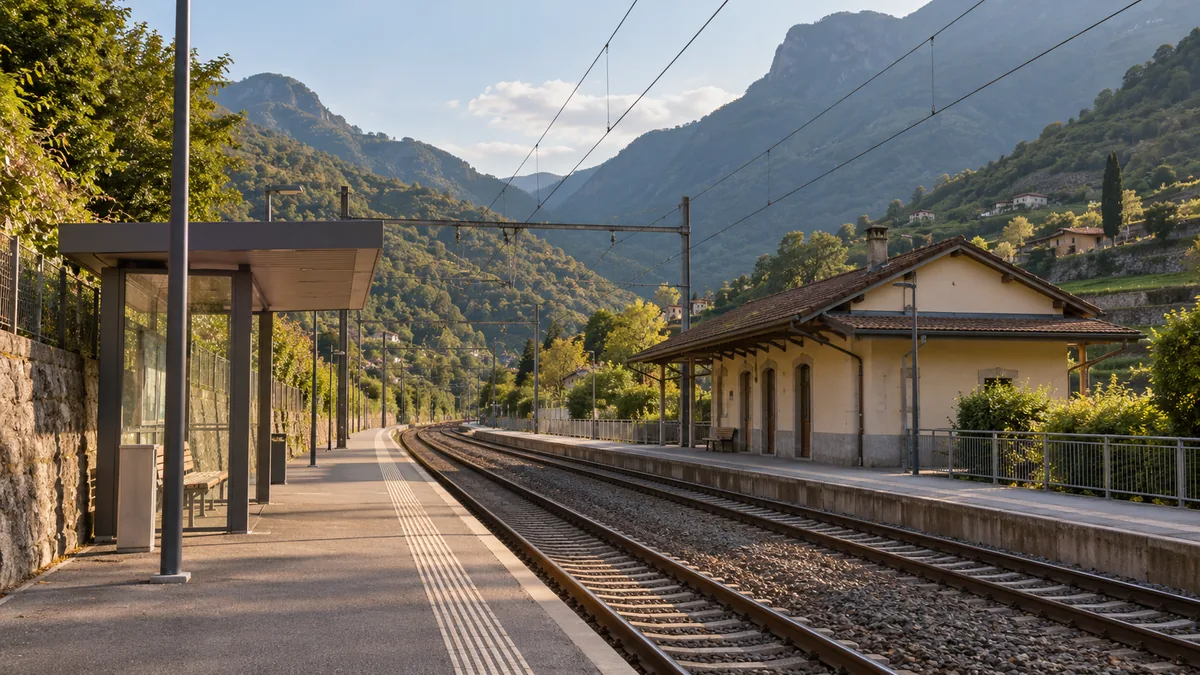
The Council of State rejects reopening in Giornico The 120 route serves Paese, Fraggio and Scuola Media TILO connections switch from the S10 at Biasca Nobody
Context
TL;DR
- The Council of State rejects reopening in Giornico
- Line 120 serves Paese, Fraggio and Scuola Media
- TILO connections transfer from the S10 at Biasca
- No feasibility study will be initiated
Key facts
- Location → Giornico
- Outcome → reopening not justified
- Response → Council of State
- Bus service → AutoPostale, line 120
- TILO connection → S10 at Biasca
- Reactivated stops → Ambrì-Piotta, Lavorgo and Bodio
- Recent request → Rodi-Fiesso station
- Traffic → IR Locarno-Zurich/Basel
The response on Giornico
BELLINZONA - The Council of State rules out reopening a railway stop in Giornico. The position is set out in the response to the interpellation submitted last December by Alessandro Corti, a Centre deputy, with Guerra and Tenconi as co-signatories. The parliamentary motion concerned rail accessibility and the historical-cultural enhancement of the Leventina village.
The Government justifies the refusal by citing the existing service offering and the assessment of railway operating costs. Giornico has the Giornico, Paese and Giornico, Fraggio stops; AutoPostale line 120 also runs scheduled services to Giornico, Scuola Media. The timetable presented by the Executive provides hourly services during off-peak hours and every half hour during the morning and evening peak periods.
The reference to line 120 is also precise in terms of locations: the response does not speak only of Giornico in general, but identifies Paese, Fraggio and Scuola Media. The rationale therefore considers both the stops served and the way they are connected to the TILO network.
This arrangement is complemented by connections described as being optimally linked to the TILO network, particularly with the S10 line at Biasca. The response therefore presents, within the same framework, the local stops, the varying frequency depending on the time of day and the interchange with the railway network. These are the elements used by the Council of State to argue that the settlement is already well served by public transport.
For the Government, the reopening proposal is not sustainable in light of operating requirements and costs. Consequently, the Council of State also declines to commission a feasibility or pre-feasibility study, as requested by the parliamentary motion.
The comparison with the parliamentary request is therefore twofold: the motion called for reopening to be examined and a preliminary analysis to be launched; the response considers the first scenario unjustified and declines the second. The two conclusions are attributed to the aspects explicitly indicated: operations and costs. The result communicated in Bellinzona is specific: for Giornico, the road-based service and connections with TILO are considered sufficient by the cantonal Government to make railway reopening unjustified.
Operational details
The precedent of the mountain line
From 2016 to the return of the stops
The decision regarding Giornico comes within a broader reconstruction of the historic Gotthard line. The State Council begins with the opening of the base tunnel: inaugurated on June 1, 2016, it became accessible to passenger traffic in December of the same year.
| Moment | Facts recalled |
|---|---|
| June 1, 2016 | Inauguration of the base tunnel |
| December 2016 | Access to passenger traffic |
| After the opening | Hourly passenger service maintained on the mountain line |
| Following year | Reactivation of the Bodio stop |
According to FFS plans, the opening of the new tunnel would have meant the cessation of service on the mountain route. The cantonal government's intervention nevertheless made it possible to maintain an hourly passenger service on the line. The response identifies this step as the starting point for the configuration described for Leventina after the opening of the tunnel.
Airolo and Faido were already existing stations. After the inauguration of the base tunnel, Ambrì-Piotta and Lavorgo were instead reactivated; Bodio followed the following year. The sequence identifies three reopenings, different in location but attributed by the Government to the same rationale: integration with the bus network. The same State Council characterizes them as an exception for a non-commissioned railway service.
The comparison with Giornico is viewed within this sequence. The three stops are not presented merely as additions to the line, but as reopenings decided primarily in relation to bus connections. For Giornico, by contrast, the response refers to the AutoPostale service and the TILO connections already available; the documented point is therefore the different outcome attributed to a new reopening compared with the three reactivations already carried out.
The institutional distinction indicated by the Government also concerns the trains that run on the line. Long-distance traffic includes Eurocity, Intercity and Interregio services: these services are planned by the Confederation, fall within the FFS remit and do not receive operating funding. This qualification completes the picture set out in the response: the historic line maintains an hourly passenger service, but the trains that run on it are part of a service offering planned at federal level and managed by FFS.
This account thus supports the conclusion expressed by the State Council: the three reopenings are acknowledged, but are placed in specific conditions, linked to the bus network and the configuration of service along the mountain route. The Government presents them as an exception, not as sufficient justification for extending the same solution to Giornico.
Key points
Rules, requests and cultural enhancement
The scope of requests in Leventina
Apart from Ambrì-Piotta, Lavorgo and Bodio, the Government specifies that no formal discussions have been initiated regarding any further reopenings in Leventina. The response recalls only one recent request: that of the Municipality of Prato Leventina for the Rodi-Fiesso station. The request had been submitted as part of the objection to the 2021 public transport offering, an objection subsequently rejected by the Grand Council.
On the railway side, FFS Infrastruttura rules out adding further stops. The reasons given are twofold: railway operations and costs. The Government also specifies that the assessment takes into account, in particular, the requirements arising from the Federal Act on the Elimination of Disadvantages for People with Disabilities. In the response, the reopening of a stop is therefore linked to technical, operational, cost and accessibility requirements.
The response refers to complex legislation, especially the Railways Act and the Disability Act. For technical matters, it identifies the website of the Federal Office of Transport as a reference. The timetable is an additional constraint: a new stop must not undermine the stability of planning, which is conditioned by constraints along the route and at important nodes such as Bellinzona.
The service under consideration is also the IR Locarno-Zurich/Basel, and therefore long-distance traffic. The Government points to the need to maintain attractive travel times: each stop penalizes through passengers, while the stops essential for transfers to road services must be retained. The response thus places timetable stability, journey duration and connections with road services on the same level.
The parliamentary question ultimately linked transport, culture and tourism. The topics mentioned included the findings of the Metron study on AlpTransit and Giornico's potential as an open-air museum. In its response, the State Council cites the continued existence of the mountain line, the return of service to the Ambrì-Piotta, Lavorgo and Bodio stops, and more effective integration with the bus network. According to the Executive, these elements brought a substantial improvement in public transport to Leventina, both qualitatively and quantitatively, with a network described as high-performing.
The picture presented therefore keeps two levels distinct: on the one hand, the historical and cultural enhancement requested for Giornico; on the other, the railway requirements that the Government considers binding for new stops. The source does not indicate formal negotiations to reopen Giornico; the reported outcome remains the abandonment of the study and the assessment that reopening is not justified.
Source: tio.ch
Frequently Asked Questions
- What is the outcome of the request to reopen the stop in Giornico?
- The Council of State rejects the reopening of the railway stop in Giornico, finding no justification either from an operational or cost perspective. This position is set out in the response to the interpellation submitted last December by Centre MP Alessandro Corti.
- What public transport services are available in Giornico?
- Giornico has the Giornico, Paese and Giornico, Fraggio stops; in addition, AutoPostale route 120 runs at regular intervals to Giornico, Scuola Media. TILO connections are very well coordinated with the S10 line in Biasca.
- Will a feasibility study be launched for the reopening?
- No, the Council of State declines to launch a feasibility or pre-feasibility study, as requested by the parliamentary motion, because the reopening is not considered justified.
- Are there precedents for reopening stops on the Gotthard line?
- Yes, after the inauguration of the base tunnel on June 1, 2016, Ambrì-Piotta and Lavorgo were reopened, and Bodio the following year, defined as exceptions linked to integration with the bus network.
Related articles
- All articles: Family and school
- Lavori A2 Giornico: Tutte le alternative per frontalieri
- Gioco dell'oca su rischi e disastri a Giornico
- Nuova pista ciclopedonale Bodio-Giornico: 2,1 km di sicurezza e connessione
- Tre Valli: 80 operatori in quattro esercitazioni
- Riapertura linea Gallarate-Stabio: info per frontalieri