Tre Valli: 80 operators in four exercises
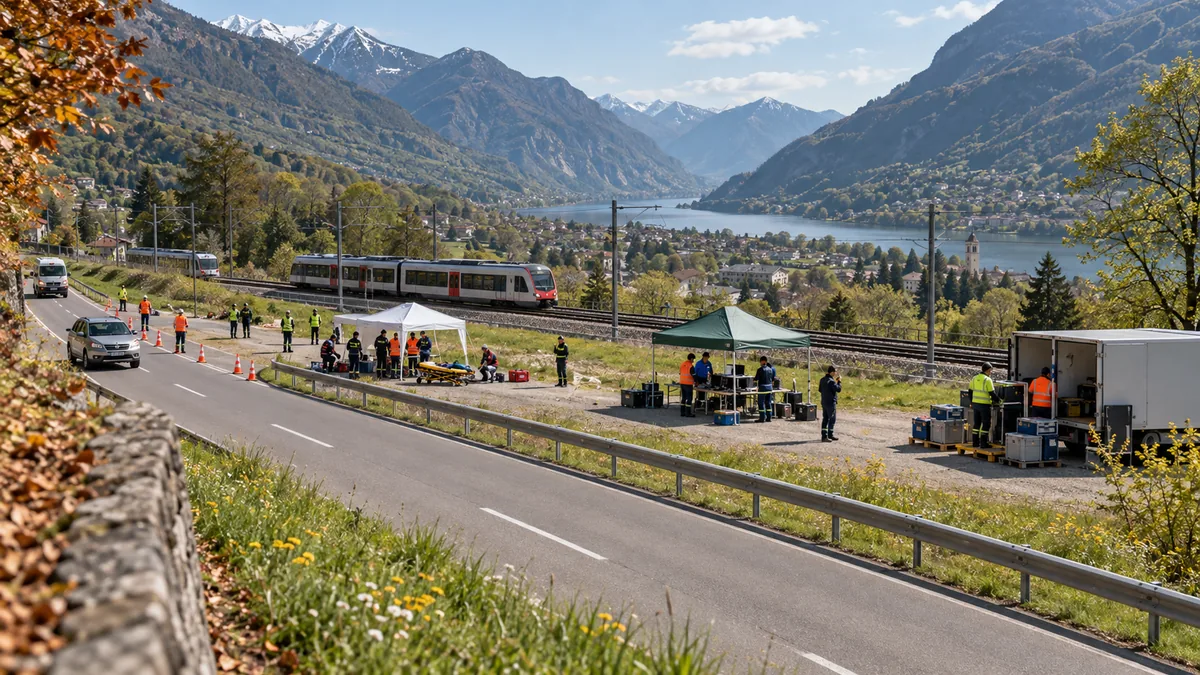
Around 80 operators trained in 2026 Four editions between Biasca and Giornico Three scenarios: fire, public order and bad weather Training will continue
Context
TL;DR
- About 80 operators trained in 2026
- Four editions between Biasca and Giornico
- Three scenarios: fire, public order and bad weather
- Training will continue in another region
Key facts
- Participants → approximately 80 operators
- Year → 2026
- Editions → four
- Locations → Biasca and Giornico
- Scenarios → fire, public order and bad weather
The course and its objectives
In 2026, approximately 80 operators took part in four editions of the course for the command staff of first-response organizations, referred to by the acronym SMEPI. Organized between Biasca and Giornico, the sessions were overseen by the Technical Commission for Training in Civil Protection.
The course was designed to improve the management of emergencies requiring the coordinated intervention of multiple services. It did not involve responses to real events: the activities used simulated scenarios to develop the ability to assess situations, make operational decisions and activate responses.
The three scenarios
The exercises tested participants in three situations. The first concerned a fire at the Heavy Vehicle Control Centre in Giornico. The second reproduced a public-order incident at the Industrial Services Centre of the Ente Ospedaliero Cantonale (EOC), in Biasca. The third was a weather-related emergency at Casa anziani leventinese in Giornico.
The work was led by instructors and carried out with the support of the managers of the infrastructures involved. In this way, participants were able to operate in their respective roles and apply the common procedures established through coordination between organizations.
Participants included heads of police, fire brigades and ambulance services, as well as Civil Protection officers and specialists from the Cantonal Technical Services. SMEPI serve as coordination structures where the organizations involved jointly organize the response to an emergency.
The program does not end with the four 2026 editions. An additional phase is planned for next year in another region of the canton, with different scenarios and new participants. The aim is to strengthen preparedness and cooperation among the organizations called upon to respond in crisis situations.
Operational details
A territorial, not tax-related connection
For a cross-border worker who works in Canton Ticino, this is not news about the G permit, AVS, LPP or LAMal: the source deals solely with training for emergency response. The connection is territorial and concerns the presence of coordinated activities between Biasca and Giornico. However, there are no elements to assert that the course led to changes in traffic conditions, schedules, access or services for the public.
Anyone crossing the border to work therefore finds information about how first-response organizations operate, not an operational notice. The source does not indicate which routes should be avoided, whether detours are planned or whether the scenarios had consequences for travel times. Nor does it describe communications addressed to workers or users of the infrastructure involved.
What can and cannot be inferred
The content does not concern the G permit, AVS, LPP or LAMal. It does not describe working conditions, pay slips, pensions or health insurance. Introducing these topics would mean attributing to the training an effect that the source does not report.
For the same reason, it is not possible to turn the number of about 80 operators into an estimate of the people involved in a possible real event. The figure concerns participation in the course, not the size of a team on duty or its presence in the area. The future perspective is also precise: next year, new scenarios and additional participants are announced in another region of the canton, but the location, schedule or composition are not indicated.
The practical value, for those who work in Ticino, is therefore the distinction between organizational preparedness and travel or work guidance. The former is documented; the latter are not contained in the text.
Key points
A four-step reading guide
1. Separate simulation and news reporting. The text presents the episodes as simulated scenarios. The first step therefore consists in not treating fire, public order and bad weather as reports of an ongoing emergency.
2. Separate location and impact. Biasca and Giornico are the locations indicated for the course and for the infrastructure involved. However, the source does not communicate closures, diversions, travel times, access or instructions for those traveling. These elements cannot be inferred from the article.
3. Separate roles and recipients. The training concerns the command staffs of first-response agencies and the exercise of common procedures. No individual procedure for users, workers or cross-border commuters is described; the text explains coordination among agencies.
4. Mark the next point of verification. The training activity is expected to resume in another region of the canton, with new scenarios and the involvement of other participants. The report does not yet indicate the venue, schedule, documents or participation methods.
For those who work across the border, this sequence avoids reading more into the news than it allows. The usable fact is the existence of a preparation program and its announced continuation. No new rules for travel or work emerge, however. The figure of about 80 operators must also be maintained in its precise meaning: participants in the four editions of the course, not a general measure of the response available.
In the absence of other indications in the text, the correct action is to stop at the locations, the simulated scenarios, the roles involved and the next announced development.
Source: ticinonews.ch
Frequently Asked Questions
- How many operators participated in the SMEPI exercises?
- In 2026, approximately 80 operators took part in four editions of the course for the senior staff of first-response organizations. The editions were organized between Biasca and Giornico, under the supervision of the Technical Commission for Training in Civil Protection. The training aims to improve the management of emergencies requiring multiple coordinated services.
- Which scenarios were simulated?
- The exercises simulated a fire at the Heavy Vehicle Control Center in Giornico, a public-order problem at the EOC Industrial Services Center in Biasca, and a weather-related emergency at the Leventine nursing home in Giornico. The text presents them as training scenarios, not real events.
- Which entities took part in the training?
- Those taking part in the activities included heads of police, fire brigades and ambulance services, as well as civil protection officers and specialists from the Cantonal Technical Services. The simulations were led by instructors and carried out with the support of the operators of the infrastructures involved. The participants practiced common roles and procedures.
- How will the training proceed?
- The training will continue next year in another region of the canton. New scenarios and other participants are planned. The source states that the objective is to consolidate preparedness and cooperation among the organizations called upon to intervene in crisis situations, but it does not specify the location, schedule, or participation arrangements.
Related articles
- Azienda Bardello cerca operatore CNC: esperienza richiesta
- Lavorare come operatore CNC in Ticino da frontaliere: stipendio medio, requisiti, riconoscimento titolo di studio e permesso G
- Quanto guadagna un operatore CNC frontaliere in Ticino?
- Soccorso alpino, esercitazione al Sasso Malascarpa
- Canton Ticino, incendio in galleria a bordo di un treno: ma è un'esercitazione