21,4 million francs for large hydroelectric plants
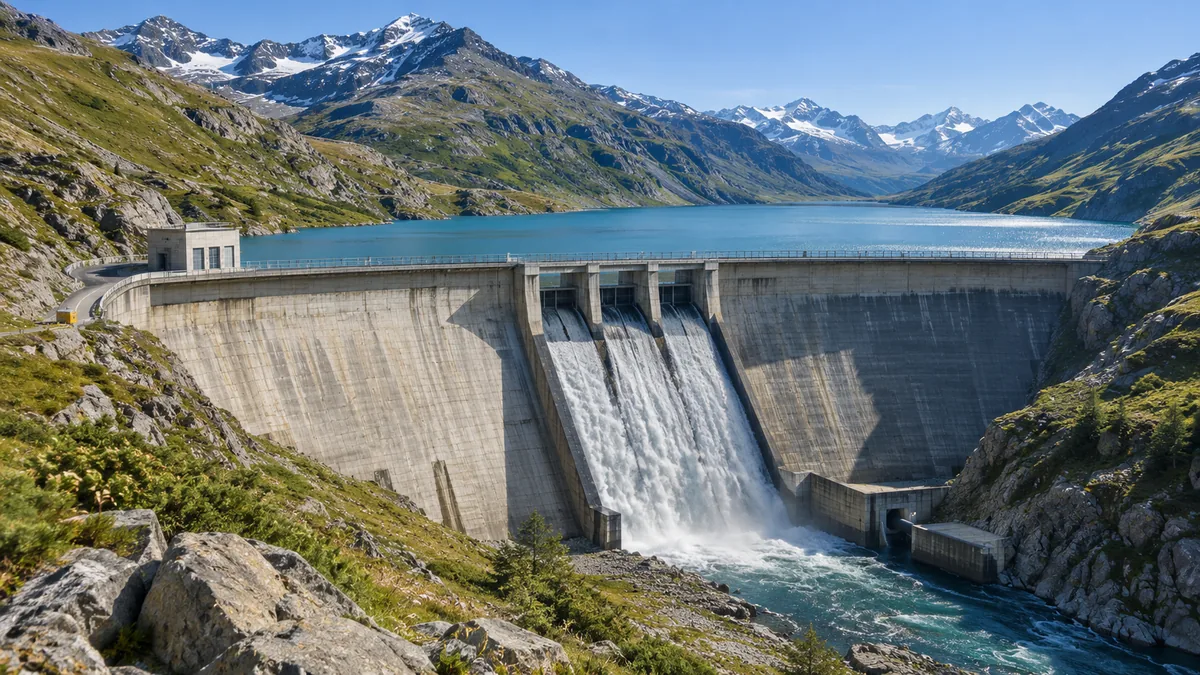
For the 2026 market premiums, relating to the 2025 financial year, the total amount is 21,4 million francs.
Context
TL;DR
- 21,4 million francs to three applicants
- The 2026 premium relates to the 2025 financial year
- Applications were submitted by the end of May 2026
- Available resources were not used in full
Key facts
- Date: November 2, 2026
- Location: Bern
- Institution: UFE
- Amount: 21,4 million francs
- Applicants: three
- Corresponding energy: 2142 million kilowatt-hours
- Share: approximately 5,7 percent of national hydropower production in 2025
- Limit: 1 cent per kilowatt-hour
The announcement from Bern
On November 2, 2026, from Bern, the release states that the Energy Act currently in force allows operators and owners of large hydropower plants in Switzerland to request a market premium for the electricity they produce when they have been forced to sell it on the market at a price below production costs. The condition must be substantiated, and the entitlement arises when revenues do not cover production costs.
For the 2026 market premiums, relating to the 2025 financial year, the total amount is 21,4 million francs. The sum is paid to three applicants. The resources available for this instrument amount to approximately 100 million francs, but in 2026 they are not used in full. The figure therefore distinguishes the available allocation from the amount actually awarded for the applications examined.
By the end of May 2026, the annual deadline for submission, three applications had been received by the UFE, for a total amount of approximately 21,4 million francs. To assess them, the UFE compared the production costs of electricity with the revenues generated. The release specifies that the comparison serves to verify whether the costs are covered or whether revenues are lower than costs.
The production associated with the 2026 contribution is stated as 2142 million kilowatt-hours and represents a share of approximately 5,7 percent of national hydropower production in 2025. For the 2024 financial year, the preceding year, approximately 19,6 million francs had been paid to three applicants. The comparison is reported by the same communication, without attributing the difference between the two amounts to a specific cause.
Information on the beneficiaries is not published individually. Under Article 98 paragraph 4 of the Energy Promotion Ordinance, data relating to recipients of the market premium may be disclosed exclusively in aggregated form. The report therefore makes the amounts, number of applicants and corresponding production available, but not the identity of the individual recipients.
Operational details
How the premium is determined
Comparing costs and revenues
The calculation starts with a review by the SFOE. For each application, electricity production costs and the revenues generated are compared. Entitlement to the premium exists when production costs are not covered, that is, when revenues are lower than costs. The rule therefore links disbursement to a difference measured for the financial year in question.
When determining revenues, the SFOE takes several sales and remuneration channels into account. The comparison includes revenues from sales on the electricity exchange resulting from trading for the following day, the so-called day-ahead market, and revenues from system services. It also includes long-term electricity trading, referred to as the forward market, the winter reserve, and the sale of guarantees of origin.
The premium is capped at 1 cent per kilowatt-hour of energy produced, equivalent to 1,0 ct./kWh. The data reported for 2026 illustrate this limit in concrete terms: dividing the 21,4 million francs indicated by the 2142 million kilowatt-hours associated with the contribution, the ratio is 0,01 francs per kilowatt-hour, that is, 1 cent. The result matches the prescribed maximum, without changing the rule that the premium compensates only for uncovered production costs.
| Item | 2026 premium | 2024 financial year |
|---|---|---|
| Reference year | 2025 | 2024 |
| Amount disbursed | 21,4 million francs | approximately 19,6 million francs |
| Applicants | three | three |
The nominal difference between the amounts indicated for the two financial years is approximately 1,8 million francs. Since both figures are presented as approximate values, the comparison should be read as a difference between the reported amounts, not as a more precise measure of the funding requirement.
Where the resources come from
Around 100 million francs from the Grid Surcharge Fund are allocated to the market premium each year. The Fund is financed by the grid surcharge, which final consumers pay for each kilowatt-hour of electricity consumed. The grid surcharge is 2,3 ct./kWh.
Of the grid surcharge, 0,2 ct./kWh are allocated to the market premium. The Fund also finances other support instruments, including the feed-in remuneration system for electricity, one-off remunerations, and investment contributions for renewable energy. The availability of around 100 million francs and the actual disbursement of 21,4 million therefore describe two different quantities: the former concerns the annual resources planned for the instrument, while the latter concerns the applications funded in 2026.
Key points
Duration and distinction from other instruments
Affected facilities and deadlines
Since 2018, the Energy Act has provided for the market premium as a support instrument for large domestic hydropower plants. The definition covers plants with a capacity above 10 MW. The benefit is granted to those bearing the risk that production costs remain uncovered: operators, owners or electricity supply companies.
To access the premium reserved for unprofitable large hydropower plants, applications must be submitted to the UFE no later than May 31 each year. The UFE is responsible for examining them, with the technical and administrative support of AFRY Schweiz AG. The May 31 deadline clarifies the ordinary deadline for the procedure, while the communication of November 2, 2026 reports the outcome of applications relating to the 2025 financial year.
The instrument has a limited duration. The final disbursement of the market premium will take place in 2031 and will refer to the 2030 financial year. The sequence indicated by the source therefore distinguishes the year of the financial year from the year in which the contribution is disbursed: the 2026 premiums concern 2025, while the final planned disbursement will be linked to 2030.
The floating premium for new plants
The premium intended for existing large hydropower plants is distinct from the floating market premium. The latter applies to new hydropower plants and those undergoing expansion or renovation.
Operators of hydropower plants can now choose whether to apply for a floating market premium or an investment contribution. Investment contributions have existed since 2018. Both instruments promote an increase in electricity production from renewable sources. For hydropower plants, the floating premium could first be applied for in June 2026.
The source also points to an information sheet on the 2026 market premium, published on November 2, 2026, with further information and prospects for the 2027 market premium. The materials mentioned also include a blog by Energeiaplus.com dated July 1, 2026. However, the communication keeps the information on beneficiaries aggregated, as provided for by Article 98 paragraph 4 of the Energy Promotion Ordinance: the names of individual applicants and an individual breakdown of 21,4 million francs are therefore not provided.
Source: admin.ch
Frequently Asked Questions
- How is the market premium for hydropower calculated?
- The Swiss Federal Office of Energy (SFOE) compares electricity production costs with the revenues generated from various sources, such as the «day-ahead market», the «forward market», the winter reserve and guarantees of origin. Entitlement to the premium arises when revenues are lower than production costs. The amount paid out is capped at 1 cent per kilowatt-hour (1,0 ct./kWh). In 2026, the ratio between the 21,4 million francs paid out and the 2142 million kilowatt-hours produced corresponds exactly to this limit.
- Who finances market premiums and what resources are available?
- The premiums are financed through the Grid Surcharge Fund, funded by Swiss final consumers who pay a surcharge of 2,3 ct./kWh for each kilowatt-hour consumed. Of this amount, 0,2 ct./kWh is specifically allocated to the market premium for large hydropower plants. Approximately 100 million francs are made available for this instrument each year, although in 2026 the amount actually allocated to the three applicants was 21,4 million francs, leaving some of the resources unused.
- What are the deadlines and the expected duration for this support?
- The Energy Act stipulates that applications for the market premium must be submitted to the UFE by May 31 of each year. This program is reserved for large hydroelectric plants with a capacity exceeding 10 MW that are not profitable. The program is time-limited: the market premium will be paid for the last time in 2031, based on data from the 2030 fiscal year. At the same time, starting in June 2026, it will be possible to apply for the new floating market premium for new or renovated plants.