Tamedia, over 100 take to the streets in Zurich against 34 full-time job cuts
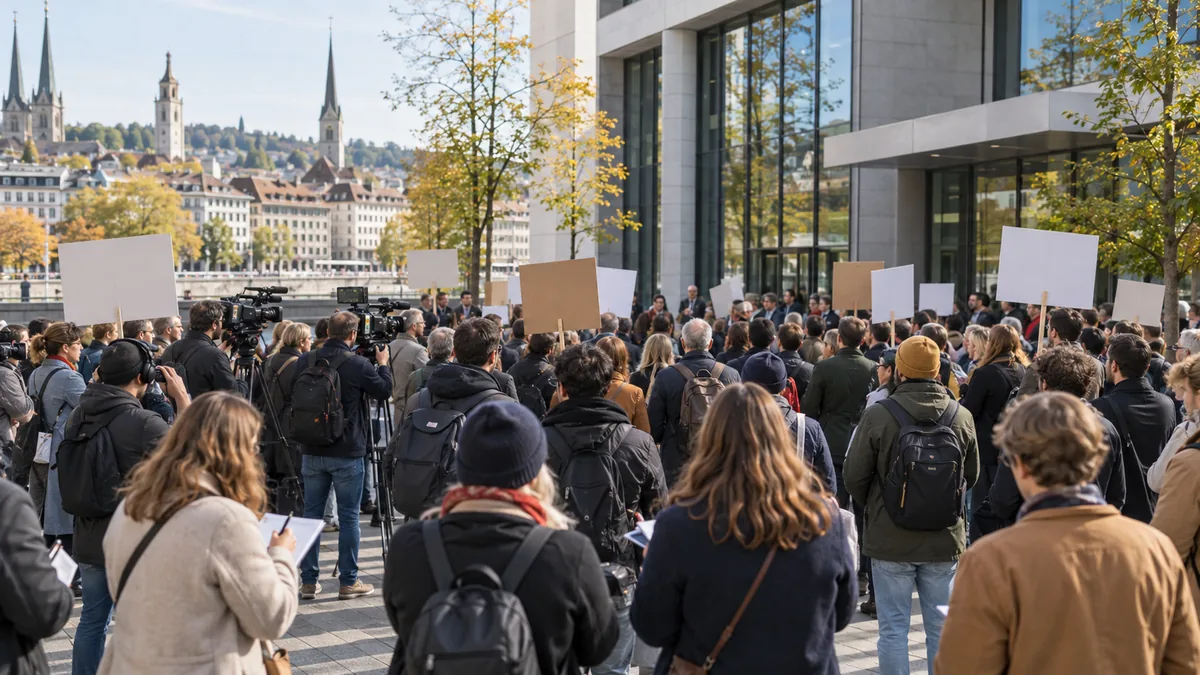
On Tuesday at noon, more than 100 Tamedia employees gathered outside the publishing house's headquarters on Werdstrasse in Zurich.
Context
TL;DR
- Over 100 employees protest in Zurich
- Tamedia announces 34 fewer full-time positions
- The cuts affect 41 employees
- Workers call for investment in journalism
Key facts
- Location → Tamedia headquarters, Werdstrasse in Zurich
- When → Tuesday at noon
- Jobs eliminated → 34 full-time
- Employees affected → 41
- Affected newsrooms → newsrooms in German-speaking Switzerland and French-speaking Switzerland
- Support → Raphael Golta, president of the city of Zurich (SP)
- Request → consultation also in German-speaking Switzerland
On Tuesday at noon, more than 100 Tamedia employees gathered outside the publishing house's headquarters on Werdstrasse in Zurich. The demonstration protested the layoffs announced in recent weeks. The workers called for an immediate halt to the job cuts, also receiving support from Raphael Golta, president of the city of Zurich and a member of the SP.
Speaking in front of the workers, Golta recalled his connection to the Zurich daily newspaper. He explained that he reads it every morning to follow events around the world. The former journalist said he was concerned about the future of local journalism and declared that he wanted to continue reading articles written by professionals rather than produced by artificial intelligence systems.
The newsrooms' demands
The company management came under fire during the mobilization. According to the newsrooms, the consequences of wrong decisions and ineffective strategies systematically fell on employees. Another point criticized was the progressive reduction in resources available for editorial work. Among the signs displayed was the slogan «Journalism instead of AI», which sums up the demand to invest in the work of information professionals.
Staff from Tamedia's French-speaking Switzerland newsrooms also joined the mobilization. On Tuesday, the French-speaking colleagues sent the Zurich employees affected by the cuts a letter expressing solidarity.
About two weeks ago, the company announced the elimination of 34 full-time positions in the newsrooms of German-speaking Switzerland and French-speaking Switzerland; the measure will lead to 41 employees being laid off. Staff are now asking that the consultation procedure, already planned in French-speaking Switzerland, also be extended to German-speaking Switzerland.
Operational details
What the numbers indicate
The employment situation involves two different quantities, which the source presents separately: 34 full-time jobs and 41 employees affected by the layoffs. The distinction is relevant because one number indicates positions, while the other indicates people. The two figures are therefore not interchangeable.
| Item | Reported figure |
|---|---|
| Jobs eliminated | 34 full-time |
| Employees affected | 41 |
| Editorial areas | Newsrooms in German-speaking Switzerland and French-speaking Switzerland |
| Announcement | About two weeks before the protest |
Purely arithmetically, the difference between 41 and 34 is 7 units. However, the text does not explain the composition of this difference and does not make it possible to determine how many people correspond to each full-time position. The figure only makes it possible to keep distinct the number of positions indicated in the plan and the number of employees who, according to Tamedia, will be laid off.
The geographical scope also has two documented levels. The protest took place in Zurich, while the plan concerns the newsrooms of German-speaking Switzerland and French-speaking Switzerland. French-speaking staff members also took part in the mobilization and distributed a letter of solidarity. The news item therefore describes a labor dispute involving both main linguistic areas mentioned in the text, without providing a breakdown of the 34 positions or the 41 employees between the two regions.
The demands likewise fall into two areas. On the employment front, the workers call for an end to the cuts, a consultation procedure also in German-speaking Switzerland, and consideration of voluntary departures. On the editorial front, they call for greater investment in journalism carried out by professionals rather than entrusted to artificial intelligence. These are staff demands: the source does not report that they have already been accepted by management.
Key points
The support and what remains to be clarified
The protest is not described solely as a mobilization within the newsrooms. Raphael Golta, president of the City of Zurich, addressed the workers, expressing support for the employees and concern about the future of local news. His reference to the Zurich daily and to reading the newspaper every day is presented together with the request to continue reading articles written by professionals. The text therefore documents support expressed during the demonstration, but does not attribute decisions on layoffs or Tamedia's strategies to the City of Zurich.
Information not yet available
Solidarity from French-speaking Switzerland is another element reported by the source. Some French-speaking staff members took part in the mobilization and circulated a letter on Tuesday in support of their Zurich colleagues. However, neither the precise number of French-speaking participants nor the full content of the letter is indicated.
The accusations against management are attributed to the editorial teams: the employees criticize the adoption of decisions they consider wrong and strategies they describe as ineffective, arguing that the consequences fall on workers. The text does not report a response from company management to these accusations. It also does not indicate how the 34 eliminated positions would be distributed between German-speaking Switzerland and French-speaking Switzerland, nor does it provide individual details about the 41 employees involved.
The issue of artificial intelligence should also be kept within the limits described. AI is at the center of the slogans and calls for greater investment in professional journalism, but the source does not claim that artificial intelligence is the cause of the layoffs or that it has replaced specific roles.
The text uses relative time references, such as Tuesday and about two weeks ago, without specifying a calendar date. The outcome of the consultation procedure is not reported; it does not say whether the cuts were modified, and no further measures after the protest are indicated.
Source: tio.ch
Frequently Asked Questions
- How many positions and employees are affected by the cuts?
- The source reports two distinct figures: 34 full-time jobs eliminated and 41 employees affected by the layoffs. The difference of 7 units is not explained in the text and does not make it possible to establish how many people correspond to each full-time job.
- What are the workers' main demands?
- Employees are calling for an immediate halt to the job cuts, a consultation procedure in German-speaking Switzerland as well (in addition to the one planned in Romandy), and greater investment in journalism produced by professionals rather than entrusted to artificial intelligence, as summed up by the slogan «Journalism instead of AI».
- Who has expressed support for the protest?
- Raphael Golta, president of the City of Zurich and a member of the PS, spoke in front of the protesters, expressing concern about the future of local news and declaring that he wanted to continue reading articles written by professionals, not by artificial intelligence systems.
- What are the contours of the dispute between German-speaking Switzerland and Romandy?
- The company plan concerns the newsrooms in German-speaking Switzerland and Romandy. French-speaking staff members also took part in the Zurich mobilization, distributing a letter of solidarity. However, the source does not provide the breakdown of the 34 positions or the 41 employees between the two language regions.
- What developments are known following the protest?
- The text does not report the outcome of the consultation procedure, nor does it indicate whether the cuts were modified or withdrawn. No response from company management to the accusations of wrong decisions and ineffective strategies made by the newsrooms is documented.