Buying used goods in Switzerland: warranty and rules
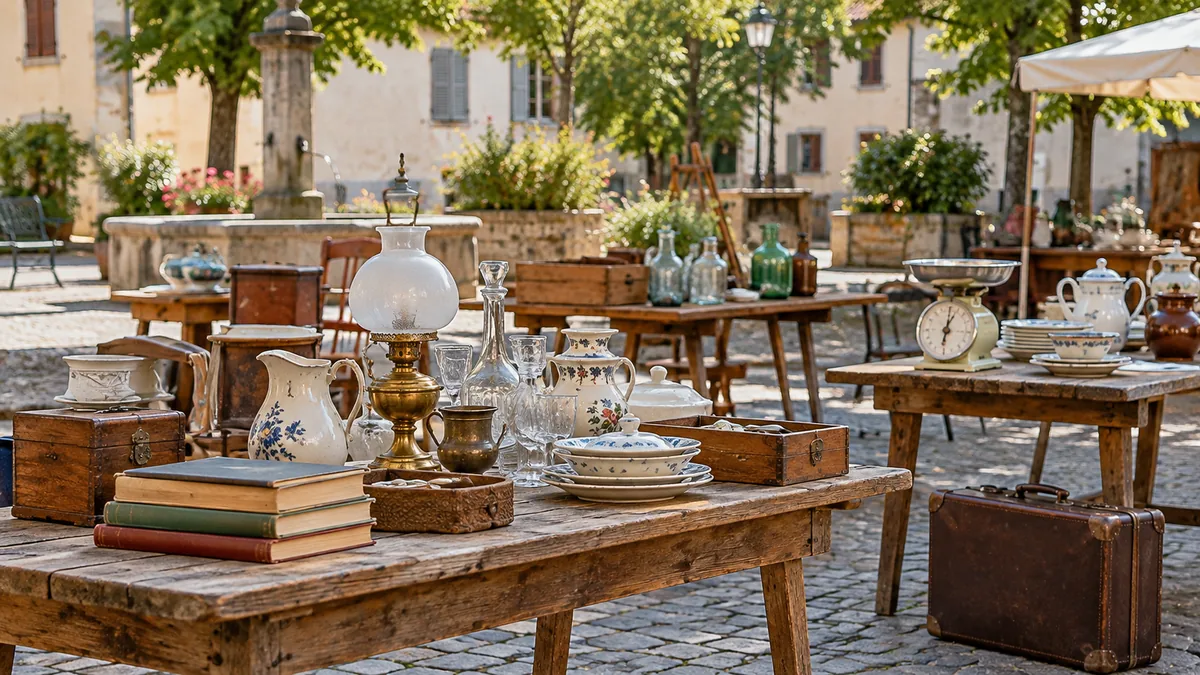
In principle, a one-year warranty, unless explicitly excluded, applies to the purchase of a used item at a flea market in Switzerland.
Context
TL;DR
- One-year warranty, unless explicitly excluded
- Public land: free items are often prohibited
- Counterfeits across the border: possible seizure and a fee of about 100 francs
- Receipt: it is better to include the seller's details
Key facts
- Guarantee at a flea market: one year in principle
- Exclusion: “sold as seen” wording
- Receipt: seller’s details
- Public land: practice often prohibited
- Border: possible fee of around 100 francs
- Reference: Gabriela Baumgartner, Radio SRF 1, October 5, 2026
In principle, a one-year warranty, unless explicitly excluded, applies to the purchase of a used item at a flea market in Switzerland. The rule falls within the framework of the Code of Obligations and concerns a market that also includes secondhand shops, online platforms and items left free of charge in front of a home.
The seller may exclude the warranty. Wording such as “sold as seen” is not presented as a mere phrase of convenience: it constitutes an explicit exclusion. Anyone who accepts this condition waives the related rights. For this reason, the source recommends asking for a receipt that includes at least the seller’s details. If a dispute arises, it is necessary to be able to identify who sold the goods.
The report refers to explanations by Gabriela Baumgartner, broadcast by Radio SRF 1 on October 5, 2026. The guidance concerns both the relationship between seller and buyer and the way in which unwanted items are left.
When a giveaway takes up the street
Leaving boxes of books, furniture or other goods marked “free” on the sidewalk or by the roadside may seem harmless. Legally, however, in numerous municipalities the act may constitute illegal dumping; when public land is occupied, it is also often prohibited.
Leaving goods to be given away in public space is not generally recognized as a right. Regulations vary from city to city: some municipalities impose strict restrictions, while others tolerate the practice only if the items do not obstruct passage and are removed quickly.
On private land, by contrast, items intended to be given away can normally be left. The person making them available no longer retains ownership, which passes to whoever collects them. The sole exception concerns items contained in bags from official used-clothing collections: they remain the property of the sponsoring organization.
Operational details
Warranty, receipt and wrong purchase
The distinction between warranty and the right of withdrawal is the point most likely to create confusion in second-hand purchases. The warranty concerns the rights connected to the purchased item and may be excluded by the seller. Withdrawal, on the other hand, concerns the possibility of changing one’s mind after the purchase has been concluded: according to the source, Swiss law does not provide for a general right of this kind.
The framework reported for the different sales channels can be summarized as follows:
| Situation | Rule indicated by the source |
|---|---|
| Flea market | In principle, a one-year warranty; the seller may exclude it |
| “Sold as seen” formula | Explicit exclusion of the warranty; the buyer waives the related rights |
| Second-hand shop | For second-hand goods, a one-year warranty instead of two |
| Exclusion in a second-hand shop | Permitted if customers are informed clearly |
| Return or exchange | Granted only voluntarily by the seller |
Second-hand shops are shops in every respect. Their activity therefore does not eliminate the rules governing warranties, but the source notes that many retailers exclude them completely. The condition indicated is that the information be clear to customers. In the case of flea markets, the same attention must be paid to the wording used by the seller before concluding the transaction.
The receipt as an identifying element
Asking for a receipt does not automatically change the warranty or turn an exclusion into a right. Its function as described in the report is more practical: retaining at least the seller’s details makes it possible to know whom to contact in the event of subsequent disputes. Without identification, pursuing a claim can become problematic precisely because it would not be possible to determine who sold the goods.
The source also distinguishes the warranty from simply changing one’s mind. Someone who makes a wrong purchase cannot assume that the seller must take the goods back. There is no general obligation to accept returns, and an exchange likewise depends on the retailer’s willingness. The fact that an item is used, that it was purchased in a shop, or that the buyer has changed their mind does not, by itself, create a general right to return it.
The practical consequence described in the text is a distinction between what the seller may be required to guarantee and what they may choose to do. The warranty may be excluded when the exclusion is communicated explicitly or clearly; returns and exchanges, on the other hand, remain voluntary initiatives. For this reason, the purchase conditions and the seller’s identity carry different weight: the former define the rights connected to the warranty, while the latter makes it possible to identify the other party if a dispute arises.
Key points
Low prices, counterfeit goods and the border
Price is one of the main reasons why second-hand markets attract buyers. However, the source urges particular caution when the price appears exceptionally advantageous. The stated criterion is not to automatically regard every bargain as suspicious, but to carefully check the condition of the item, ask the seller questions, and assess whether the price is truly plausible. If in doubt, the suggestion is to be wary; if one decides to purchase anyway, it is advisable to ask for a receipt.
The designer handbag case
One might consider an authentic designer handbag sold for a price much lower than its market value. The person who buys it is not obliged to disclose its actual value to the seller. However, the seller could later challenge the contract if they proved that they had entered into it without knowing the item's value.
This passage shows that the source does not present a very low price as automatic proof of illegal activity or counterfeiting. Instead, it is a factor that calls for more careful checks of the item and the plausibility of the deal. The source does not indicate a numerical threshold above which the price must be considered suspicious and does not establish that every highly advantageous purchase should be refused.
The risk for those who buy across the border
Anyone who sells stolen or counterfeit goods commits a crime; on the other hand, according to the report, anyone who in good faith buys such an item at a Swiss second-hand market does not commit a criminal offense. The most significant difficulties arise with cross-border purchases, when people visit second-hand markets in neighboring countries and then return to Switzerland.
Customs checks focus above all on counterfeit branded products. If found during an inspection, they may be seized; anyone bringing them into Switzerland may also have to pay a fee of about 100 francs. The source presents this figure as approximate, not as an amount that applies indiscriminately to every inspection, and does not indicate any additional amounts.
The border therefore marks a difference compared with a good-faith purchase made at a Swiss second-hand market. In the first case described, the buyer does not commit a criminal offense; in the second, bringing counterfeit branded products into the country may lead to seizure and a fee. Checking the item, asking the seller questions, and obtaining a receipt therefore remain central; these are measures that the source links both to protecting the buyer and to the possibility of reconstructing the purchase.
Source: rsi.ch
Frequently Asked Questions
- What is the warranty for goods purchased at a flea market?
- In principle, the purchase of a used item at a flea market in Switzerland is accompanied by a one-year warranty, according to the Code of Obligations. However, the seller may explicitly exclude this warranty, for example by using the wording «sold as seen». Anyone who accepts this condition waives the related warranty rights.
- What happens if counterfeit products are purchased abroad?
- Customs authorities monitor counterfeit branded products. Anyone who brings counterfeit items purchased at foreign flea markets into Switzerland risks having the goods confiscated and paying a fee of around 100 francs. By contrast, according to the source, purchasing a counterfeit product in good faith at a flea market in Switzerland does not constitute a criminal offense.
- Is it possible to return an item purchased at a second-hand shop?
- Swiss law does not provide for a general right of withdrawal or exchange for second-hand purchases. The return or exchange of a product may be granted only voluntarily by the seller. Even in second-hand shops, where a one-year warranty is provided for second-hand goods (rather than two years), it may be excluded if customers are clearly informed.
Related articles
- All articles: Franc and prices
- Mercatini usato: garanzia, marciapiede e falsi oltreconfine
- Nessuna proroga per le garanzie statali alle aziende elettriche
- Affittare bene un immobile: strategie e consigli per proprietari
- Di più Auto: mercato del nuovo non decolla, svizzeri preferiscono l'usato
- IA chatbot: impatto su acquisti e consumatori svizzeri