PS launches initiative against gender-based violence in Thun
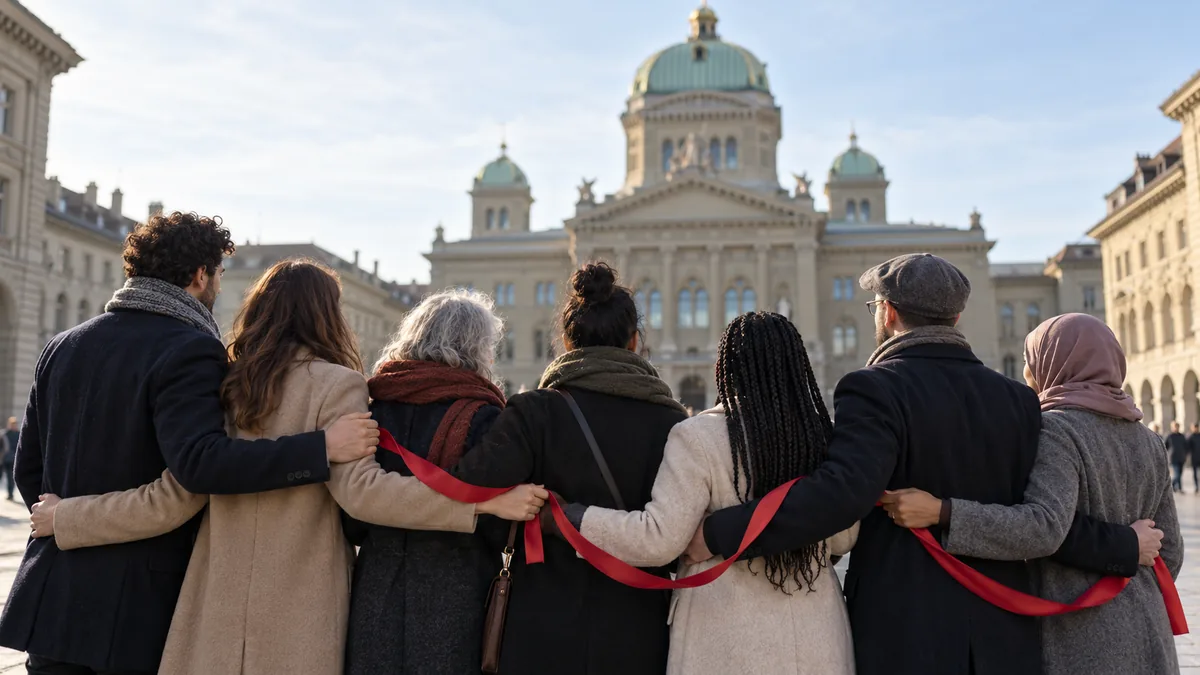
On Saturday, during the congress of the Swiss Socialist Party in Thun, the delegates unanimously approved launching a popular initiative to strengthen the protection of women from violence and combat gender-based violence.
Context
TL;DR
- The SP launches an initiative on gender-based violence in Thun
- Delegates approve the project unanimously
- At least 500 million additional francs requested each year
- Signature collection planned to begin in spring 2027
Key facts
- Initiator → Swiss Socialist Party
- Location → Thun
- Resources requested → at least 500 million additional francs per year
- Approval → unanimity among the delegates
- Next step → legal review by the Federal Chancellery
- Signature collection → spring 2027
On Saturday, during the congress of the Swiss Socialist Party in Thun, the delegates unanimously approved launching a popular initiative to strengthen the protection of women from violence and combat gender-based violence. The project is not limited to calling for more prevention: it also proposes closer cooperation between the Confederation, the cantons and specialized services.
The financial demand is explicit. The PS is calling for at least 500 million additional francs to be made available each year to combat gender-based violence. The party argues that support for victims still depends too much on their place of residence and considers the progress made in this area insufficient.
To support its position, the PS recalls that 27 femicides were recorded in Switzerland in 2025 and that there have already been 18 cases since the beginning of this year. Tamara Funiciello, National Councillor and co-president of Socialist Women, described femicides as merely the tip of the iceberg, also citing rapes, beatings, humiliations and discrimination. “Protection costs money, but violence costs lives,” she said.
The institutional step
Federal Councillor Beat Jans also spoke at the congress. He argued that domestic and gender-based violence are not private matters, but a responsibility of the state governed by the rule of law and society as a whole.
Thun’s green light does not conclude the process: before the PS launches the signature collection, scheduled for spring 2027, the text will have to undergo legal review by the Federal Chancellery. In her speech, Socialist co-president Mattea Meyer accused the UDC of having “a structural problem with violence,” citing visits to Vladimir Putin and Xi Jinping and tributes to Donald Trump.
Operational details
The territorial issue
The proposal's most concrete implication concerns the relationship between place of residence, services and institutional levels. The SP starts from the observation that support for victims still depends too much on their place of residence. Viewed from a national perspective, this criticism shifts the focus: it is not enough to demand a response to violence; it is necessary to ask to what extent prevention and assistance are coordinated among the Confederation, Cantons and specialized services.
More resources, but with what structure
The request for at least 500 million additional francs each year introduces a precise financial dimension, but the available text does not define how the resources should be distributed. The source does not specify amounts for individual Cantons, allocation criteria, programs to which the funds should be allocated or a control mechanism. For this reason, it is not possible to translate the figure into a concrete benefit for an individual or an expense attributable to a territory. The key issue to watch in the debate will be the link between funding and objectives: strengthened prevention, institutional cooperation and a response less dependent on place of residence.
For anyone living or working in Switzerland, the distinction between a proposal and a measure currently in force is decisive. The available text does not describe a new service, a change to support arrangements or the immediate disbursement of 500 million. The source places the project in a preliminary phase: the text still has to undergo legal review by the Federal Chancellery, and signature collection is scheduled to begin only in spring 2027. Until that stage, the operational fact is therefore political and procedural, not a change that has already been implemented.
Beat Jans's intervention is also indicative. Defining domestic violence and gender-based violence as a responsibility of the rule-of-law state and society as a whole broadens the scope of the discussion, but does not indicate new responsibilities or concrete obligations. Mattea Meyer's position on the SVP belongs to a different level: it is a political criticism of the party and its leadership, not a decision on the initiative. Separating these levels helps avoid confusing the requested funding, the organization of services and the debate between parties.
Key points
How to follow the process
For the reader, the most practical approach is to follow the indicated stages and not anticipate the effects of a proposal still in progress. The sequence available is short, but each step has a distinct meaning.
1. Recognize the current phase. The project was unanimously approved by the PS delegates meeting in Thun. This signals the congress's decision, not the entry into force of a new protection or new funding.
2. Await the legal review. The text will have to be submitted to the Federal Chancellery. This is the next stage indicated by the source; the collection of signatures is planned for spring 2027.
3. Mark spring 2027 on the calendar. The PS plans to begin collecting signatures then. For the public, the practical reference is therefore the season announced by the party.
4. Assess the content through four questions. Does the proposal aim to strengthen prevention? How does it address cooperation among the Confederation, Cantons and specialized services? How does it link this cooperation to the request for at least 500 million additional francs every year? Does it respond to the criticism that support depends too heavily on place of residence? These are the criteria that emerge from the project and the PS's rationale.
Separate facts, positions and accusations
When following the dossier, it is advisable to distinguish the congress decision from the political statements. Funiciello explained the need to invest in protection; Jans described combating violence as a task of the rule of law and society; Meyer criticized the UDC and referred to a case involving a former Aargau cantonal parliamentarian accused of abuse. These are statements present in the news coverage, but they do not amount to an outcome of the initiative or a judicial decision on the case cited.
In the phase described by the source, the actionable point is to keep the timeline and content distinct: the PS's approval, the subsequent legal review and the planned collection of signatures are known; no new services, cantonal amounts or individual procedures are described. This distinction prevents a political request from being turned into an already operational measure.
Source: rsi.ch
Frequently Asked Questions
- What is the PS's financial request in the initiative against gender-based violence?
- The Swiss Social Democratic Party is calling for at least 500 million additional francs to be made available every year to combat gender-based violence. This amount is explicitly stated in the text of the initiative unanimously approved by the congress in Thun.
- When is the collection of signatures for the initiative scheduled?
- The SP plans to launch the signature collection in spring 2027, after the text has undergone legal review by the Federal Chancellery. This step is necessary before proceeding with the popular signature-collection phase.
- What are the next institutional steps after congressional approval?
- Following the unanimous approval by the delegates in Thun, the text of the initiative will have to undergo legal review by the Federal Chancellery. Only after this review can the collection of signatures begin, scheduled for spring 2027, according to the party.
Related articles
- All articles: Transport and traffic
- PS sostiene tre iniziative e documento lavoro dignitoso
- Trasporti pubblici sotto attacco: il SEV alza la voce contro la violenza
- Confederazione mantiene aree Thun per esercito e difesa
- Baume-Schneider chiede protezione contro la sottomissione chimica
- Medicina di genere in Svizzera: nuove sfide e opportunità