FFS: 97 heat-related track deformations, task force for summer 2026
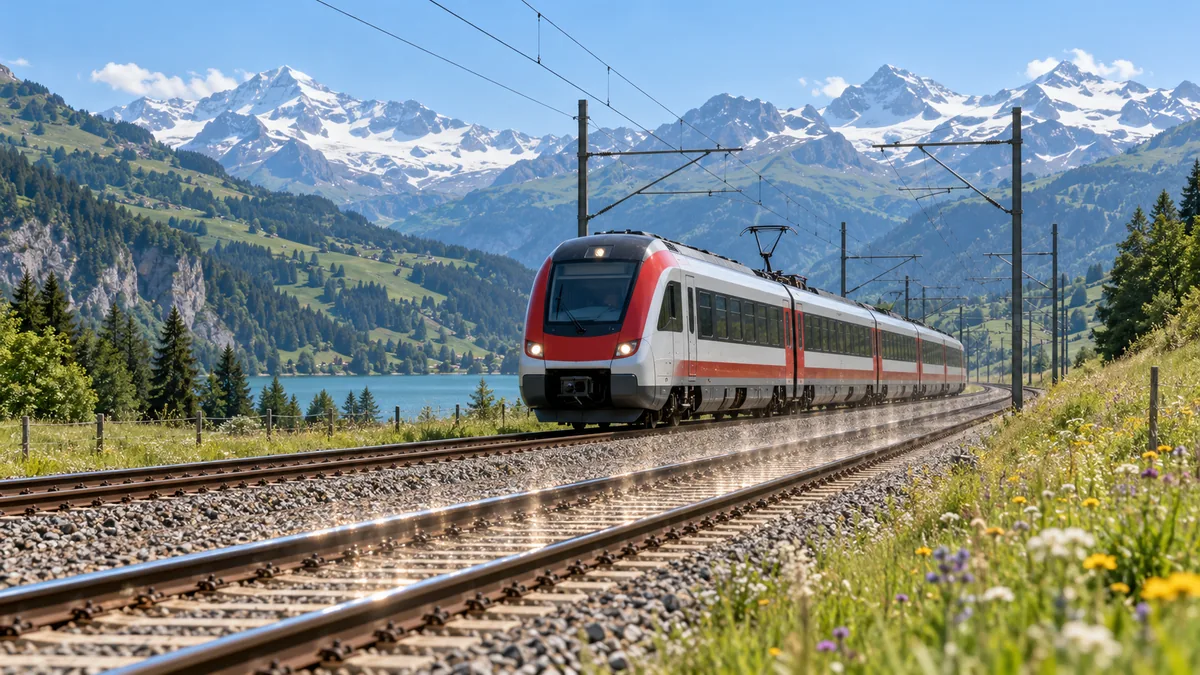
The FFS recorded 97 deformations and crushings.
Context
TL;DR
- The FFS recorded 97 cases of deformation and buckling.
- The figure is almost four times that of the previous year.
- A task force has been established for summer 2026.
- The white paint lost half its effect after two years.
Key facts
- Cases: 97 deformations and crushing
- Comparison: almost four times the previous year
- Task force: set up for the heat of summer 2026
- Monitoring: dense SBB network
- White paint: initial effect of about 4.5 degrees
The data communicated by the SBB
In the response to Keystone-ATS, the SBB endorsed the data of 97 deformations and crushing of the tracks, cited by the SonntagsZeitung. The communication, dated Bern, concerns last summer, marked by exceptional temperatures. According to Sunday, the figure is almost four times higher than that recorded in the previous year.
The phenomenon includes deformations and expansions of the railway infrastructure. The company said the increase had no impact on safety. In the same newspaper, however, Patrick Braess, an expert at the Federal Polytechnic University of Zurich, warned of the risk of derailments caused by the heat.
SBB explained that it has a dense monitoring network. Events with safety implications are systematically transmitted to the Federal Office of Transport. The rails are regularly checked with measuring and diagnostic vehicles, so as to assess the situation in a targeted manner. Rigorous infrastructure maintenance has been identified as the most important preventive measure. The company also pointed out that zero risk never exists.
Monitoring, reporting and vehicle checks are described as tools already used by SBB. The task force is instead in charge of defining any additional measures for exceptional heat, if necessary.
Faced with the exceptional heat of summer 2026, the company has set up a task force to define additional measures, if necessary. The strategy also includes long-term interventions: concrete sleepers, considered more stable than those in wood, and a higher neutralization temperature during welding, to make the rails more resistant to temperatures that tend to be higher.
SBB also experimented with white paint. At first, cooling averaged about 4.5 degrees; after two years, the dirt had reduced the effect to about half. The more intense the traffic, the faster the effect fades. This is why SBB is evaluating, in an ongoing analysis, whether white coatings are sensible in certain cases.
Operational details
An increase to be viewed with caution
For those who live or work in Switzerland and use the train, the figure must be considered on two levels: the number of occurrences and their operational consequences. The source indicates 97 cases of deformation and buckling, but does not report delays, cancellations, speed restrictions or timetable changes. Consequently, that number alone does not make it possible to describe the punctuality of the services or the impact on a single line.
The second distinction concerns safety. The FFS state that the increase has no repercussions for safety; Patrick Braess, by contrast, points to the risk of derailment linked to heat. In the source, the two statements are not accompanied by a shared technical explanation. The relevant point for the reader is therefore the existence of a comparison: the company's assessment on the one hand, the expert's warning on the other. Neither position can be turned into a broader assessment than the one reported.
On a practical level, the FFS's response combines monitoring and infrastructure interventions. Measurement and diagnostic vehicles are used to assess the tracks in a targeted way; rigorous maintenance is identified as the main preventive measure. Concrete sleepers and raising the neutralization temperature during welding, on the other hand, are among the long-term solutions. The difference is significant: the first line of action identifies problems, while the second aims to make the tracks more stable or more heat-resistant.
The white paint also shows the limits of an apparently simple response. The initial cooling effect did not remain unchanged: dirt and heavy traffic reduced it. The FFS are therefore evaluating coatings in certain cases, without presenting them in the source as a general solution. For the public, this means that the issue remains technical and operational: no measure that applies equally to every route has been announced, but an analysis linked to track conditions.
Key points
The verifiable operational sequence
The source does not describe deadlines or procedures that passengers must follow. The concrete action reported concerns FFS and can be reconstructed into a precise sequence.
First step: regular inspection of the rails. Swiss Federal Railways use measurement and diagnostic vehicles to examine the infrastructure. This makes it possible to assess the situation in a targeted manner, as specified by the company.
Second step: monitoring and reporting. FFS have a dense monitoring network; when an event is relevant to safety, it is systematically reported to the Federal Office of Transport. The source does not indicate any other authorities or reporting channels, so it is not possible to add a different procedure.
Third step: maintenance. FFS define rigorous infrastructure maintenance as the most important preventive measure. This principle is accompanied by technical interventions: where provided for, concrete sleepers instead of wooden ones and a higher neutralization temperature during welding.
Fourth step: additional measures. The task force established for summer 2026 must define any further interventions if necessary. The source does not indicate a deadline or a definitive list of measures. White paint is also still under analysis: its cooling effect is reduced by dirt and fades more quickly when traffic is heavy.
The final point stated by FFS is that zero risk never exists. The task force and the analysis of coatings are therefore, in the source, tools for deciding whether to add measures, not announcements of an outcome that has already been determined.
For the reader, the actionable information is above all a distinction: the source does not ask anyone to change their travel behavior and does not announce a new rule for passengers. Instead, it describes how the company monitors, reports, maintains and assesses. To explore the topic of everyday mobility further, consult the guide to mezzi pubblici.
Source: tio.ch
Frequently Asked Questions
- How many cases of binary deformation did SBB record last summer?
- SBB recorded 97 track deformations and crushings during last summer, a figure almost four times higher than the previous year, as confirmed to Keystone-ATS and reported by the SonntagsZeitung.
- What measures have SBB taken to address the exceptional heat?
- The SBB has set up a task force for the summer of 2026 to define additional measures, use a dense monitoring network with measuring vehicles, report relevant events to the Federal Office of Transport and focus on rigorous maintenance, concrete sleepers and higher neutralization temperature in welding.
- Does the white paint on the tracks work against the heat?
- The white paint experiment showed an average initial cooling of about 4.5 degrees, but the effect halved after two years due to dirt and heavy traffic. SBB is evaluating whether white coatings are sensible in certain cases, without presenting them as a general solution.
- Are there any risks to passenger safety?
- SBB said the increase in cases had no impact on safety, while ETH Zurich expert Patrick Braess warned of the risk of derailments caused by the heat. The company emphasizes that zero risk never exists.
- How are tracks monitored by SBB?
- SBBs have a dense monitoring network and regularly check the rails with measuring and diagnostic vehicles to assess the situation in a targeted manner. Safety-relevant events are systematically reported to the Federal Office of Transport.
Related articles
- La canicola incide anche sul traffico ferroviario
- Raffreddare le città svizzere? "Il lavoro è appena iniziato"
- «Ubriachi fradici» accatastano oggetti sui binari e arriva il treno
- Caldo a Ginevra: impatto su donne, anziani e bassi redditi
- Canicola e lavoro: il Consiglio di Stato avvia il dialogo con i sindacati