EurEau Water Summit in Zurich: 60% untreated water
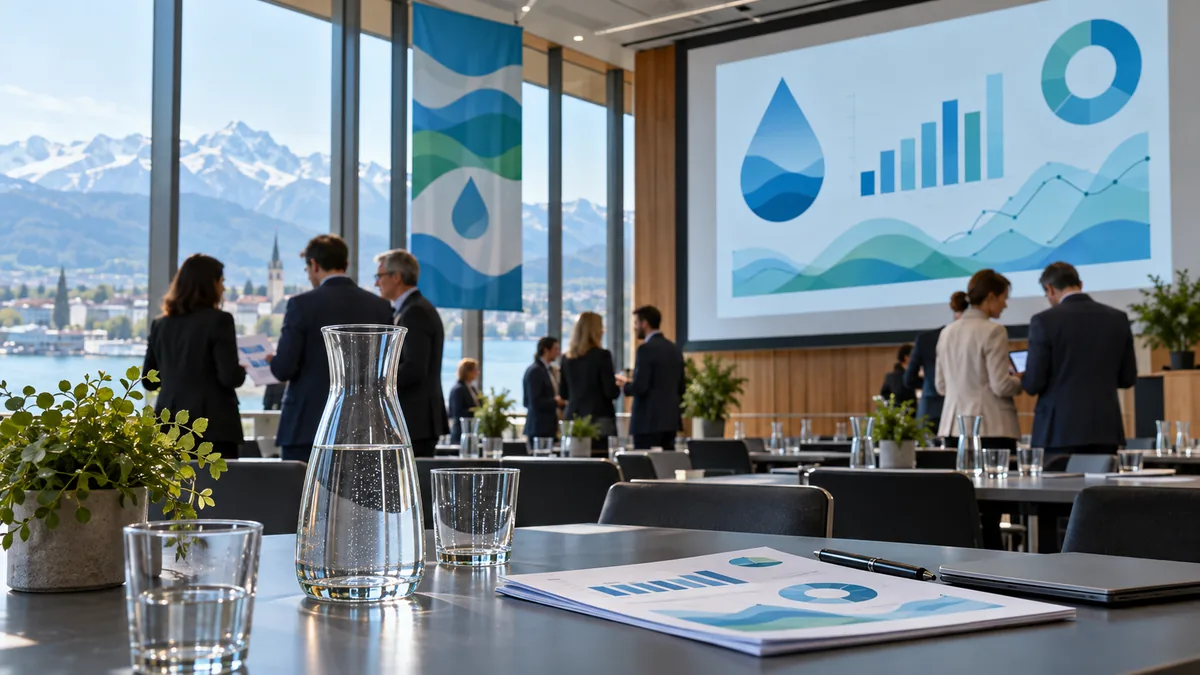
According to Keystone-ATS, numerous experts and representatives from the water resources management and treatment sectors are meeting in Zurich starting today, seeking answers to the challenges of drinking water supply.
Context
TL;DR
- Drought and pollution threaten drinking water
- The summit brings together experts and managers in Zurich
- In Switzerland, 60% can receive no or only simple treatment
- 80% of drinking water comes from groundwater
Key facts
- Event → Swiss EurEau Water Summit
- Location → Zurich
- Duration → through Wednesday
- Drinking water in Switzerland → approximately 60% distributed without treatment or after simple treatment
- Source → 80% from groundwater
The summit puts water at the center
According to Keystone-ATS, numerous experts and representatives from the water resources management and treatment sectors are meeting in Zurich starting today, seeking answers to the challenges of drinking water supply. The Swiss EurEau Water Summit is being held through Wednesday.
SVGW and VSA highlighted in a statement the challenges facing drinking water management throughout Europe. The former is the Association for Water, Gas and Heat; the latter is the Swiss Association of Water Protection Professionals. The topics identified include climate change and micropollutants, as well as increasing quality requirements and infrastructure financing. For the organizers, these factors make cross-border exchanges more important than ever.
In Switzerland, the figure provided by the organizers describes the water that can be distributed to the population: approximately 60% without treatment or after simple treatment. The same indication points out that 80% comes from groundwater. The source links the increasing concentration of pollutants in groundwater to pressure on the local supply. Removing chemical substances, where possible, would require considerable personnel, energy and financial resources.
The summit therefore offers a picture consisting of a figure on distribution and pressure on groundwater. On the one hand, the organizers describe a share of drinking water that can be distributed without treatment or with simple treatment; on the other, they indicate the need to strengthen groundwater protection. The text presents these elements as the basis for the search for solutions in Zurich, not as a final assessment of the meeting.
The reference to personnel, energy and financial resources shows that, in the organizers' description, groundwater pollution is also a treatment management problem. For Switzerland, groundwater protection is identified as an increasingly important element in the search for solutions in Zurich.
Operational details
Pressure on groundwater and the role of “sponge lands”
From water quality to retention
The most concrete connection drawn by the organizers runs from the concentration of pollutants in groundwater to the management of rainwater. The first part concerns pressure on local water supplies and the difficulty of eliminating chemical pollutants; the second introduces measures that strengthen water retention. The text does not present a single project, but a set of natural or technical measures linked to the so-called “sponge lands”.
| Passage | Description of the relationship |
|---|---|
| Aquifers with higher pollutant levels | Local water supplies are under pressure |
| Removal of chemical pollutants | If feasible, it would require personnel, energy and financial resources |
| Protection of groundwater | Takes on an increasingly prominent role |
| Sponge lands | Strengthen rainwater retention |
The range of places mentioned makes the scale of the proposal concrete: soils, watercourses, wetlands, peatlands, forests, and entire river basins. Retention is not described solely as a function of a piece of land; the source also places it in ecosystems and river basins as a whole. This wording makes it possible to read groundwater protection and rainwater management as two elements set alongside each other in the same description of water-resource management, without attributing an already defined implementation project to the source.
As for the effects, the organizers use cautious wording: the measures “could contribute” to mitigating peak flows, reducing water stress, preserving aquifers, limiting erosion, enhancing habitats, and increasing the climate resilience of landscapes. The source further specifies that the beneficial effects would extend to agricultural crops and soil fertility, forests, drinking-water supplies, biodiversity, and local recreational activities.
The relevant point is that the same measures are associated with water-related and land-related outcomes. This is not an estimate of effectiveness: it is the list of potential effects reported in the organizers’ document. The distinction matters because the text speaks of a possible contribution, not results already measured.
Key points
An international network and a balance sheet still to be built
The scope of the meeting
The summit also has a European dimension in terms of its organization. It is being held in Switzerland for the first time, and approximately 400 Swiss and foreign representatives are expected to attend the main event on Wednesday. EurEau operates as a European association for water resource management: it comprises 38 national organizations responsible for drinking water and wastewater, active in both the public and private sectors and coming from 33 countries.
These figures define the scope of the exchange announced by SVGW and VSA. This is not merely a meeting among Swiss experts: the network includes drinking-water and wastewater operators, as well as public and private organizations. The connection with the issues listed in the release is therefore explicit: climate change, micropollutants, quality requirements and infrastructure financing are presented as challenges that make cross-border exchanges more important.
The reference to the European dimension, however, does not in itself add an operational decision for Switzerland. The source indicates that the meeting is seeking solutions, but does not provide a timetable for measures, a final agreement or a specific cost for the infrastructure. Nor does it quantify the concentration of pollutants in groundwater, the amount of personnel or energy that would be needed to remove them, or the outcome of measures involving sponge landscapes.
The documented picture therefore remains precise within its limits: pressure on the local water supply, protection of groundwater to which the organizers attribute an increasing role, and a series of natural or technical measures whose potential usefulness is listed, not measured. As far as the event is concerned, the text provides the location, duration and expected attendance; it does not yet report any outcomes after Wednesday.
This delimitation makes it possible to distinguish what has already been documented from the perspective discussed at the summit: the source reports the problems, describes the measures under consideration and indicates the possible benefits, but does not attribute to them an outcome that has already been achieved.
Source: swissinfo.ch
Frequently Asked Questions
- What percentage of drinking water in Switzerland is distributed without treatment or with simple treatment?
- According to the organizers of the Swiss EurEau Water Summit, about 60 % of drinking water in Switzerland can be distributed without any treatment or after simple treatment. This information was presented during the meeting in Zurich.
- Where does most Swiss drinking water come from?
- 80 % of Swiss drinking water comes from groundwater, as indicated by the data provided by the summit organizers. This source of supply is at the center of discussions on groundwater protection.
- What are the main challenges highlighted by the note from SVGW and VSA?
- The joint statement by SVGW and VSA highlights four key challenges: climate change, the presence of micropollutants, growing water quality requirements, and the need to finance management infrastructure. These issues were discussed at the Swiss EurEau Water Summit.
Related articles
- Di più "Slow Water", l'agricoltura svizzera si prepara alla crisi climatica
- Siccità in Svizzera: a rischio l'80% delle acque sotterranee
- Vero o falso: nelle catene di approvvigionamento svizzere esiste il lavoro forzato?
- Rappresentante per il commercio USA elogia investimenti svizzeri
- Conti 3a: tassi in calo allo 0,21%, ecco chi paga di più