AI lends its voice to scammers: how to defend yourself against suspicious calls
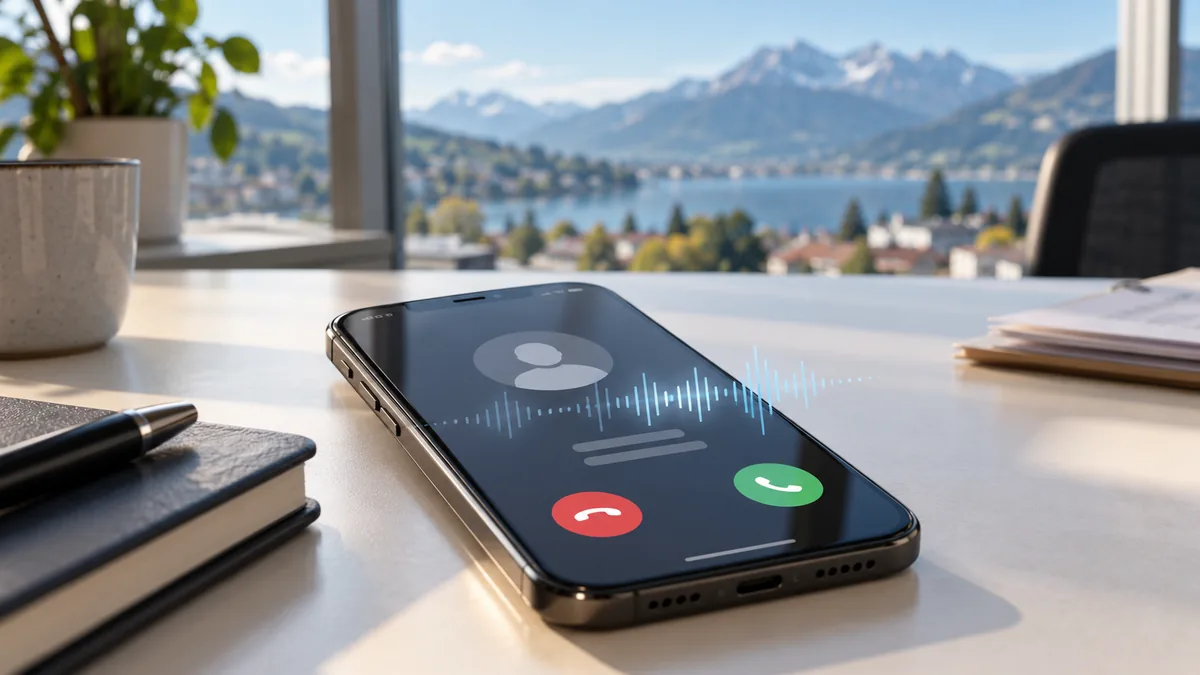
An Italian bank is alleged to have lost 95 million euros.
Context
TL;DR
- An Italian bank is said to have lost 95 million euros.
- A company in the canton of Schwyz lost several million francs.
- The UFCS report concerns the first half of 2026.
- The verification must be carried out through another channel.
Key facts
- Italian case → 95 million euros
- Swiss case → company in the canton of Schwyz; several million francs
- Report → UFCS; first half of 2026
- Calls from fake officials → 75% drop
- Online identity theft in Switzerland → 2%, 80%, 3%
A fraud based on altering a voice using artificial intelligence reportedly caused an Italian private bank to lose 95 million euros. In Switzerland, by contrast, a company in the canton of Schwyz lost several million francs following phone calls that reproduced the voice of a business partner.
The increasingly widespread use of generative AI tools will make this type of fraud more common. The risk concerns both individuals and companies, especially when a familiar voice is used to make a financial or IT request seem credible.
A familiar voice is not proof
On the RTS programme On en parle on October 8, 2026, Sandy Lavorel, founder of FlairSafe, identified verification through a second channel as the main defence:
It is advisable to contact the person again using another channel to confirm their identity, especially if a payment is requested or if you are asked to communicate a code or provide a password.
Lavorel also recalls a basic rule of digital hygiene: slow down. Scammers exploit urgency to push victims to act without thinking. Even when the voice sounds like that of someone very familiar, it is important to avoid making decisions under pressure and to verify the request through a different channel.
FlairSafe is a free platform that helps identify online scams. It currently does not specifically detect voice-cloning fraud, but it can analyse the risk level of a message via a screenshot or copied-and-pasted text. Discussions are under way with several partners to develop this feature.
The latest report by the Federal Office for Cybersecurity, covering the first half of 2026, notes that the use of AI in scams continues to increase. Attackers use it to create personalised and credible content. Targets include company employees, while CEO fraud uses an artificial voice that imitates that of a superior to persuade employees to make illicit bank transfers.
The related material on Switzerland also reports a 75% drop in calls from fake officials, following new rules that block spoofed foreign numbers. The material on online identity theft in Switzerland also includes the percentages 2%, 80% and 3%: these are data referring to that related material and are not attributed to the two voice-cloning cases described here.
Operational details
Why verification must move beyond the phone call
The threat described by the source changes how a request must be assessed. The problem is not merely listening to a modified voice, but deciding whether a voice alone can confirm the identity of the person speaking. The answer indicated by the source is no, even when the caller seems familiar.
Familiarity and authenticity are two different things
A phone call may sound as though it is coming from a business partner, a superior, or someone familiar. This element makes the request more credible, but does not replace checking through another channel. The decisive step is to separate what is said on the phone from identity verification: the phone call brings the request, the callback is used to check it.
Urgency is the other element to treat with caution. According to Sandy Lavorel, scammers often pressure the victim to act without thinking. For this reason, slowing down is not simply a pause, but the way to prevent pressure from determining the decision. When the request concerns a payment, a code or a password, the need to change channels becomes particularly clear.
For companies, the procedure has a concrete consequence for daily work. An employee may receive a phone call supposedly from a business partner or a superior. In CEO fraud, the artificial voice is used precisely to persuade employees to make illicit bank transfers. Verification should therefore not stop at recognizing the voice or the role claimed by the caller.
The before-and-after comparison is stark. Before verification, the request remains a communication received under pressure. After moving to another channel and calling the person back, the caller must confirm their identity and the request. The source does not present the tone of voice as a sufficient tool for carrying out this check.
FlairSafe, too, must be placed correctly in the sequence. The platform can analyze screenshots and copied-and-pasted texts, but it does not yet specifically detect voice cloning. If the main element is a phone call, the protection described by the source remains slowing down followed by verification. The case of the company in the canton of Schwyz shows why the rule also applies to people working in Switzerland and not only to private individuals exposed to online messages.
Key points
What to do when a suspicious phone call comes in
The procedure indicated by the source can be applied without trying to technically recognize the voice. The objective is to prevent the pressure of the call from immediately turning into a payment, the disclosure of a code or the handing over of a password.
Operational sequence
1. Slow down. Do not make a decision while the caller insists on the urgency. The pause helps escape the pressure scammers use to push people to act without thinking.
2. Identify the request. Clarify whether the call is asking for a payment, a code or a password. These are the situations for which the source recommends verifying the identity through another channel.
3. Change channels. Stop automatically trusting the voice and call the person back to verify their identity. The check must take place outside the received call.
4. Apply the same rule to familiar voices. The fact that the caller seems to be a business partner, a superior or someone you know does not eliminate the need to call back and verify.
5. Analyze any related messages. If the request is accompanied by a message, you can submit it to FlairSafe via screenshot or by copying and pasting the text. The platform assesses the message's risk level, but does not yet specifically detect voice cloning.
The sequence for those who work in a company
An employee who receives a request attributed to a business partner or a superior can apply the same steps before proceeding. The source indicates that company employees are often targeted to steal large sums; for this reason, verification should not be set aside when the voice sounds authentic.
Switching to another channel is also the point that distinguishes message analysis from identity confirmation. FlairSafe can help assess a text or a screenshot, while a phone call with a cloned voice requires the callback indicated by Lavorel. Ongoing discussions with several partners specifically concern the development of a feature for this type of fraud.
The operational rule therefore remains straightforward: slow down, identify what is being requested, change channels and verify the person. This is the procedure to apply even when the voice really seems to be that of someone you know well.
Source: rsi.ch
Frequently Asked Questions
- What loss did the Italian bank suffer as a result of the cloned-voice scam?
- The Italian private bank lost 95 million euros as a result of a scam that used an artificially modified voice to deceive staff and obtain a transfer of funds.
- How does Sandy Lavorel recommend verifying the identity of the caller when a voice scam is suspected?
- Sandy Lavorel advises slowing down, not making decisions under pressure, identifying the request (payment, code, or password), and then changing the communication channel: call the person back through another means to confirm their identity before taking action.
- What does the UFCS report on the first half of 2026 indicate regarding AI-based scams and calls from fake officials?
- The UFCS S1 2026 report highlights an increase in the use of AI to create personalized and credible content, primarily targeting company employees; it also reports a 75% decrease in calls from fake officials thanks to new regulations on spoofed numbers and states that online identity theft in Switzerland stands at 2%, 80%, and 3%.
Related articles
- All articles: Franc and prices
- Svizzera indifesa: ritardo difesa missilizia e IVA
- Richiamo uova Migros: sospetta contaminazione salmonella
- Noleggio sociale per frontalieri: 100 euro al mese?
- Tox Info: aumento chiamate grazie all’intelligenza artificiale
- Ex manager FFS sotto inchiesta per milioni sottratti