Lissago, new illegal occupation and new complaints
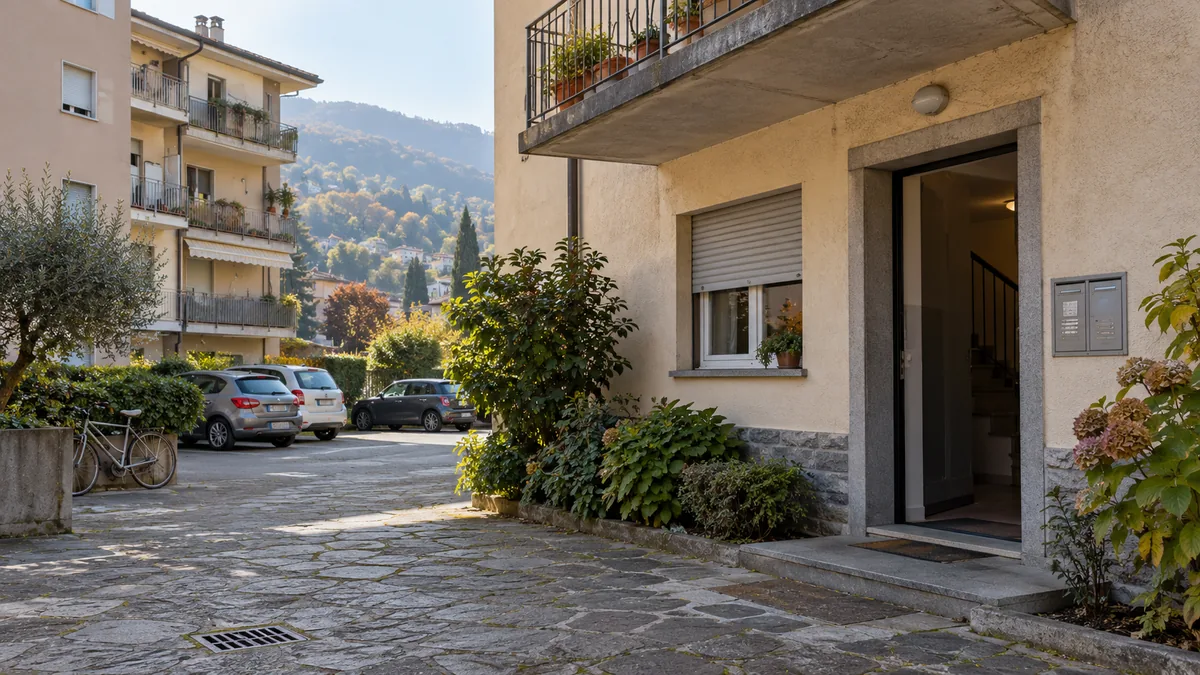
Repopulating the courtyard, according to the approach indicated by the Municipality, would help prevent new occupations and the public-order and hygiene problems connected to the situation.
Context
TL;DR
- Another door was broken through during the night of October 16–17
- The same couple was identified and reported again
- The large courtyard houses 18 public housing apartments
- Fifteen apartments are currently uninhabitable
Key facts
- Place → Lissago, in the «large courtyard»
- When → night between Friday, October 16, and Saturday, October 17
- Involved → same couple already flagged, reported and removed
- Outcome → identification and a new report on Saturday morning, October 17
- Structure → 18 apartments used as public housing
- Uninhabitable → 15 apartments
- First course of action → evictions and sealing
- Second course of action → funds from a regional grant to renovate the courtyard
New episode in Lissago
During the night between Friday, October 16, and Saturday, October 17, another door in the «large courtyard» in Lissago was broken down. The same couple, already flagged, reported and removed, entered the apartment. On the morning of Saturday, October 17, State Police officers identified the two occupants and reported them again.
The new report comes as the issue is being addressed on several fronts. Municipal council committees are meeting, the issue is being discussed, local police and State Police are deploying officers and filing reports. Social services are also taking action to try to reach those responsible. Despite this sequence of interventions, the occupations in the courtyard are not stopping.
The «large courtyard» comprises 18 apartments used as public housing. The text describes a vicious circle: a door is forced open, occupants enter, identification and a report follow, but the problem resurfaces. The repetition of the occupations keeps the issue open for those living in the area and for the administrations called upon to manage it.
The Municipality has identified two courses of action and a third, more complex one, for which it nevertheless intends to try every possible avenue.
Evictions, renovation and assistance
The first course of action concerns evictions and sealing. Some occupied apartments have already been subjected to them; the same measures should also be extended to the new homes where the «squatters» have broken down the doors.
The second involves renovating the courtyard. The aim is to obtain funding from a regional grant program to make the 15 apartments currently uninhabitable available, the ones that are systematically occupied. Repopulating the courtyard, according to the approach indicated by the Municipality, would help prevent new occupations and the public-order and hygiene problems connected to the situation.
The third course of action combines the reports, which have now been repeated for weeks, with an attempt to reach the two occupants and bring them back into the network of people assisted by social services. This path is made difficult by the occupants’ own opposition, as they have been known for years to those who provide assistance in the city.
Meanwhile, Lissago residents continue to keep watch and report the new occupations. Their expectation is that a definitive solution will be found, one capable of restoring peace to the nights and dignity to the neighborhood.
Operational details
For a cross-border worker reading the news from the Canton of Ticino, the first practical point is also the article's limitation: the source describes a local news story in Lissago and not a change in the rules governing cross-border employment. It does not attribute to the case any effects on the G permit, AVS, LPP, LAMal, tax rebates, or withholding tax. Presenting a consequence on these issues would mean adding a connection that the text does not provide.
The point that emerges instead concerns the way the Municipality is trying to interrupt a recurring problem. The three lines of action do not have the same target: one concerns apartments already occupied, one the condition of the courtyard, and one the people involved.
Three directions, three different levels
| Direction | Stated objective | Characteristic in the text |
|---|---|---|
| Evictions and seals | Apply the measures to occupied homes | First route, already under way in some apartments |
| Regional call for proposals | Make 15 uninhabitable apartments available and repopulate the courtyard | Longer route, potentially more effective |
| Complaints and social services | Repeat the complaints and try to reintegrate the two occupants into the assistance system | Third route, more complex |
The difference is also temporal. Evictions and seals address the newly forced-open doors and occupied apartments. Renovating the courtyard, on the other hand, requires obtaining funding from a regional call for proposals and aims to make the housing units currently uninhabitable usable. The Municipality considers it a longer route, but potentially more effective precisely because it aims to repopulate the complex.
The third line of action concerns the relationship with the two occupants. Complaints have been repeated for weeks, while social services are trying to reach them to bring them back into the support system. The text does, however, point to their opposition, which makes this path more difficult.
For residents, the role described by the source remains one of monitoring and reporting. For institutions, the task is divided among police interventions, municipal decisions, and efforts by social services. The source does not give a date for a definitive solution and does not describe a conclusive outcome of the three paths.
Key points
The text does not specify a form, a specific office, a telephone number, or a deadline for reports. Therefore, a credible procedure must remain within the steps described by the source, without adding administrative instructions that are not present.
The sequence described by the source
1. Local monitoring. The residents of Lissago continue to monitor the situation in the courtyard and keep an eye out for new occupations. This is the first step indicated by the text, together with reporting incidents that recur.
2. Reporting. When a new occupation is detected, the residents report it. The source links this activity to the new broken-down door and the subsequent identification of the couple who had already been reported, formally reported to the authorities, and removed.
3. Identification and reporting. In the incident on 17 October, State Police officers identified the occupants and reported them again. The text also recalls that local police and State Police are already engaged, with patrols and reports.
4. Eviction and sealing. The first course indicated by the Municipality consists of evictions and the application of seals. Some occupied apartments have already received them; the Municipality plans to apply them to the new dwellings with broken-down doors as well.
5. Work on the courtyard and assistance. The second course is seeking funding from a regional grant program to renovate the 15 uninhabitable apartments. At the same time, social services are trying to bring the two occupants back into the care system.
These steps do not constitute a guaranteed timeline. The source still speaks of a vicious circle and reports that the occupations have not stopped. Therefore, it is not possible to indicate a closing date for the matter, nor to claim that one of the three courses has already produced a definitive solution. For cross-border commuters, the article does not describe consequences for routes, border crossings, wages, or tax procedures: the concrete information remains the account of events in the courtyard and the activities of residents, the Municipality, the police, and social services.
Source: varesenews.it
Frequently Asked Questions
- What happened on the night between October 16 and 17?
- In Lissago, another door was broken down in the “large courtyard.” It was the same couple that had already been flagged, reported, and removed. On the morning of Saturday, October 17, State Police officers identified the two occupants and reported them again.
- What are the main directions indicated by the Municipality?
- The first course of action concerns evictions and seals, already applied to some occupied apartments. The second involves obtaining funds from a regional call for applications to refurbish the courtyard and make the 15 apartments currently uninhabitable available. There is also a third, more complex option, based on new complaints and the intervention of social services.
- How many apartments are there in the large courtyard?
- The large courtyard of Lissago comprises 18 public-housing apartments. The text indicates that 15 are currently uninhabitable and are systematically occupied. The municipality aims to obtain regional funds to make them available, repopulate the courtyard, and prevent new occupations and public-order and hygiene problems.
- Why is the social services pathway considered difficult?
- Social services are trying to locate the two occupants to bring them back into the support network. The source describes this process as difficult because the occupants themselves oppose it. It adds that those involved in providing assistance in the city have known them for years.