Railway: disruptions continue between Yverdon and Lausanne
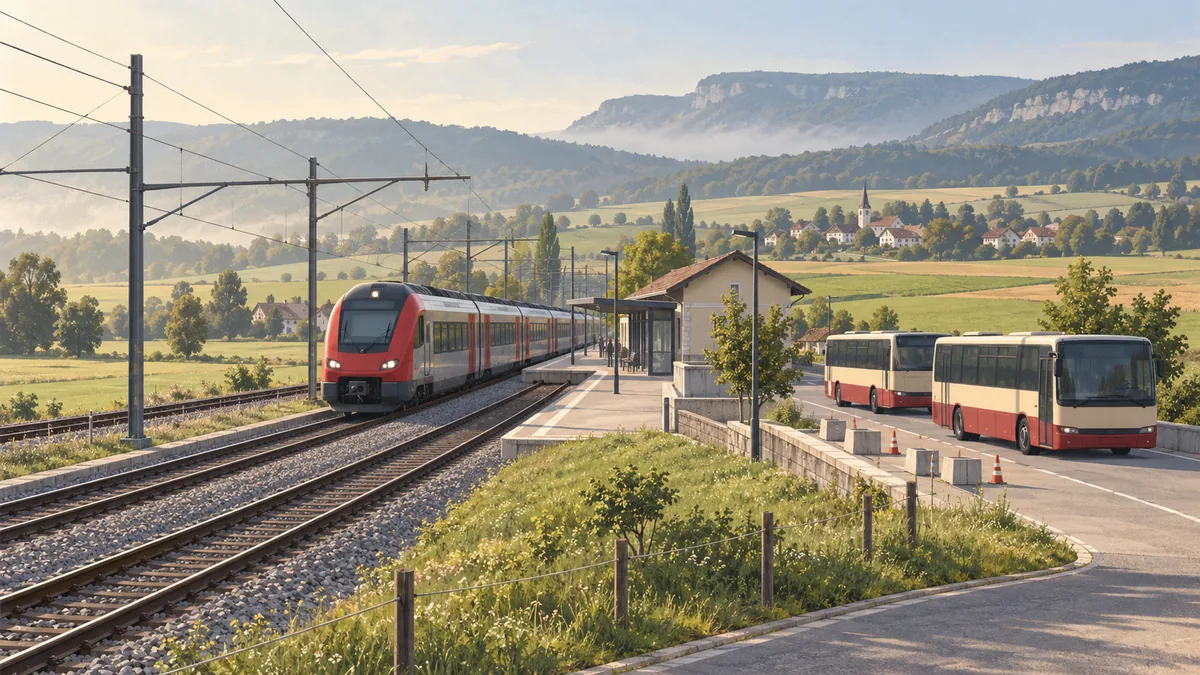
The Yverdon-les-Bains-Lausanne line remains disrupted Two long-distance trains per hour, with delays Regional trains and Geneva airport: buses Problems
Context
TL;DR
- The Yverdon-les-Bains–Lausanne line remains disrupted
- Two long-distance trains per hour, with delays
- Regional trains and Geneva Airport: buses
- Technical problems expected until tomorrow at 6.00
Key facts
- Cause: fire near the tracks in Eclépens
- Probable origin: arson
- Time of fire: yesterday morning around 3.15
- Lines disrupted: IC5, IC51, R1 and R2
- Route affected: Cossonay-Penthalaz–Chavornay
- Airport connection: Yverdon-les-Bains–Geneva bus
- Expected duration of problems: until tomorrow at 6.00
Rail services remain suspended on the route between Yverdon-les-Bains and Lausanne following the fire that broke out yesterday near the tracks in Eclépens (VD). However, traffic is not completely halted: an FFS spokesperson told Keystone-ATS this morning that two long-distance trains per hour provide service in both directions, albeit with considerable delays.
The solution announced is different for regional traffic, which is provided by replacement buses. A bus service has also been arranged to connect Yverdon-les-Bains with Geneva Airport. The report thus distinguishes three travel needs: the main route, regional connections and the transfer to the airport. To find one’s way among these options, one can consult the service on mezzi pubblici, without confusing long-distance services with replacement ones.
The origin of the disruption
The flames broke out yesterday morning around 3.15 in a cable duct near Eclépens station; the origin is probably arson. The fire caused a fault in a switching cabin, disrupting the IC5, IC51, R1 and R2 lines.
The fault also disrupted the route between Cossonay-Penthalaz and Chavornay. Regional traffic on this section is provided by replacement buses, while two long-distance trains per hour continue to run in both directions on the route between Yverdon-les-Bains and Lausanne. This combination makes the service described by FFS partial and slower.
The expected duration
The FFS spokesperson added that the technical problems should last until tomorrow at 6.00. Until then, the announced situation provides for delayed long-distance trains, buses for regional services and a dedicated bus connection between Yverdon-les-Bains and Geneva Airport. These are the three modes to keep separate when planning a trip in the affected area.
Operational details
What changes for travelers
The practical effect of the disruption depends on the service used. The information provided does not describe a single solution for everyone, but separates long-distance travel, regional traffic and the connection between Yverdon-les-Bains and Geneva Airport.
| Journey | Service indicated | Condition communicated |
|---|---|---|
| Yverdon-les-Bains–Lausanne | Two long-distance trains per hour, in both directions | Significant delays |
| Regional traffic | Replacement buses | Connection guaranteed by bus |
| Yverdon-les-Bains–Geneva Airport | Bus service | Connection provided |
The distinction between the services
For the connection between Yverdon-les-Bains and Lausanne, the presence of two trains per hour does not amount to problem-free service: the FFS spokesperson spoke of significant delays. The operational consequence is clear: the long-distance train remains the indicated option, but the journey must be considered alongside the announced delay.
Regional traffic follows a different criterion. Replacement buses are the means by which that service is guaranteed; it is therefore not correct to automatically apply the figure of two long-distance trains to regional services. The same caution is needed for the airport: the connection indicated is a bus service from Yverdon-les-Bains, distinct both from long-distance trains and from the replacement of regional traffic.
The reference to the route between Cossonay-Penthalaz and Chavornay also has practical significance. Anyone who needs to travel along that segment must take into account the specific indication concerning regional traffic, instead of reading only the general information about the Yverdon-les-Bains–Lausanne line. In this way, the choice of mode follows the actual route and not just the name of the line.
Time completes the comparison: technical problems are expected until tomorrow at 6.00. To organize journeys and understand the difference between delayed long-distance trains and replacement services, the website's reference to mezzi pubblici can complement the information communicated by FFS.
Recommended tools
For an updated estimate, use the net salary calculator and the CHF-EUR exchange comparator.
Useful tools to protect your net income
To reduce FX leakage, compare CHF-EUR exchange options and banks for cross-border workers.
Key points
Practical procedure
When a journey falls within the disruption window, the procedure can start from the destination. The available communication provides three operational indications to associate with the actual route and the direction of travel.
Four steps
1. Identify the route. Note whether the journey concerns the line between Yverdon-les-Bains and Lausanne, the section between Cossonay-Penthalaz and Chavornay, or the connection to Geneva Airport. These are distinct references in the communication.
2. Associate the service. For the Yverdon-Lausanne route, consider the two long-distance trains per hour, in both directions, allowing for significant delays. For regional traffic, the service indicated is that of replacement buses.
3. Separate the airport connection. If the destination is Geneva Airport, the specific reference is the bus arranged between Yverdon-les-Bains and the airport. It should not be confused with the replacement of regional traffic, even though both services use buses.
4. Consider the time frame. The technical problems should last until tomorrow at 6:00. Anyone planning the journey before that deadline must therefore base themselves on the combination of delayed trains and buses communicated by SBB.
Do not confuse the two bus services
The word bus appears in two different indications. On the one hand, it replaces regional traffic; on the other, it connects Yverdon-les-Bains to Geneva Airport. The destination makes it possible to understand which of the two solutions to consider. The same criterion applies to the return journey: the indication about the two long-distance trains concerns both directions, whereas the airport connection is described starting from Yverdon-les-Bains.
This reading avoids applying the same mode to every segment. To plan the journey with the available solutions, consult our tool for mezzi pubblici.
Source: swissinfo.ch
Frequently Asked Questions
- How long are technical problems expected to last between Yverdon and Lausanne?
- The FFS spokesperson reported that the technical problems are expected to last until tomorrow at 6.00. Until then, two long-distance trains per hour provide the connection in both directions, but with considerable delays. Regional traffic, on the other hand, is ensured by replacement buses.
- Which connections remain available during the disruption?
- Two long-distance trains per hour provide the connection between Yverdon-les-Bains and Lausanne in both directions, with delays. Regional traffic is guaranteed by replacement buses. A bus service has also been arranged to connect Yverdon-les-Bains with Geneva Airport.
- What caused the railway malfunction?
- The fire broke out yesterday morning around 3.15 in a cable duct near Eclépens station. The probable cause was arson. The flames caused a fault in a switching cabin and disrupted the IC5, IC51, R1 and R2 lines, as well as the section between Cossonay-Penthalaz and Chavornay.
Related articles
- All articles: Transport and traffic
- Tamedia: 41 licenziamenti, 13 a Losanna e Ginevra
- Ginevra-Friburgo, una linea ferroviaria sotto pressione
- Porsche arretra sull'elettrico, interrotta la produzione della Taycan
- Linea ferroviaria dell'Albula chiusa almeno fino a domani sera
- Tamedia taglia 34 posti di lavoro in Svizzera