Geneva–Fribourg, a railway route under pressure
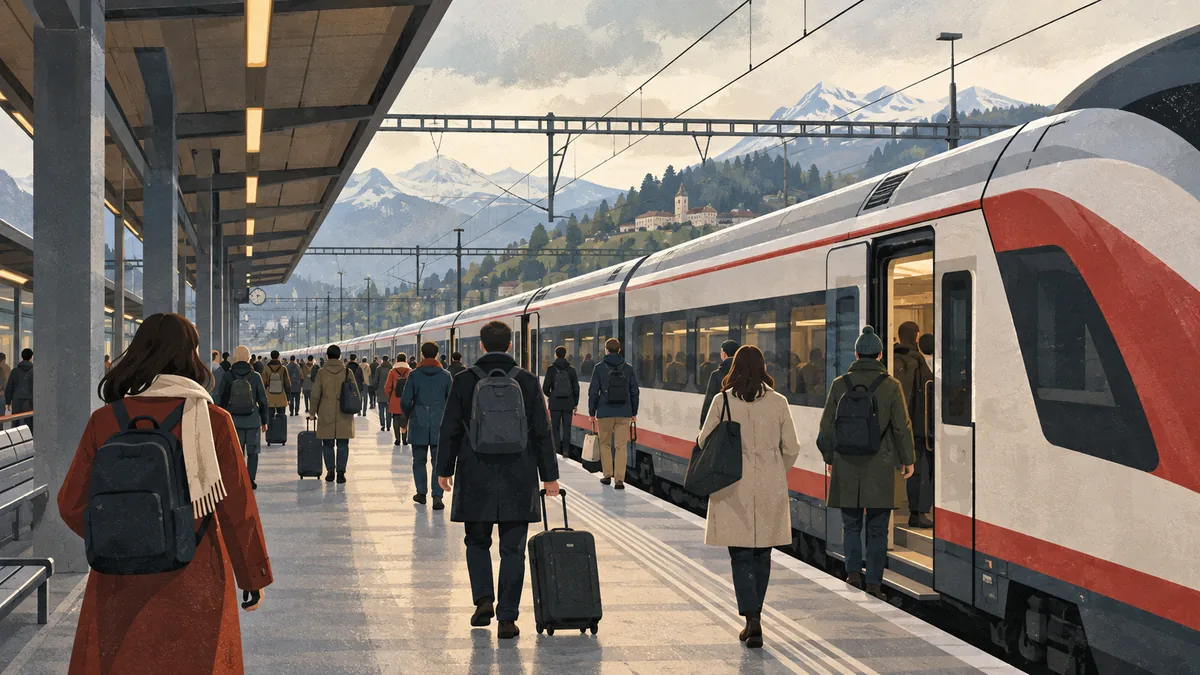
Thirteen disruptions on the line since the beginning of the year More than 150’000 passengers and over 700 trains every day Burnt cables, damaged tracks and a bird
Context
TL;DR
- Thirteen disruptions on the line since the beginning of the year
- Over 150’000 passengers and more than 700 trains every day
- Burnt cables, damaged tracks and a bird among the causes
- Léman 2030 expands the stations in Lausanne and Geneva
Key facts
- Line → Geneva-Fribourg
- Disruptions → thirteen since the beginning of the year
- Daily traffic → over 150’000 passengers and more than 700 trains
- Causes → burnt cables, damaged tracks, short circuit caused by a bird
- Programme → Léman 2030
- New line → Morges-Perroy
Thirteen disruptions since the beginning of the year have affected the railway line between Geneva and Fribourg. Each incident started with a failure at a strategic point and halted traffic on a route that carries over 150’000 passengers every day and sees more than 700 trains pass through.
The causes of the incidents varied: cables caught fire, tracks were damaged and a bird even caused a short circuit. For passengers, however, the outcome was similar: delays and cancellations, with few alternatives when the line is blocked. The frustration, the source reports, is palpable among those who say they have already experienced several service disruptions.
The reliability bottleneck
Among the incidents mentioned are the track damage attributed to the Servette ultras in Lausanne. The case adds to a sequence in which the source of the problem changes, while the consequence for rail traffic remains the same. For those who need to plan a journey, the issue is therefore not only the technical cause of the failure, but also the difficulty of quickly finding a replacement for the route.
The pressure is also evident on board. During peak hours, it is not always possible to find a seat; in the morning and evening, trains are often full. The line thus combines two distinct problems: disruption when a failure occurs and overcrowding when the service continues.
According to FFS, not all disruptions are caused by its operations. Linus Looser, Head of Infrastructure at Swiss Federal Railways, explains:
«Every day, the line sees over 150’000 passengers and more than 700 trains pass through. Disruptions are no more frequent than elsewhere, but they have a greater impact: without alternative routes, a single failure can bring the entire line to a standstill and have a major impact on customers.»
Over the past twenty years, the number of passengers has tripled. The infrastructure response includes the Léman 2030 programme, with the expansion of the stations in Lausanne and Geneva, and the new line between Morges and Perroy, the first step towards greater capacity between Lausanne and Geneva. For those consulting mezzi pubblici, the article therefore describes a route where demand, overcrowding and vulnerability of rail traffic combine.
Operational details
What changes for those who use the route
The practical reading of the situation starts with a distinction: reliability and capacity are related but not identical problems. A fault at a strategic point can bring the line to a standstill because there are not enough alternative routes; when the trains are running, however, the number of passengers and the growth recorded translate into trains that are often full. Solving one problem does not automatically eliminate the other.
Three pressures to separate
| Pressure | Source data | Described consequence |
|---|---|---|
| Disruptions | thirteen since the beginning of the year | delays and cancellations |
| Network without alternatives | a single fault can block the entire line | major impact on customers |
| Demand | passengers tripled in twenty years | more pressure on the route |
The table helps read the risk without confusing an incident with the underlying trend. The causes listed are different, from burnt cables to a short circuit caused by a bird, but the traveler experiences the same operational problem when service comes to a halt. The frequency indicated by the source is not enough on its own to describe the daily burden: the lack of alternatives and the crowding of trains during peak hours also matter.
For those who use the route, the concrete consequence is greater exposure to two scenarios. In the first, a delay or cancellation disrupts the travel itinerary, and changing routes is not necessarily possible. In the second, the train departs but a seat is not guaranteed, especially in the morning and evening. These are different conditions, and the infrastructure response must take both into account.
Investments and the pace of demand
The Léman 2030 program and the Morges-Perroy line show that the increase in passenger numbers requires more capacity. The source links the new line to the expansion between Lausanne and Geneva and mentions the expansion of the stations in Lausanne and Geneva. However, it does not present these works as an immediate solution to every disruption between Geneva and Fribourg. The distinction is useful: more seats and greater capacity concern structural pressure, while a blockage caused by a fault remains a service continuity problem. The mezzi pubblici must therefore also be assessed on both levels: the ability to travel and the reliability of the route.
Recommended tools
For an updated estimate, use the net salary calculator and the CHF-EUR exchange comparator.
Useful tools to protect your net income
To reduce FX leakage, compare CHF-EUR exchange options and banks for cross-border workers.
Key points
A checklist for finding your way
Those using the line can translate the available data into an assessment sequence, without attributing procedures to the source that it does not indicate.
Before setting out
1. Identify whether the journey concerns the line between Geneva and Fribourg. It is the route at the center of the thirteen interruptions recorded since the beginning of the year. 2. Consider the time slot. In the morning and evening, trains are often full, so a seat is not guaranteed during peak hours. 3. Keep the two risks separate: a crowded train does not mean that a line is interrupted, while a breakdown at a strategic point can bring traffic to a standstill. 4. In the event of a disruption, do not assume that an immediate alternative route exists. The source notes that the absence of alternatives can block the entire line and increase the impact on customers. 5. Read the long-term projects: Léman 2030 concerns the expansion of the stations in Lausanne and Geneva; Morges-Perroy is indicated as the first step toward increasing capacity between Lausanne and Geneva.
The sequence should be read as a planning criterion, not as an operating timetable or a promise of an alternative route. The practical point is to calibrate expectations: the route serves a very high volume of travelers, demand has tripled in twenty years, and the network has little leeway when a breakdown affects a strategic point.
FFS state that they are investing to provide more seats and a reliable service and ask for understanding when disruptions or overcrowding occur. For the reader, the assessment therefore remains tied to three concrete elements of the source: interruptions, overcrowding and capacity-enhancement works.
To find your way among the mezzi pubblici, use Frontaliere Ticino's dedicated tool.
Source: rsi.ch
Frequently Asked Questions
- How many disruptions did the Geneva-Fribourg line experience?
- Since the beginning of the year, rail traffic has come to a standstill thirteen times on the railway line between Geneva and Fribourg. The source lists various causes: burnt cables, damage to the tracks and a short circuit caused by a bird. The incidents had a significant impact because the route is used every day by more than 150’000 passengers and over 700 trains.
- Why can a single failure block the entire line?
- According to Linus Looser, head of Infrastructure at Ferrovie federali, the line does not have enough alternative routes when a fault occurs at a strategic point. According to the FFS, disruptions are no more frequent than elsewhere, but the consequences are greater: a single problem can stop the entire line and significantly affect customers.
- What projects are planned to increase capacity?
- The source mentions the Léman 2030 program, which provides for the expansion of the stations in Lausanne and Geneva. A new line between Morges and Perroy is also being built, described as the first step toward increasing capacity between Lausanne and Geneva. The measures respond to growing demand, with passenger numbers tripling over the past twenty years.
Related articles
- All articles: Transport and traffic
- Linea ferroviaria dell'Albula chiusa almeno fino a domani sera
- «Ubriachi fradici» accatastano oggetti sui binari e arriva il treno
- Per TPL un 2025 tra passato e futuro, con numeri record
- Neutralita, la stampa sottolinea la sconfitta dell'UDC
- La canicola incide anche sul traffico ferroviario