Federal Council approves joining Knifefish for electronic attack
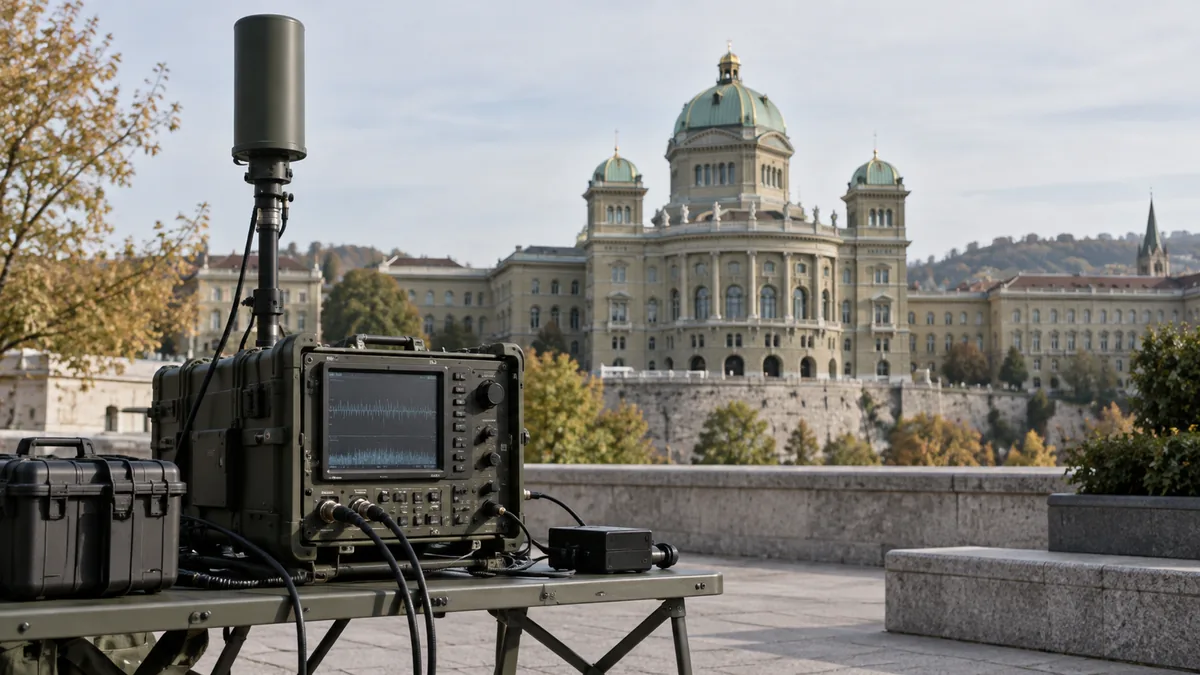
On October 14, 2026, the Federal Council approves Knifefish Switzerland modernizes its electronic warfare capabilities Knifefish facilitates procurement and exchanges
Context
TL;DR
- On October 14, 2026, the Federal Council approves Knifefish
- Switzerland modernizes its electronic warfare capabilities
- Knifefish facilitates procurement and exchanges with European partners
- Neutrality remains guaranteed and withdrawal is possible
Key facts
- Decision → Switzerland's accession to the Knifefish MoU
- Date → October 14, 2026
- Basic program → Sawfish, Swiss accession in November 2025
- Objective → acquisition of electronic attack systems
- Participants → Netherlands, Germany and Denmark
- Planned accession → Sweden through an amending agreement
Bern, October 14, 2026. The Federal Council gave its assent to Switzerland's accession to the memorandum of understanding on cooperation for electromagnetic combat capabilities intended for electronic attack, known as the Knifefish MoU.
The measure is part of the modernization of the Swiss Armed Forces' electronic warfare assets. The armed forces need systems capable of detecting, influencing or jamming electromagnetic signals. Switzerland is thus participating in a European program aimed at acquiring electronic attack systems.
A program built with European partners
With Knifefish, the Netherlands is implementing a program to acquire these systems and facilitate exchanges with European partner states. Germany and Denmark are already participating in the initiative. Sweden intends to join through an amending agreement.
Switzerland's accession to the MoU stems from the Sawfish program, which Switzerland joined in November 2025. The latter concerns tactical electronic warfare systems, while Knifefish concerns electromagnetic combat capabilities for electronic attack.
The Federal Council links this new step to the armaments policy strategy of June 20, 2025. Among other objectives, the strategy provides for a targeted expansion of cooperation with neighboring states and other European partners. The decision of October 14, 2026, therefore brings together three elements already identified in the source: the modernization of the Swiss Armed Forces, European cooperation on procurement, and the connection with the Sawfish program.
Operational details
What changes operationally
The most concrete effect described in the press release concerns how military procurement is organized. Cooperation makes it possible to better coordinate materials and data, as well as to jointly use testing equipment and spare parts. For Switzerland, this model may translate into economies of scale and more advantageous purchase prices.
The advantage is not solely economic. Joint procurement strengthens interoperability between Switzerland and the European states participating in the cooperation. The source therefore indicates an operational benefit, linked to the possibility of making materials, data and equipment work together, and a logistical benefit, linked to the shared management of testing and spare parts.
The three functions of electronic warfare
Electronic warfare uses the electromagnetic spectrum, which includes radio systems, radar and other electromagnetic signals. Its functions are distinct:
| Area | Function |
|---|---|
| Electronic attack | Reduces the ability of opposing forces to use the electromagnetic spectrum. |
| Electronic protection | Protects its own systems from interference. |
| Electronic support | Detects and analyzes signals. |
Knifefish concerns electronic attack; the Sawfish program, on the other hand, concerns tactical systems for electronic warfare. This distinction makes it possible to view the accession as an expansion of Swiss cooperation in a sector composed of multiple capabilities, rather than as a single type of equipment.
A precise political clause also remains in place. The MoU allows Switzerland to decide on a case-by-case basis which projects to participate in. Neutrality is guaranteed, and Switzerland may withdraw from the cooperation at any time if one of the states participating in the program becomes involved in an armed conflict.
Key points
How to follow the next steps
The source makes it possible to reconstruct a precise institutional sequence, useful for avoiding confusion between the armament strategy, cooperation programs and individual projects.
The sequence to follow
1. The first reference is the Federal Council’s strategy on armament policy, dated June 20, 2025. The document provides for targeted expansion of cooperation with neighboring states and other European partners.
2. The second step is Sawfish. Switzerland joined it in November 2025; the program concerns tactical electronic warfare systems.
3. The third reference dates back to October 14, 2026: on that date, the Federal Council approved Switzerland’s accession to the declaration of intent known as MoU Knifefish.
4. For each subsequent project, the case-by-case rule must be taken into account. Accession to the MoU does not automatically determine Swiss participation in every project: the source gives Switzerland the option to choose.
5. Finally, the condition related to neutrality must be verified. If one of the states participating in the program becomes involved in an armed conflict, Switzerland may withdraw from the cooperation at any time.
The certain date to follow is therefore that of the approval on October 14, 2026. The communiqué describes accession to the declaration of intent and the framework for cooperation, while the program’s objective is the acquisition of electronic attack systems. The procedure described is institutional: it concerns the selection of projects, coordination with partner states and the possibility of ending participation under the conditions indicated.
To understand future developments, the safest approach is to keep the three levels separate: the Federal Council’s strategy, the Sawfish program already linked to Switzerland and the new MoU Knifefish. This distinction avoids attributing to the decision content that the source does not indicate.
Source: admin.ch
Frequently Asked Questions
- What is the Knifefish MoU and when did Switzerland join?
- The Knifefish MoU is a statement of intent for cooperation in electromagnetic combat capabilities for electronic attack. The Federal Council approved Switzerland's accession on October 14, 2026.
- Which countries participate in the Knifefish program?
- The Netherlands leads the program, with Germany and Denmark already participating. Sweden intends to join through an amending agreement.
- How does Knifefish relate to the Sawfish program?
- Accession to Knifefish is based on the Sawfish program, which Switzerland joined in November 2025. Sawfish concerns tactical systems for electronic warfare, while Knifefish focuses on electronic attack.
- What operational benefits does Knifefish cooperation bring?
- Cooperation makes it possible to coordinate materials and data, jointly use testing equipment and spare parts, achieving economies of scale, more advantageous purchase prices, and greater interoperability with partner states.
- How is Swiss neutrality guaranteed in the Knifefish MoU?
- The MoU allows Switzerland to decide on a case-by-case basis which projects to participate in. Neutrality is guaranteed, and Switzerland may withdraw at any time if a participating state becomes involved in an armed conflict.