Traffic lights on motorways: USTRA's traffic plan
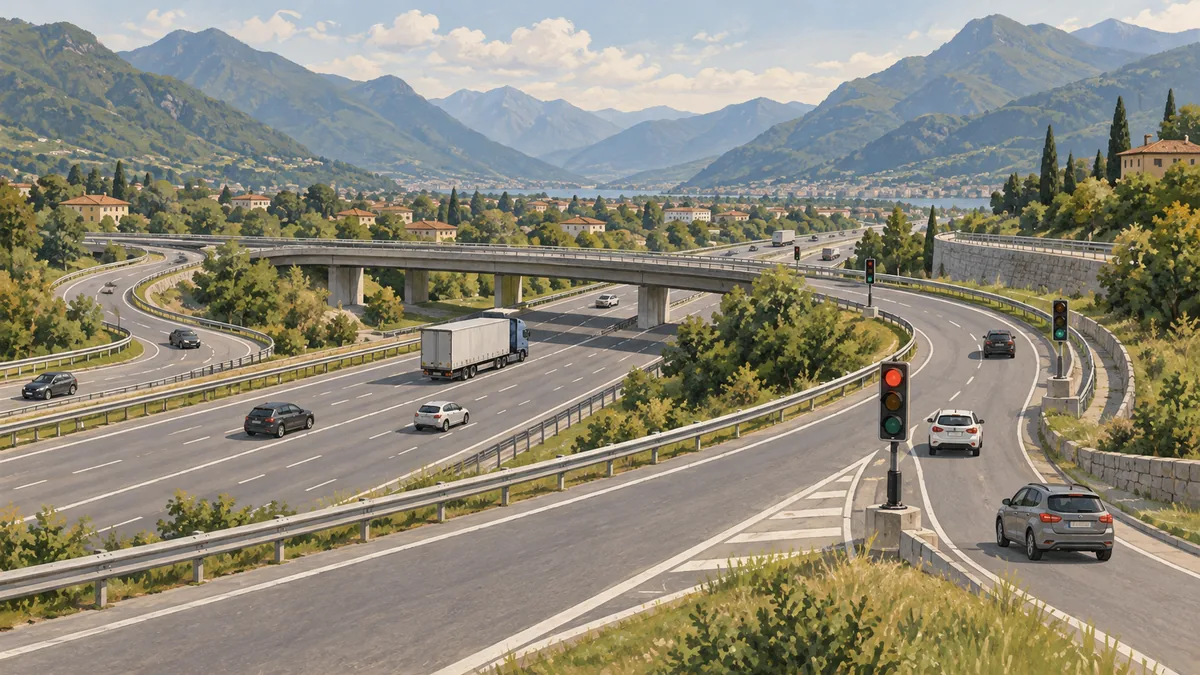
USTRA considers more than 120 traffic lights at interchanges In 2025 the motorways recorded 68'040 hours of congestion The systems can increase capacity by up to 5%
Context
TL;DR
- USTRA is evaluating over 120 traffic lights at interchanges
- In 2025, motorways recorded 68'040 hours of congestion
- The systems can increase interchange capacity by up to 5%
- Benefits in Cadenazzo are expected from December 2026
Key facts
- Office: USTRA
- Systems already in operation: 15
- Increase in congestion: approximately 20% compared with the previous year
- New locations under consideration: more than 120
- Focus: Zurich, Basel and French-speaking Switzerland
- Internal memo cited: January 2025
The national plan
With 68'040 hours of congestion recorded in 2025, Swiss motorways saw an increase of approximately 20% compared with the previous year. It is in this context that the Federal Roads Office, USTRA, is seeking new solutions, following the public rejection of the motorway expansion in 2024.
The proposal under consideration aims to make motorways flow more smoothly by using traffic lights at interchanges. The objective is to regulate vehicle access and allow vehicles to merge in stages, thereby preventing slowdowns and accidents. However, the measure has an explicit side effect: queues may form on cantonal and municipal roads before the entrance to the motorway.
As reported by SonntagsZeitung, the Confederation would be prepared to knowingly accept this risk. An internal memo from January 2025, cited by the same publication, in fact takes into account that queues may extend to the local road network.
In Switzerland, 15 ramp-metering systems are already in operation; USTRA is also assessing more than 120 new locations, especially in the regions of Zurich and Basel and in French-speaking Switzerland. According to USTRA estimates, the new traffic lights could increase the capacity of motorway interchanges by up to 5%.
The Ticino case
The issue directly affects Ticino, where traffic lights are already at the center of controversy. In Cadenazzo, the first activation phase of an intelligent traffic-light system coordinated by USTRA has begun. The office had clarified that the benefits would not be immediate and linked them to the traffic-light system becoming operational at the railway station intersection, starting in December 2026.
The national plan for motorway access routes is proceeding separately from the Cadenazzo project. Outside Ticino, in the Basel region alone, 19 systems would be under consideration; however, the cantons of Basel-Stadt and Schaffhausen reportedly stated that they had not been involved in the assessments. To follow the development of the queues without confusing the two dossiers, storico traffico e code is available.
Operational details
The benefit may shift to another road
For a cross-border commuter reader, and more generally for anyone travelling in Canton Ticino, the question is not only whether the queue gets shorter. Where it forms also matters. USTRA's plan aims to protect motorway traffic flow, but states that it allows for slower traffic on cantonal and municipal roads. The possible effect, therefore, is a shift of the problem: fewer vehicles stopped on the motorway carriageway, more vehicles waiting before the interchange.
It is a scenario, not a report of an already measured result. USTRA is examining the locations; the source does not say that all the traffic lights have been installed or that a specific Ticino exit is included in the list. For this reason, the estimate cannot be turned into a promise of shorter travel times. A cross-border commuter may view the project as a new way of regulating access, not as the elimination of queues.
Two plans that should not be confused
The first dossier is national: it concerns ramp metering and over 120 locations under study. The second is Cadenazzo's intelligent traffic-light project, which has already entered the first activation phase and is coordinated by USTRA. The source specifies that the two projects are distinct. USTRA's presence, therefore, is not enough on its own to consider them a single intervention.
The date must also be read with caution. The reference to December 2026 concerns the benefits of the Cadenazzo traffic-light system and the operation of the system at the railway station intersection. It is not a deadline indicated for all over 120 national locations.
According to USTRA, the positive effects of the traffic-light system will only be appreciable from December 2026, with the activation of the system at the railway station intersection in Cadenazzo.
For anyone who wants to add an external calculation to the news report, costo auto pendolare can be consulted separately: however, it does not replace the distinction between a measure under study and a system already being activated.
Recommended tools
For an updated estimate, use the net salary calculator and the CHF-EUR exchange comparator.
Useful tools to protect your net income
To reduce FX leakage, compare CHF-EUR exchange options and banks for cross-border workers.
Key points
Five steps for reading updates
For the cross-border commuter who has to interpret a traffic update, the first precaution is not to automatically merge different pieces of news. The procedure can be as follows:
1. Identify the dossier. If the text refers to motorway access points and more than 120 new locations, the reference is USTRA's national plan. If it mentions Cadenazzo and the intelligent traffic-light system, it concerns the separate local project.
2. Check the stage. The words “is examining” indicate an assessment of the locations; they do not mean that a system is already operational. The 15 systems active in Switzerland are separate from the more than 120 new positions under consideration.
3. Put the dates into context. 2024 is the year of the popular rejection of the motorway expansion. January 2025 is the date of the internal note cited by SonntagsZeitung. December 2026, on the other hand, concerns the indicated start of traffic-light control at the intersection by Cadenazzo railway station.
4. Look at where the effect is measured. If the stated goal is to make the motorway flow more smoothly, also consider the possible downside: queues on cantonal and municipal roads. This is the step that prevents confusing the flow at an interchange with that of the entire local network.
5. Use the numbers as a reference. The 68'040 hours of congestion in 2025 describe the problem; 20% measures the increase compared with the previous year; 5% indicates the maximum capacity increase hypothesized for the interchanges. None of these values alone provides a travel time for a road in Ticino.
This framework makes it possible to read the announcements without attributing the plan for 120 traffic lights to Cadenazzo or turning a national assessment into an activation that has already been decided. It also avoids adding alternative routes, schedules or results not present in the news. For the reader, the operational distinction remains between systems already active, locations under consideration and expected benefits on a date referring to Cadenazzo.
For a separate verification of the salary, use calcolatore stipendio.
Source: tio.ch
Frequently Asked Questions
- What does USTRA's national plan entail?
- USTRA is examining more than 120 new locations for installing traffic-light systems at motorway interchanges, with the aim of regulating vehicle access and preventing accidents. According to the office, these traffic lights could increase interchange capacity by up to 5%. However, the measure has a side effect: the possibility that traffic queues will shift from the motorways to cantonal and municipal roads, a risk that the Confederation is prepared to accept, as indicated in an internal memo from January 2025.
- What is the situation in Cadenazzo?
- The Cadenazzo project is separate from the national plan. It is a smart traffic-light system coordinated by USTRA, which has already entered the first activation phase. The expected benefits are not immediate and are linked to the operation of the traffic lights at the railway station intersection, scheduled to begin in December 2026. It is important not to confuse this local intervention with the more than 120 locations currently under study at the national level.
- How much have traffic-jam hours increased in Switzerland?
- In 2025, Swiss motorways recorded 68'040 hours of congestion, marking an increase of around 20% compared with the previous year. This figure prompted USTRA to seek new traffic management solutions, given that 15 ramp metering installations are already operational in Switzerland. The greatest concentration of new locations under consideration is in the regions of Zurich, Basel and French-speaking Switzerland.
Related articles
- All articles: Transport and traffic
- Semafori contro il traffico parassitario: la strategia dei Grigioni funziona
- A2 verso Chiasso: USTRA valuta il dosaggio alle rampe
- Semafori a Cadenazzo: il punto del Consiglio federale sul traffico
- Progetto MeMe per la riduzione del rumore dell'autostrada A2
- Semaforo Melide: un'ora e venti per Paradiso-Melide