A2 towards Chiasso: USTRA evaluates ramp metering
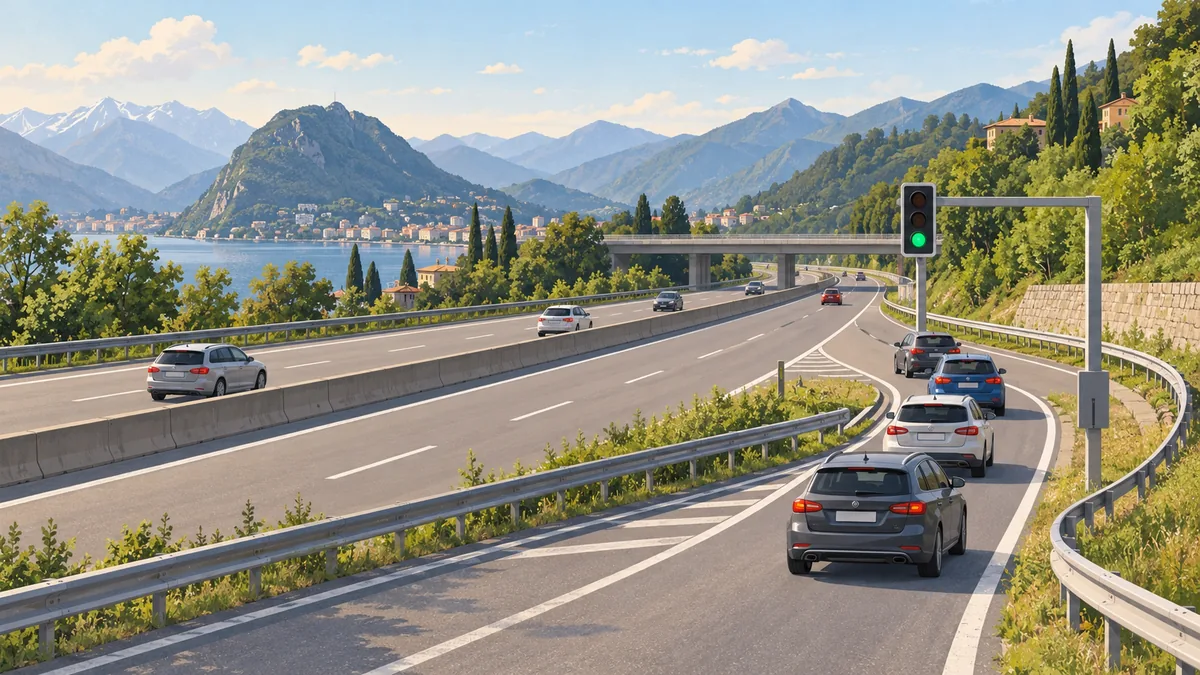
USTRA evaluates over 120 points for dosage.
Context
TL;DR
- USTRA is assessing over 120 ramp-metering locations.
- 15 systems are active in Switzerland.
- Two systems are active on the A2 towards Chiasso.
- The January 2025 note takes downstream queues into account.
Key facts
- Manager → Federal Roads Office (FEDRO)
- Scored points → over 120
- Plants in Switzerland → 15
- Lifts on the A2 towards Chiasso → 2
- Basel area → 19 plants under consideration
- Internal note → January 2025
- Other hypotheses on A2 → 4
The Federal Roads Office (FEDRO) is examining more than 120 sites for installing metering systems at motorway ramps. This was reported by SonntagsZeitung. However, this is not a definitive decision: it will only proceed if checks confirm its feasibility and a positive effect on traffic.
The system is based on traffic lights that regulate access to the highway, allowing vehicles to pass at intervals. In this way, close entries are limited and the flow on the main roadway is more regular. In Switzerland, 15 plants are already operational.
For FEDRO, ramp metering is a measure to be activated when traffic is intense.
From assessment to A2
For those traveling on the A2 towards Chiasso, the framework already includes two DoRa systems, also referred to as ramp metering, at the Lugano Sud and Melide/Bissone ramps. The FEDRO list also reports four other hypotheses: one concerns Lugano North towards Chiasso; the others, towards Basel, Lugano Sud, Melide/Bissone and Mendrisio. The distinction is concrete: the first two systems are active, while the four items are presented as hypotheses.
In the Basel region, 19 plants are being examined. An internal FEDRO note from January 2025 considers it possible that the dosage generates traffic jams on the roads downstream. The cantons of Basel-Stadt and Schaffhausen reportedly declared that they were not actually involved, while the Union of Swiss Cities also fears consequences for those who travel on foot or by bicycle.
To follow the evolution of the queues without confusing the study phase with a decision, the reader can place the article alongside storico del traffico e delle code.
Operational details
What changes for the cross-border commuter
For a cross-border commuter using the A2 towards Chiasso, the practical difference concerns above all access to the on-ramp. The traffic light controls entry: it regulates passage at intervals, while the stated objective concerns a smoother flow on the main carriageway. The intended effect is to reduce merges that are too closely spaced. The source does not associate the device with a guaranteed travel time.
A balance to be verified
The same measure may, however, shift part of the pressure onto downstream roads. The USTRA internal note from January 2025 explicitly allows for the possibility of queues on downstream roads. For those travelling between home and work, the assessment therefore cannot stop at the point where the traffic light is located: the project must be considered together with its consequences for the local network. The Swiss Cities Union also points to possible effects on pedestrians and cyclists.
The stage matters as much as the location. An installation already active at Lugano Sud or Melide/Bissone does not have the same status as one of the four possibilities mentioned in the USTRA list. Similarly, the 19 installations under consideration in the Basel area do not constitute an activation schedule. The source does not indicate times, waiting durations, start dates or alternative routes: these elements should not be inferred from the announcement alone.
For this reason, the useful information is not only the number of points examined. A cross-border commuter can distinguish three questions: Is the ramp already regulated? Is the point merely under evaluation? Does any potential effect concern the main carriageway or downstream roads? The source makes it possible to ask these questions, but not to give an operational answer for every individual journey.
The dossier does not announce changes to the G permit, AVS, LPP, LAMal, tax rebates, withholding tax, INPS or double taxation: the source speaks of motorway access, traffic flows and possible queues. For an additional check of the route, the cross-border commuter can consult the tempi di attesa ai valichi, keeping observed data separate from hypotheses still under study.
Useful planning tools
To estimate your pension strategy, use the pension planner and the pillar 3 simulator.
Useful planning tools
To estimate your pension strategy, use the pension planner and the pillar 3 simulator.
Key points
How to read the next steps
The source does not indicate a schedule for activation, operating hours or waiting times. To turn the news into an orderly check of one’s route, it is therefore advisable to proceed through precise distinctions, without giving hypotheses the same weight as systems already in operation.
Four checks for commuters
1. Identify the access point. If the route involves the A2 towards Chiasso, compare the name of the ramp with the two systems already in operation: Lugano Sud and Melide/Bissone. If the reference is Lugano Nord towards Chiasso, treat it as a hypothesis in the USTRA list, not as a system already announced.
2. Separate operation from objective. The traffic light regulates entry by allowing vehicles through at intervals. The intended effect is to make the flow on the main carriageway more regular by avoiding entries that are too close together; no guaranteed result is indicated for every individual journey.
3. Check both sides of the network. In addition to the main carriageway, consider the downstream roads, because the USTRA internal note of January 2025 takes the possibility of queues into account. The assessment must therefore also include the point where traffic could accumulate.
4. Verify the transition from assessment to a concrete project. USTRA states that Cantons and municipalities will be involved at that stage. Until then, the 120 national points and the 19 in the Basel area remain figures from an assessment, while the four hypotheses indicated for the A2 do not amount to an equal number of activations.
This method avoids confusing a measure already in operation with a study still conditional on feasibility and a positive effect on traffic. The source provides no documents to submit nor any individual procedure for requesting or rejecting ramp metering: the practical action consists of distinguishing the affected section, the project status and the possible downstream effect.
To connect the route to the commuting balance, use costo auto pendolare.
Evaluating a Ticino job offer? Simulate your net payslip: enter gross salary, marital status and municipality for a detailed breakdown.
Source: ticinonews.ch
Discover Ticino job offers updated daily: 4,000+ positions from Swiss companies hiring cross-border workers.
Frequently Asked Questions
- How many points is the USTRA evaluating for dosing?
- The Federal Office of Roads is evaluating over 120 possible points to install dosing systems at highway ramps. The objective is to proceed only if the verifications will confirm the feasibility and a positive effect on traffic. The figure therefore indicates an examination phase and is not equivalent to the announcement of installations already approved in all points.
- Where are the systems on the A2 towards Chiasso already active?
- On the A2 towards Chiasso, two DoRa systems, or ramp metering, are already active at the Lugano Sud and Melide/Bissone ramps. The USTRA list also indicates four other hypotheses: Lugano Nord towards Chiasso and, towards Basel, Lugano Sud, Melide/Bissone and Mendrisio. The four items are presented as hypotheses, not as activations already carried out.
- Does dosing eliminate queues on highways?
- No. The system is designed to allow vehicles to enter at intervals, avoiding too close inputs and making the flow on the main road more regular. An internal USTRA memo from January 2025, however, notes that dosing can result in columns on downstream roads. The positive effect must in any case be verified.
- When will Cantons and Municipalities be involved?
- The USTRA states that Cantons and Municipalities will be involved when moving on to concrete projects. The issue arose because the Cantons of Basel-City and Schaffhausen reported that they had not been concretely involved; the Union of Swiss Cities fears repercussions also for pedestrians and cyclists.