Page generated ·
Giogo di Santa Maria (Passo dell'Umbrail) border wait times — today 2026-10-19
Giogo di Santa Maria (Passo dell'Umbrail): Observed snapshot: October 19, 2026 at 09:07 AM GMT+2 · Outdated reading: not current traffic.
Last available reading Observed snapshot: October 19, 2026 at 09:07 AM GMT+2 · Outdated reading: not current traffic
Wait times unavailable
We have no reading for the crossings in this area right now. This is not a zero-minute queue: the data is missing. Wait times refresh every 15 minutes.
Wait times unavailable
We have no reading for the crossings in this area right now. This is not a zero-minute queue: the data is missing. Wait times refresh every 15 minutes.
Live webcam
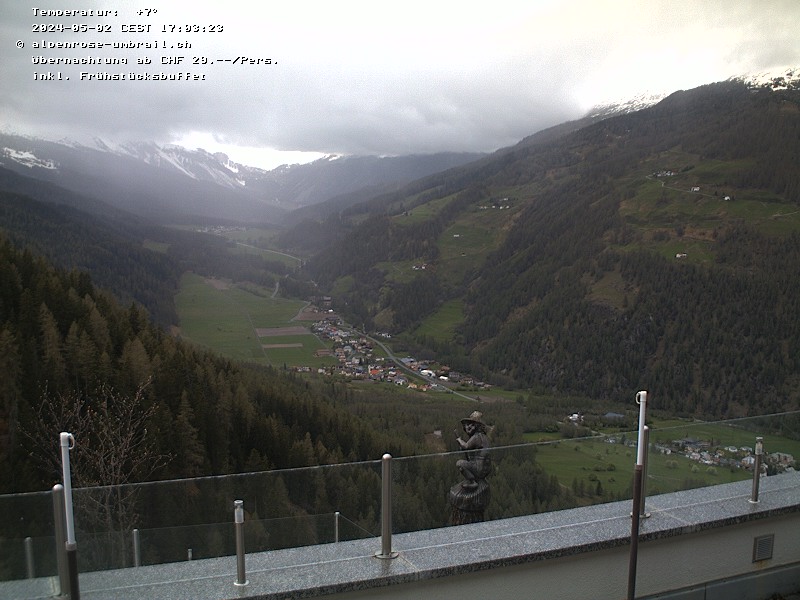
Images refresh automatically every minute while the page is open. Use the "Source" link for the official live feed.
Today's hourly trend
Data is being collected — the chart will fill in as new crossings are recorded.
Weekly pattern (last 30 days)
Best hours: 00:00 · Worst hours: 09:00
Crossing info
- Type: Local road
- Hours: Chiuso da neve, tipicamente ott/nov-mag/giu (verificare stagione ogni anno)
- Morning average: n.d.
- Evening average: n.d.
Compare nearby crossings
This comparison groups 6 crossings in the same Graubünden–Italy corridor, ordered by straight-line distance. Compare the observed reading and source before choosing where to cross.
The nearby crossings, in distance order, are Müstair – Taufers, Tunnel Munt La Schera (Passo del Gallo), Forcola di Livigno, Campocologno-Tirano and Castasegna-Villa di Chiavenna.
| Crossing | Observed wait | Updated | Source |
|---|---|---|---|
| Giogo di Santa Maria (Passo dell'Umbrail) This crossing | 0 min Free-flowing | 10/19, 09:07 AM | Live route estimate (rotating provider) |
| Müstair – Taufers | n/a — | — | n/a |
| Tunnel Munt La Schera (Passo del Gallo) | 0 min Free-flowing | 10/19, 09:07 AM | Live route estimate (rotating provider) |
| Forcola di Livigno | 0 min Free-flowing | 10/19, 09:07 AM | Live route estimate (rotating provider) |
| Campocologno-Tirano | 0 min Free-flowing | 10/19, 09:07 AM | Live route estimate (rotating provider) |
| Castasegna-Villa di Chiavenna | 0 min Free-flowing | 10/19, 09:07 AM | Live route estimate (rotating provider) |
The observed figure combines approach and checkpoint time when available; it is not the full journey from your starting point. Missing data stays unavailable.
Editorial morning/evening averages: not live data and not the travel time to reach the crossing.
| Crossing | Morning | Evening | Distance |
|---|---|---|---|
| Giogo di Santa Maria (Passo dell'Umbrail) | n/a | n/a | 0.0 km |
| Müstair – Taufers | n/a | n/a | 11 km |
| Tunnel Munt La Schera (Passo del Gallo) | n/a | n/a | 21 km |
| Forcola di Livigno | n/a | n/a | 31 km |
| Campocologno-Tirano | n/a | n/a | 41 km |
| Castasegna-Villa di Chiavenna | n/a | n/a | 74 km |
Frequently asked questions about Giogo di Santa Maria (Passo dell'Umbrail)
When is Giogo di Santa Maria (Passo dell'Umbrail) least congested?
On average the Giogo di Santa Maria (Passo dell'Umbrail) crossing shows the shortest queues mid-morning (10:00–12:00) and mid-afternoon (14:00–16:00). Outside the commuter peaks (06:30–08:30 and 17:00–19:00), wait times often drop below 5 minutes.
How are wait minutes calculated?
Wait times are derived from two routing measurements: an approach segment (~500 m before the crossing) and the crossing segment (crossing → Swiss checkpoint). The excess time over the traffic-free baseline is the queue. Data is collected every 15 minutes during peak hours.
What should I do if the queue exceeds 40 minutes?
If the main crossing is congested, check whether a local crossing in the same area shows a shorter wait in the map above. Local crossings typically have lower capacity but often remain fluid when the main ones saturate.
Do the webcams work at night?
Where available, webcams run 24/7, but night-time visibility depends on how the crossing is lit: crossings with constant lighting stay readable, smaller local crossings may appear dark during night hours.
Planning the queue at Giogo di Santa Maria (Passo dell'Umbrail). Wait time at Giogo di Santa Maria (Passo dell'Umbrail) follows commuter traffic, checks and road events. In the Graubünden–Italy area, the last 30 days show 00:00 as the quietest window and 09:00 as the busiest. Check the live reading and webcam before leaving: border traffic can change quickly. Compare readings collected at similar times and always add the drive needed to reach an alternative crossing: the displayed minutes describe the observed segment, not the whole journey.
Planning the Giogo di Santa Maria (Passo dell'Umbrail) crossing: snapshot, live reading and peak windows
The reading for Giogo di Santa Maria (Passo dell'Umbrail) may update after opening the page. Always check the observation time and source beside the wait estimate: a recent reading is more useful when deciding when to leave. If no update arrives, the last available reading remains visible and may be expired. A traffic estimate describes delays on the observed road segment and does not guarantee the duration of customs checks. When comparing crossings, check that observations were taken at similar times and include the extra travel time needed to reach an alternative route.
If the live reading shows a significant queue, consider the crossings in the same cluster: Müstair – Taufers · Tunnel Munt La Schera (Passo del Gallo) · Forcola di Livigno · Campocologno-Tirano. The corresponding pages share the same reading updates, so you can keep two open in separate tabs and pick the one with the lowest number at departure time. Remember that the "wait minutes" value only measures the approach + checkpoint segment: the travel time from your own starting point to Giogo di Santa Maria (Passo dell'Umbrail) is not included in the figure and must be added separately, depending on your actual route. For those returning in the evening, the difference between a main crossing and a local crossing in the same area can still be worth a few total minutes even when the queue figure is similar, because the local exit often avoids the sudden backups typical of higher-volume crossings.
How often is the Giogo di Santa Maria (Passo dell'Umbrail) number refreshed?
Check the date and time beside the reading. The page attempts to show the latest available observation; if no update arrives, the previous reading remains. Do not treat an expired reading as current.
Why do I see a few minutes here but the motorway looked clear?
The value measures the extra time on the approach segment (~500 m before the crossing) vs the traffic-free baseline. Even with a smooth motorway, a customs check, a lane switch or an approaching heavy vehicle can briefly bump the number. It is normal for Giogo di Santa Maria (Passo dell'Umbrail) to oscillate by 5–10 minutes between two consecutive polls during peak windows.
Plan your Giogo di Santa Maria (Passo dell'Umbrail) crossing by checking the current reading and, when available, the live webcam feed. Over the last 30 days the best hour to transit has been 00:00; the worst hour is 09:00. Check the source and observation time before leaving, and compare the readings with the interactive map. If you are returning to Italy after work, remember that commuter peaks can change quickly: between 17:00 and 19:00 Giogo di Santa Maria (Passo dell'Umbrail) may also show queues. For regular cross-border commuters, always keep your ID document at hand: even within the Schengen area, the Giogo di Santa Maria (Passo dell'Umbrail) crossing can be subject to spot checks on vehicles, goods and customs declarations (food imports above the personal allowance, cash above CHF 10,000, regulated substances). The most targeted checks usually fall between 06:00–08:00 and 17:00–19:30, overlapping with commuter peaks. If you drive a Switzerland-registered company car, keep the employer authorisation letter and a copy of the vehicle registration in the glovebox: this avoids prolonged customs questioning at Italian border checkpoints.
Discover more