Stadler Rail tests the first narrow-gauge hydrogen train
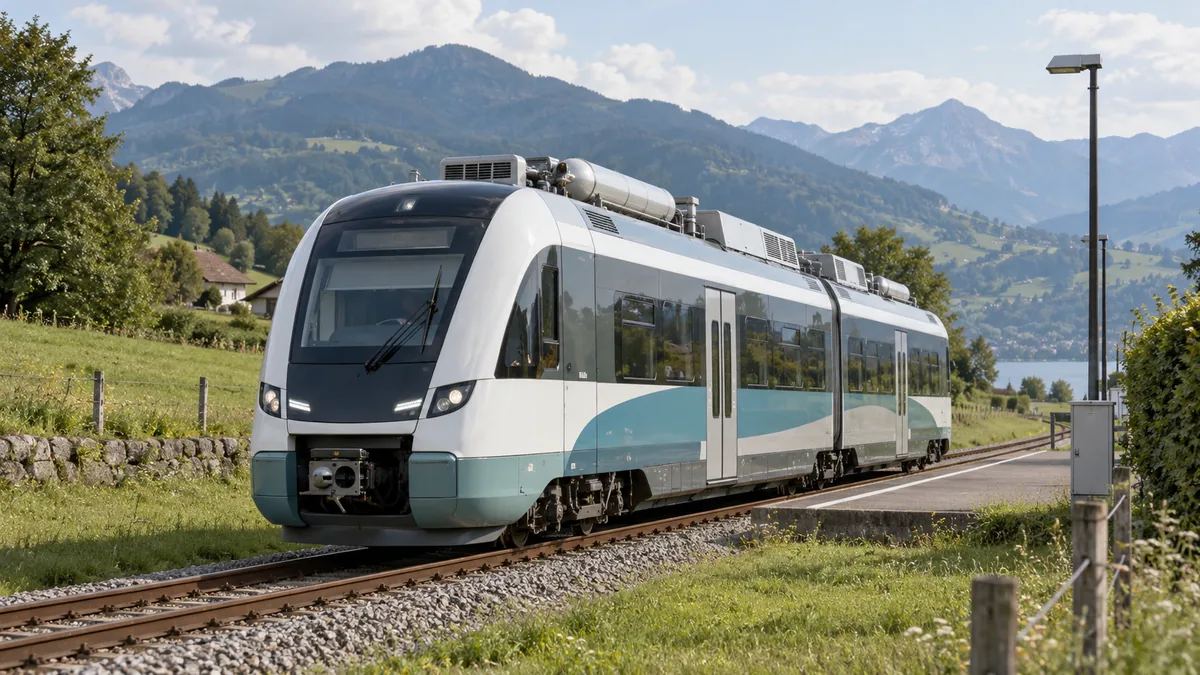
Stadler Rail tests a hydrogen train in Switzerland The train is intended for Sardinia The Hemishofen-Ramsen route measures almost 4 km The tests
Context
TL;DR
- Stadler Rail tests a hydrogen train in Switzerland
- The train is destined for Sardinia
- The Hemishofen-Ramsen route measures nearly 4 km
- The tests will cover 21 vehicles over three years
Key facts
World first → narrow-gauge hydrogen train Destination → Sardinia Test site → Hemishofen-Ramsen, canton of Schaffhausen Gauge of Italian networks → 950 millimetres Program → 21 vehicles over the next three years Employees → 18,000, of which 6,000 in Switzerland Turnover 2025 → 3.7 billion francs Action → approximately 31 francs in the afternoon indicated
Almost four kilometers between Hemishofen and Ramsen, in the canton of Schaffhausen, host the new test phase of Stadler Rail. In the spring the company built a dedicated route here for rolling stock destined for the Italian narrow-gauge networks. The line runs inside an existing standard gauge track and has a third rail.
The convoy is the first hydrogen train built on narrow gauge. It is intended for use in Sardinia and is tested in Switzerland before arriving on the network of the Sardinian Regional Transport Company, ARST. The news is attributed to ATS, indicated in the source as Keystone-ATS.
The regional lines in southern Italy partly use a gauge of 950 millimetres. Trains designed for this distance between the rails are running, according to the press release, in Puglia, Sicily, the Naples area and Sardinia.
From the Californian test to the Italian fleet
The technical reference used by Stadler is the FLIRT H2 made for California. That train carried out its tests on the standard gauge line; the success of the project led to the expansion of the route with the third rail. The systems of the vehicle produced for ARST are now being checked, before moving on to the final tests on the Sardinian network.
Carlo Poledrini, general director of the Sardinian railway company, defined the imminent delivery of the new trains as a decisive step. In the statement reported in the note, he links the testing phase to the possibility of quickly starting the final tests and continuing towards zero-emission mobility and greater energy self-sufficiency.
Over the next three years, the Schaffhausen route will play a role in the commissioning of the fleet that Stadler Rail is building for Sardinia, Calabria and Sicily. The planned checks concern a total of 21 vehicles.
Stadler Rail originates from the engineering firm founded by Ernst Stadler in Zurich in 1942. The company, now based in Bussnang, in the canton of Thurgau, builds high-speed and regional trains, trams and metro vehicles, also used on the Swiss and Ticino railways. The company employs 18,000 people, 6,000 of them in Switzerland, and recorded a turnover of 3.7 billion francs in 2025.
Operational details
The point to watch is not just hydrogen technology. For those observing the Swiss economy, the news brings together a test infrastructure in the canton of Schaffhausen, an industrial program intended for Sardinia, Calabria and Sicily, and a company that also operates on Swiss and Ticino lines. The practical significance lies in distinguishing what is being tested in Switzerland from what will be verified on the destination networks.
The path from testing to deployment
The third rail is the technical detail to bear in mind. The route built between Hemishofen and Ramsen is part of a standard-gauge line, while the rolling stock intended for the Italian networks is designed for a gauge of 950 millimetres. The source therefore describes a Swiss platform set up to test a train intended for a different type of network.
| Phase | Available data | Operational interpretation |
|---|---|---|
| Test in Switzerland | Systems of the vehicle built for ARST | Current verification |
| Next step | Final tests on the Sardinian network | After arrival in Sardinia |
| Fleet program | 21 vehicles | Entry into service over the next three years |
| Technical precedent | FLIRT H2 for California | Project that led to the expansion |
This sequence avoids confusing the opening of the Schaffhausen route with the conclusion of the program. ARST's statement in fact indicates that an important phase had already been completed before the vehicles arrived, followed by the final tests on Sardinia's network. The available timeframe for the fleet is the next three years.
The second point of analysis is financial. On the afternoon cited by the source, Stadler Rail shares were gaining nearly 2%, at around 31 francs. The 2% therefore indicates the session's movement. Since the beginning of January, the share price had risen by 44%, while over a twelve-month period the increase reached 57%. The 44% and 57% measure different periods and should not be read as a single change.
The historical comparison added by the source is the price of 43 francs at the time of its stock-market debut, in April 2019. To read the news correctly, four reference points must therefore be kept separate: the afternoon movement, the growth since the beginning of the year, the twelve-month growth and the price of the initial offering. All concern the share price, while the railway project is described through tests, vehicles and entry-into-service timelines.
Key points
To follow the story without conflating technical, operational and financial data, it is advisable to build a monitoring sheet based on the coordinates already indicated in the source.
Five steps for following the project
1. Start with the geography. For each update, note whether it concerns the route between Hemishofen and Ramsen, in the canton of Schaffhausen. This is the Swiss testing site; Sardinia, on the other hand, is the destination indicated for the convoy.
2. Check the gauge. Separate the 950 millimeters of the networks served in Italy from the Swiss standard-gauge line, which has a third rail. This distinction makes it possible to understand which part of the update concerns the testing site and which concerns the rolling stock intended for the Italian regional network.
3. Use the three-year period as the horizon. The temporal reference provided is that of the next three years. Each communication can be linked to the commissioning of the fleet planned for Sardinia, Calabria and Sicily and to the total of 21 vehicles undergoing verification.
4. Identify the operational phase. News about the vehicle’s systems concerns testing in Switzerland. News about the final tests, on the other hand, concerns the next step indicated by ARST on its own network in Sardinia. The two phases are not interchangeable.
5. Separate the project from the stock quotation. When consulting stock-market data, always indicate the period: almost 2% in the afternoon, 44% since the beginning of January and 57% over twelve months. The reference to 43 francs instead belongs to the stock-market debut in April 2019.
This method makes it possible to update the news without turning market data into a forecast about the railway program. It keeps the location of the tests, the destination of the trains, the number of vehicles and the share’s performance distinct.
To extend monitoring from the individual project to the broader picture of companies active in Switzerland, consult the aziende che assumono.
Source: swissinfo.ch
Frequently Asked Questions
- Where are Stadler Rail hydrogen trains tested?
- Stadler Rail's hydrogen trains are being tested on a nearly 4km track between Hemishofen and Ramsen, in the canton of Schaffhausen, Switzerland.
- What is the final destination of hydrogen trains?
- The hydrogen trains are intended for use in Sardinia, where they will be used on the network of the Azienda Regionale Sarda Trasporti (ARST).
- How many vehicles will be checked in the coming years?
- Over the next three years, Stadler Rail will test a total of 21 vehicles destined for Sardinia, Calabria and Sicily.
Related articles
- All articles: Transport and traffic
- FFS: arriva la nuova locomotiva merci Stadler Rail
- Stadler Rail accelera nel primo semestre e vola in borsa
- Stadler Rail: 117 mln per nuovi treni Friburgo
- Spuhler (Stadler Rail) e i bilaterali III: tra economia e istituzioni
- Ciberattacco a Stadler Rail: presunto hacker a processo a Zurigo