Swiss diesel nears 2,50 francs: Cressier alert
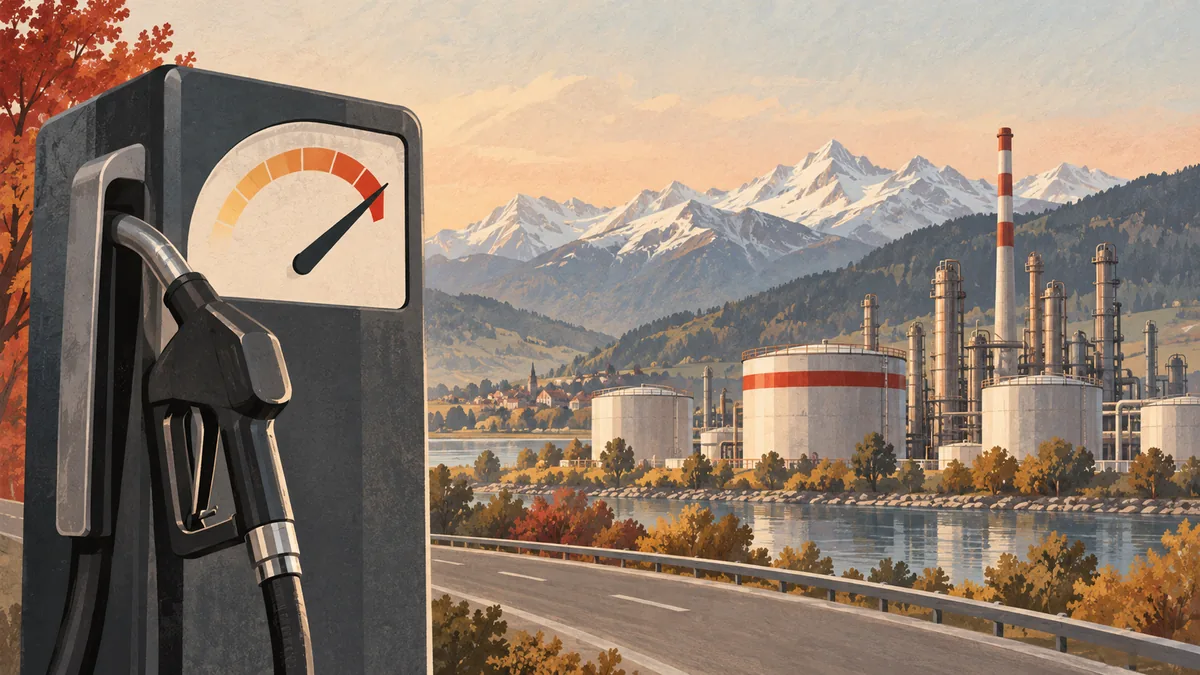
Il diesel in Svizzera sfiora 2,50 franchi al litro
Context
TL;DR
- Diesel in Switzerland is nearing 2,50 francs per litre
- Cressier supplies around 35% of the country's fuel supply
- European refining has limited capacity
- G7 reserves are a buffer, not a solution
Key facts
- Plant operator → Varopreem
- Refinery → Cressier (NE), the only one in Switzerland
- Coverage → approximately 35% of national fuel consumption
- Operating rate → nearly full capacity
- Last new refinery in the United States → 1977
- Last new refinery in Europe → 1975
- Plants closed in Europe since the beginning of the century → more than 30
- Demand → could decrease if prices remain high in 2027
The alarm from the Cressier refinery
Diesel in Switzerland now sells for almost 2,50 francs per litre. Raising the alarm is Dev Sanyal, CEO of Varopreem, the company entrusted with managing Switzerland's only refinery, in Cressier (NE). In an interview published by the Neue Zürcher Zeitung, the manager describes a combination of record prices, limited refining capacity and geopolitical uncertainty in Europe.
For those following costo della vita in Svizzera, the price at the pump is the most visible signal, but it does not by itself tell the whole story of the refiners' situation. Sanyal links the current phase to the rigidity of the global fuel supply system: for years, he explains, efficiency dominated decision-making; now resilience carries much more weight.
«These are absolutely extraordinary times: I have been working in this sector for 38 years and I have never experienced a situation like the current one»
The rise at the pump does not automatically translate into higher margins for refiners. Input costs have also increased in the market, while differences in crude oil qualities and transport costs also have an impact. Sanyal also brings 30 years of experience at the British giant BP, a factor informing his reading of the current cycle.
Cressier at the heart of national production
The group is not directly active in retail sales or in the management of service stations. It does, however, control the Cressier refinery: the facility covers approximately 35% of national fuel consumption and operates nearly at full capacity. The facility is therefore a national link in the chain, but it does not eliminate the difficulties coming from the European market.
The CEO urges people not to consider a good half-year a guarantee for the entire year: the possible obstacles remain numerous. Among the scenarios mentioned is a possible ban by the United States on diesel exports. The effect would be immediate on European markets, with another sharp increase in prices and a shock to supplies that have so far also been supported by US exports.
The release of additional strategic reserves by the G7 countries has reduced the risk of an immediate deterioration and may help ease some of the pressure on supply and prices. Sanyal considers them a buffer, not the solution to the shortage of refining capacity.
Operational details
Prices, reserves and capacity: the Swiss perspective
The practical issue for Switzerland is not just how much a litre costs, but how quickly an external problem can feed through to consumer prices and industry. Sanyal sees the Confederation's ability to withstand high prices as an advantage over many Asian and African nations; this does not, however, shield it from the economic effects.
The transformation of the sector helps to understand the risk. Refinery closures could have seemed economically justified: the global market was supposed to prevent shortages. Governments also considered these plants not critical infrastructure but rather relics of the past destined to become redundant with the energy transition. Since the beginning of the century, more than 30 have been closed in Europe.
The comparison between an efficient market and a resilient market
That choice reduced available capacity just as geopolitical uncertainties are putting routes and facilities under pressure. The war between Iran and Israel and Ukrainian attacks have rendered refineries in the Gulf region and Russia unusable. If bottlenecks around the Strait of Hormuz or in Russia are added, the interview speaks of a perfect storm.
| Signal | Effect indicated by the interview |
|---|---|
| G7 strategic reserves | They reduce the risk of an immediate worsening and somewhat ease pressure on supply and prices. |
| U.S. halt on diesel exports | Shock for European markets and a further sharp increase in prices. |
| Bottlenecks near the Strait of Hormuz or in Russia | This would result in a highly critical scenario, and a physical shortage cannot be ruled out. |
| High prices in 2027 as well | European demand could decline. |
Demand behavior confirms that the market has not yet shown a clear trend: after about eight months of war in Iran, Sanyal does not detect a significant change in European diesel and petrol consumption. However, high prices persisting in 2027 would change the scenario, with a possible contraction in demand.
To assess the impact on a personal budget without confusing the consumer price with refining costs, this analysis can be considered alongside busta paga svizzera. The figure to watch is not just today's price, but the duration of the shock and how supply, costs and demand move together.
Useful tools to protect your net income
To reduce FX leakage, compare CHF-EUR exchange options and banks for cross-border workers.
Key points
How to follow developments without confusing the signals
To follow the risk without turning every news item into a forecast, those who live or work in Switzerland can use a simple sequence. The method separates the data observed at the pump, industrial costs, and events capable of altering supply.
Four operational steps
1. Set the starting point. The reference is the price of diesel at the pump, almost 2,50 francs per liter. It should be read as a cost for the consumer, not as automatic proof of higher profits for refiners.
2. Separate price and cost structure. In the case described by Sanyal, higher prices also correspond to higher input costs. Differences in crude quality and transport can change the refinery's outcome, so the change at the pump and the industrial margin are not the same thing.
3. Check supply signals. The release of G7 reserves reduces the risk of immediate worsening but acts as a buffer. A possible United States ban on diesel exports, by contrast, would be a shock for Europe. Bottlenecks around the Strait of Hormuz or in Russia are described as a perfect storm, and a physical shortage cannot be ruled out.
4. Distinguish the short and medium term. The CEO does not predict how long the problems will last. If prices remained high also in 2027, European demand could decline; even after a possible resolution of the crisis in Hormuz, a premium linked to operators' perceived risk could remain in crude oil.
This framework is also useful for reading the situation at the national level. Switzerland is better positioned than many Asian and African nations in its ability to pay high prices, but Sanyal nonetheless points to major effects on consumer prices and industry. For a family or a business, therefore, monitoring should not stop at a single refueling: it is worth observing whether the event concerns reserves, refining, or international routes, because the duration of the problem changes the economic pressure.
The final step is to translate fuel spending into disposable income, without introducing forecasts about the duration of the crisis that Sanyal does not venture. For this check, use calcolatore stipendio.
Source: tio.ch
Frequently Asked Questions
- Why is diesel in Switzerland approaching 2,50 francs per litre?
- Diesel in Switzerland is nearing 2.50 francs per liter. Dev Sanyal, CEO of Varopreem, links the period to record prices, limited refining capacity and geopolitical uncertainties. The increase at the pump does not automatically mean higher margins for refiners: input costs have also risen, while crude quality and transport affect the result.
- What role does the Cressier refinery play for Switzerland?
- Cressier (NE) is Switzerland's only refinery and is operated by Varopreem. It covers approximately 35% of national fuel consumption and operates almost at full capacity. Varopreem does not operate in retail and does not manage service stations. The facility is therefore a national link in the chain, but it does not eliminate problems that may come from the European market.
- Do G7 reserves solve the refining capacity shortage?
- The decision by the G7 countries to release additional strategic reserves has reduced the risk of an immediate worsening and may partly ease supply and prices. For Sanyal, however, reserves are a cushion, not the solution to the shortage of refining capacity. Any U.S. ban on diesel exports would have immediate effects on European markets.