Cross-border welder in Ticino: salary and requirements
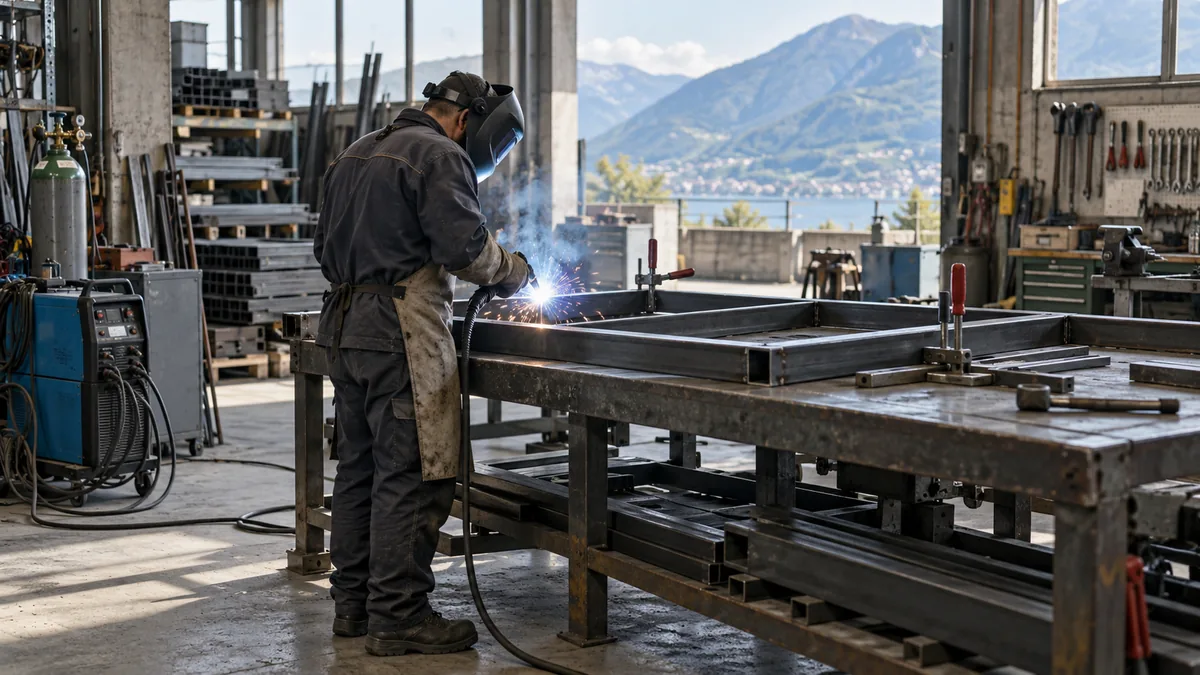
G permit, withholding tax and contributions: the verified overview for those considering cross-border work as a welder in Ticino, with an agreement in force since 2024.
Context
TL;DR
- Agreement signed on December 23, 2020
- In force since January 1, 2024
- Old cross-border workers: exemption of €7'500
- New cross-border workers: allowance of €10'000
Key facts
- Work → cross-border welder in Canton Ticino
- Permit → G
- Income tax → withheld only in Switzerland
- Old cross-border workers → transitional regime 2024–2033
- Convention → March 9, 1976
The New Cross-Border Workers Agreement was signed on December 23, 2020, and has been in force since January 1, 2024. Italy ratified it through Law 83 of June 13, 2023. Therefore, the phrase «new 2026 tax agreement» should be corrected: the agreement has been in force since 2024, not since 2026.
For a cross-border welder working in Canton Ticino, the central tax issue is withholding on employment income. The source states that tax at source is withheld only in Switzerland, never in both countries. Italy avoids double taxation through the tax credit indicated in section CE of Form 730.
The dates do not serve the same purpose: December 23, 2020 concerns the signing, June 13, 2023 the Italian ratification, January 1, 2024 the entry into force, and July 17, 2023 the threshold used to distinguish old cross-border workers. Separating these steps avoids assigning to 2026 an effective date that the source places in 2024.
The distinction between old and new cross-border workers
The regime changes depending on the category identified by the source. Old cross-border workers are people who already had that status before July 17, 2023: they are entitled to an exemption of €7'500, included in a transitional regime covering the period 2024–2033. New cross-border workers, by contrast, have a tax-free threshold of €10'000.
Permit G forms part of the administrative framework to be considered for cross-border work. Switzerland is not a member of the European Union or the European Economic Area. Here, the tax framework is defined by the dates of the agreement, the tax-free thresholds and the withholding rule.
Operational details
Withholding tax and comparison between periods
Swiss withholding and Italian IRPEF belong to areas that the source keeps distinct. For the cross-border worker's employment income, the withholding is in Switzerland; the credit in section CE of the 730 is the Italian mechanism cited to avoid double taxation. The Italy-Switzerland Convention against double taxation was signed on March 9, 1976.
Comparing the Italian brackets
The Italian figure changes depending on the period considered. For 2024–2025 income, the indicated rates are 23%, 35% and 43%. From 2026, the source reports 23% up to €28'000, 33% from €28'001 to €50'000 and 43% above €50'000. For 2026, the stated reference is Law 199/2025, Art. 1 para. 3. The change to the middle bracket does not justify turning these percentages into an estimate of the welder's net income: there is no individual income to which to apply them.
| Period | Indicated IRPEF bracket |
|---|---|
| 2024–2025 | 23% / 35% / 43% |
| From 2026 | 23% up to €28'000; 33% from €28'001 to €50'000; 43% above €50'000 |
The table serves to avoid confusing an IRPEF bracket with Swiss withholding. Tax rates, including federal and cantonal ones, are set by federal and cantonal laws. At federal level, they are administered by AFC/ESTV, the Federal Tax Administration; cantonal tax administrations are also involved. They are not set by UFAS, which concerns social security, nor by BFS, which collects statistical data.
For the cross-border worker in the Canton of Ticino, the correct comparison therefore involves three separate elements: classification as an old or new cross-border worker, tax period and type of levy. Automatically adding an Italian percentage to the Swiss one would produce an interpretation incompatible with the rule of a single withholding in Switzerland and the Italian tax credit.
Key points
Swiss contributions, LAMal and limitations of the available data
The percentages indicated do not in themselves define a net salary. The source lists some Swiss rates and contributions: AVS/AI/IPG equal to 5.3% for the employee; AD/AC at 1.1%, with the cap of CHF 148'200; LAINF between 0.7% and 1.5%; LPP between 7% and 18% depending on age bracket, starting at age 25. These are withholding and pension data, not a specific salary range for the profession of welder.
LAMal and pension provision are not withholding tax
LAMal is health insurance. Cross-border workers with a G permit have the right of option and, for adults, the deductibles indicated range from CHF 300 to 2500. LAMal must therefore be kept separate both from withholding tax and from the AVS, LPP, AD/AC and LAINF items. The material does not characterize LAMal as “health tax.”
The reference to INPS also does not allow Italian percentages to be added: the source does not provide INPS rates for the welder’s case. The same limitation applies to tax refunds: the issue is relevant to Ticino-Italy relations, but the material available here does not indicate amounts or calculation criteria. Inserting figures would go beyond the verified data.
The editorial request also concerns professional requirements and possible recognition of the educational qualification. On these two points, neither a list of technical requirements nor a procedure or obligation to have the welder’s qualification recognized is provided. Therefore, the most solid information remains the cross-border framework: G permit, withholding tax, deductibles under the new agreement, Swiss contributions and LAMal. It is not possible to derive a net salary or a numerical difference compared with Italy from this information alone.
To apply the available items to a simulation without confusing taxes and contributions, payslip simulator can be used.
Frequently Asked Questions
- Where is the cross-border worker's income tax withheld?
- For cross-border workers, withholding on employment income takes place only in Switzerland, not in both countries. Italy avoids double taxation through the tax credit indicated in section CE of Form 730. This rule concerns cross-border tax treatment; the source does not provide a specific net salary figure for the welder.
- When did the New Cross-Border Workers Agreement enter into force?
- The agreement was signed on 23 December 2020 and entered into force on 1 January 2024. Italy's ratification is Law 83 of 13 June 2023. The verified date is not 2026: the phrase "new 2026 tax agreement" does not change the effective date indicated in the reference text.
- What is the difference between old and new cross-border workers?
- Those considered old cross-border workers are those who already had that status before 17 July 2023. For them, the source indicates an exemption of €7'500 and a transitional regime from 2024 to 2033. For new cross-border workers, an exemption of €10'000 is provided. The text does not add a specific salary bracket for work as a welder.
- What contributions and coverage are indicated for the cross-border worker?
- The source reports AVS/AI/IPG at 5.3% for the employee, AD/AC at 1.1% with a cap of CHF 148'200, LAINF between 0.7% and 1.5%, and LPP between 7% and 18% by age bracket from age 25. For LAMal, cross-border workers with a G permit have the right of option; the indicated adult deductibles range from CHF 300 to 2500.
Related articles
- All articles: Franc and prices
- trasferirsi a Madesimo da frontaliere: pro e contro
- Vivere a La Thuile e lavorare in Vallese da frontaliere
- Vivere a Appiano Gentile e lavorare in Ticino da frontaliere
- Progettista elettrico frontaliere: imposte e permesso G
- Vivere a Ferrera di Varese e lavorare in Ticino da frontaliere