Cost of Living: Where It's Cheaper to Live in Switzerland
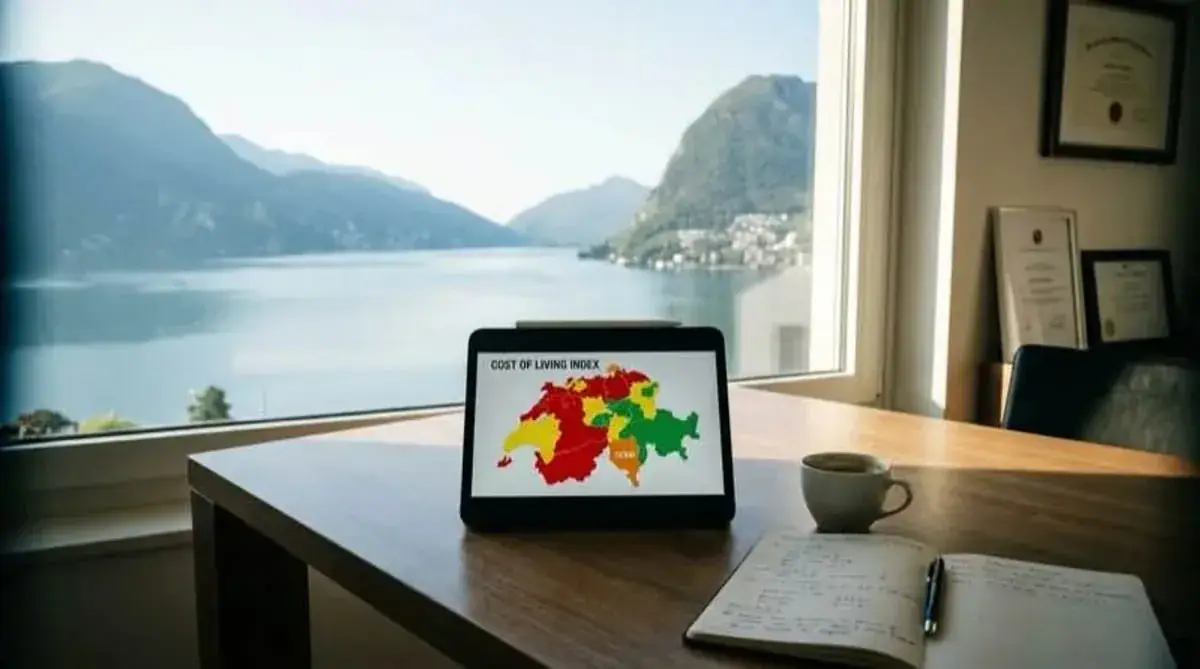
A study reveals huge differences between municipalities: monthly costs for a family range from 3,000 to 7,000 CHF. Ticino stands out for its record-high health insurance premiums.
Context
TL;DR
- Cost of living in Switzerland varies greatly by municipality.
- Medel is the cheapest, Commugny the most expensive for families.
- Rents, taxes, and health insurance drive cost disparities.
Key facts
- Cheapest Municipality: Medel (Lucmagn), Graubünden, around 3,000 francs/month for a family.
- Most Expensive Municipality: Commugny, Lake Geneva, around 7,000 francs/month for a family.
- Rent Difference: 4-room apartment costs less than 1,300 francs in Graubünden, over 4,000 in Geneva.
- Tax Variation: Taxpayer in Neuchâtel pays almost ten times more than in Zug.
- Health Insurance: Premiums vary significantly, impacting family budgets.
- Southern Ticino: Among the most expensive for health insurance premiums, over 18,300 francs/year.
- Tax Burden Example: 500,000 francs income: 80,000 francs in Freienbach, 180,000 in Trey.
- Cross-Border Workers: Moving to Ticino requires careful financial planning due to higher costs.
Living in Switzerland has a cost, but this cost is not the same everywhere. In fact, it can more than double depending on the chosen municipality. An analysis by the weekly magazine «Beobachter» has exposed the enormous territorial disparities by calculating the monthly burden of rent, taxes, and health insurance premiums. The results are surprising and provide a precise map of economic affordability in the Confederation.
The most emblematic case is the gap between the cheapest and the most expensive municipality. In Medel (Lucmagn), in the upper Surselva region of Graubünden, a typical family (four people, gross income of 150,000 francs, 4.5-room apartment) spends just over 3,000 francs a month on these three main cost items. On the opposite end is Commugny, on the shores of Lake Geneva, where the same family must budget around 7,000 francs per month. A difference of almost 4,000 francs that completely redefines purchasing power.
The Factors of Divergence
The analysis, which also considered the case of a single person with an income of 100,000 francs, is based on three pillars:
- Rents: Rental costs are the first, and most intuitive, differentiating factor. In the valleys of Graubünden, a 4-room apartment can cost less than 1,300 francs, while in the Geneva region, it easily exceeds 4,000 francs.
- Taxes: The tax burden varies spectacularly. A taxpayer in the Canton of Neuchâtel pays almost ten times the taxes compared to one in the Canton of Zug. This fiscal lever is used strategically by some cantons to attract residents.
- Health Insurance: Premiums for mandatory health insurance also show strong regional disparities, with a significant impact on the family budget.
The most affordable areas are the peripheral valleys of Graubünden, but also some municipalities in the Canton of Zug, where an extremely advantageous tax system compensates for higher rents.
Operational details
While this data may seem distant to a cross-border worker living in Italy, it becomes crucial when considering a move to Switzerland to obtain a B permit. And it is here that a worrying fact emerges for those looking at our canton. The study highlights that southern Ticino is among the most expensive regions regarding health insurance premiums.
📊 Health Insurance Premiums Compared (family/year)
- Southern Ticino: Over 18,300 francs
- Canton of Aargau: Just over 14,400 francs
- Canton of Zug: Around 10,700 francs
This figure places Ticino among the least convenient areas in this respect, a burden that directly weighs on the monthly budget of a resident family. While a municipality like Steinhausen (ZG) can balance rents that are double those in Graubünden with negligible monthly taxes (only 178 francs for the sample family), in Ticino the cost of healthcare is added to a tax burden and a real estate market that, especially in urban areas like Lugano and Mendrisio, is certainly not among the cheapest in Switzerland.
The tax burden is another key element. The study shows that with an income of 500,000 francs, one would pay about 80,000 francs in taxes in Freienbach (SZ), while in Trey (VD) it's almost 180,000 francs. Although Ticino does not reach the peaks of the French-speaking cantons, its taxation is significantly higher than that of the cantons in central Switzerland, which are considered true tax havens. For those working in Ticino, this analysis offers a realistic snapshot of the costs to face if they decide to move their residence across the border.
Key points
What does all this mean for a cross-border worker? It means that the choice to move to Ticino cannot be based solely on the convenience of eliminating the commute. It requires careful financial planning. The Swiss salary, although high, is eroded by fixed costs that are significantly lower in Italy, chief among them being health insurance.
The decision to switch from a G permit to a B permit involves a radical change in lifestyle and, above all, in the structure of expenses. While the costs of daily travel and the complexities of double taxation (for "new" cross-border workers) are eliminated, one enters a system where healthcare, rent, and local taxes can absorb a substantial portion of the income.
Evaluate Before Deciding
💡 Before considering a move, it is essential to create a detailed simulation of your future budget. It's not enough to compare net salaries; you need to write down all monthly expenses.
- Estimate the rent for the desired type of housing in the area of interest.
- Calculate the health insurance premium for the entire family (remembering that it is individual).
- Forecast the municipal and cantonal tax burden.
To get a precise idea of how your purchasing power would change, personalized analysis tools are indispensable. Our cost of living comparator is designed for this very purpose: it allows you to compare expenses between your current municipality of residence in Italy and a potential new life in Ticino, offering a clear and realistic picture. Run a simulation before making any decisions.
(Source: Beobachter/Tio.ch, February 23, 2026)
Frequently Asked Questions
- What is the cheapest Swiss commune for a frontier worker?
- According to the analysis of the weekly Beobachter, the cheapest municipality is Medel (Lucmagn) in the upper Surselva, where a family of four people with a gross income of 150'000 francs can spend less than 3'000 francs per month for rent, taxes and sick cash prizes.
- What is the impact of sick cash prizes on the budget of a family in southern Ticino compared to other cantons?
- In southern Ticino, a family pays over 18,300 francs per year for sick cash prizes, a significantly higher value than the Canton Argovia (about 14,400 francs) and the Canton Zugo (about 10,700 francs).
- What are the main factors affecting the cost of living for a frontier worker in Switzerland compared to Italy?
- The main costs are rents, taxes and sick cash prizes. The Graubünden and Zugo valleys offer lower rents and advantageous tax, while Ticino has higher health premiums and taxes than other Swiss regions, increasing the total cost for families.
Related articles
- All articles: Health and insurance
- Vivere in Svizzera: ecco dove costa 4'000 CHF in meno al mese
- Migliori Comuni per Frontalieri 2026 | Classifica
- Pizza e bibita sempre più care: la classifica delle 30 città più costose
- Antonelli vince GP Miami 2026: ordine d'arrivo e classifica mondiale
- Costo della Vita Ticino vs Lombardia 2026