Public establishment license in Bern: requirements and application
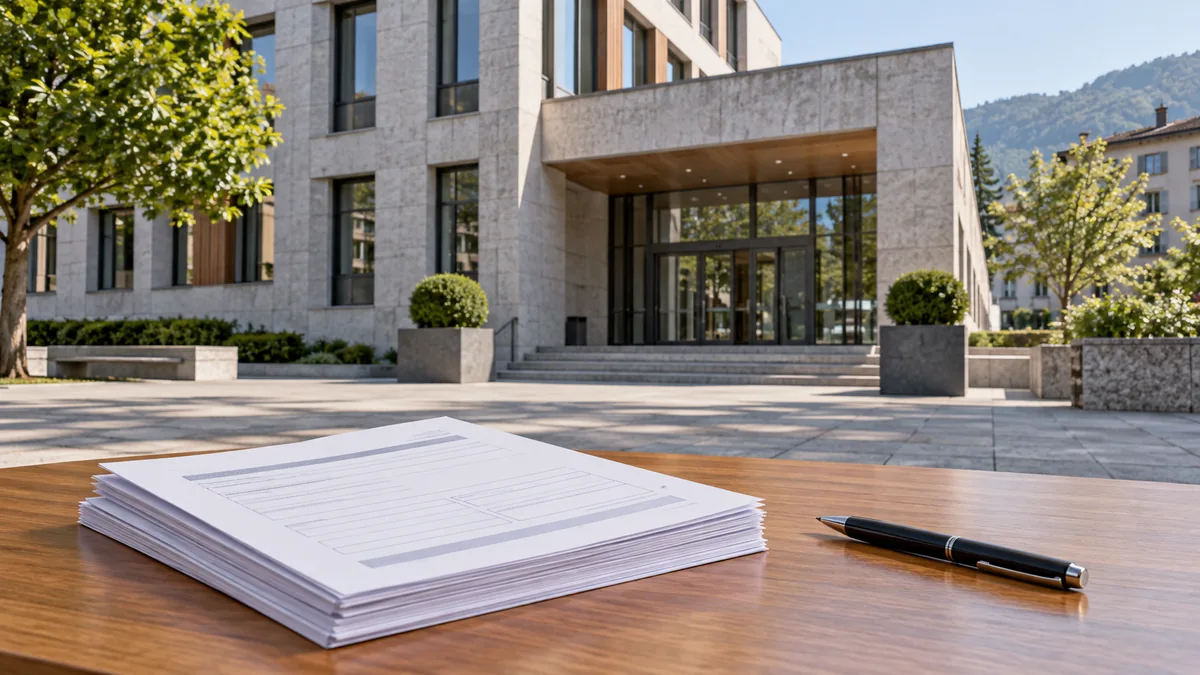
In the Canton of Bern, the license applies to restaurants and establishments.
Context
TL;DR
- In the Canton of Bern, the licence concerns restaurants and establishments.
- The requirement may concern training or responsibility.
- The application and jurisdiction are verified at cantonal or municipal level.
Key facts
- Area → public establishments in the Canton of Bern
- Activities → restaurants and clubs
- Requirement → training or responsibility required
- Procedure → application to the competent authority
- Check → official cantonal or municipal source
In the Canton of Bern, the search for requirements for a public operating license starts with three questions: which restaurant or establishment falls under the practice, what training or responsibility is required and which authority should receive the application. These are the operational points for those seeking license requirements and applications.
Competence comes before practice
Public businesses are among the services regulated, depending on the case, by the Canton, the municipality or the competent institution. The same variability concerns holidays, business hours, hunting and fishing licenses, vehicle registration and testing, university fees and integration programs. In the Canton of Bern it is therefore necessary to verify the applicable procedure with the competent authority, rather than relying on a national procedure without further checks.
The question must be traced back to the correct institutional level. If the jurisdiction is cantonal, the reference is the official source of the Canton; if it is municipal, you need to check the official source connected to the municipality. Responsibility may also lie with another institution. For this reason, the authority item should not be filled in by assumption.
The cantons and municipalities administer various services with their own rules; public establishments fall within this perimeter. A generic national response, therefore, does not replace the local verification envisaged for the Canton of Bern.
The professional requirement also requires a separate check. For restaurants and venues, the practice may concern the training or responsibility required. Whoever prepares the application must ascertain which condition applies to the activity considered, without replacing the requirement with a generic description of the public business. The point is not to choose a standard formula, but to follow the condition indicated by the competent authority.
Requirements, deadlines and amounts must be verified with the official source of the canton, municipality or competent institution. This rule avoids automatically transferring to Bern a procedure that is valid elsewhere and keeps the application for the license distinct from other obligations that an activity may have.
For those looking for a practical answer, the path can be read in two blocks: first the activity, restaurant or venue is identified, then the authority that governs the question is identified. Only then do you check training or responsibilities, terms and amounts in the official source. This sequence is the core of the verification for the public operating license in the Canton of Bern.
Operational details
The obligations that run in parallel
A licence for a public establishment does not replace checks on the other obligations. To assess a restaurant or establishment in Switzerland, taxation, employment and payroll contributions must be considered separately. This distinction prevents confusion between the licensing authority and the body that handles taxes or social security.
Taxation, staff and contributions
In tax matters, the structure has three levels: direct federal tax, cantonal tax and municipal tax. Each canton has its own law and multiplier; the municipality applies a multiplier to the cantonal tax. The AFC/ESTV handles IFD and IVA, while the cantonal administrations cover the cantonal and municipal levels. In planning for a public establishment, the tax check must therefore be conducted alongside the application, without assigning the licence tasks that belong to the tax system.
Personnel entail further rules. There is no federal minimum wage, although some cantons have their own. The maximum working time is 45 hours per week in industry, offices and retail, or 50 hours in other sectors. Minimum annual leave is four weeks, five for those under 20. Maternity leave lasts 14 weeks at 80% through IPG; paternity leave lasts two weeks. Notice periods are 1, 2 or 3 months, respectively, during the first year, from the second to the ninth year and from the tenth year onward.
| Item | Rule |
|---|---|
| AVS/AHV, AI and IPG | 5.3% paid by the employee; 10.6% total including the employer |
| AD/AC | 1.1% up to the annual ceiling |
| LAINF/LAA | 0.7–1.5% depending on the sector |
| LPP/BVG | On the coordinated salary: 7% (25–34), 10% (35–44), 15% (45–54), 18% (55+) up to the reference age |
These data do not determine which office receives the application, but they change the economic assessment of the activity. An establishment operating without staff has a different scope from one that hires staff; the transition must be assessed under the rules on wages and contributions, not on the licence alone. The same caution applies to the minimum wage: the review must take the applicable canton into account, because there is no single federal threshold.
Key points
From verification to application
To turn research into action, it is best to follow a brief, orderly sequence. There is no need to build a national checklist: what is needed is to identify the competent authority and apply the official source relevant to the case.
Five operational steps
1. Define the activity. State whether the application concerns a restaurant or a venue in the Canton of Bern. This distinction is the basis for identifying the relevant requirements.
2. Verify the authority. Check whether the procedure is cantonal, municipal or entrusted to another competent institution. Use the official source for the level identified.
3. Single out the professional requirement. Look for the section dedicated to the required training or responsibility. Do not assume that only one of the two conditions applies to every activity.
4. Check timelines and amounts. Before submitting, verify the requirements, deadlines and amounts in the official source. These elements follow the rules of the competent authority.
5. Submit the application. Once the authority has been identified, submit the application according to the procedure indicated by the official source and retain the authority's reference.
If the verification points to the canton, a municipal page does not replace the cantonal source; if it points to the municipality, a generic cantonal description is not enough. This distinction serves to avoid two opposite errors: looking for a single national office or applying in Bern a procedure valid in another canton.
At the same time, create separate checks for taxation and personnel. For direct federal tax and VAT, the reference is AFC/ESTV; at the cantonal and municipal levels, the cantonal administrations are involved. If the activity has staff, the minimum wage applicable in the canton, maximum working hours, holidays and contributions to AVS/AHV, AD/AC, LAINF/LAA and LPP/BVG must also be checked.
For license fees, do not replace the official source with figures taken from a guide for another canton. The operational reference remains the page of the competent authority at the time of the application.
Frequently Asked Questions
- Which competent authority manages the license for a public exercise in the Canton of Bern?
- The competence can be cantonal, municipal or belong to another institution. It is essential to verify the official source of the correct institutional level before submitting the application, as there is no single national procedure for this type of practice.
- What are the professional requirements to open a restaurant or restaurant in Bern?
- Requirements may relate to the specific training or responsibility required for the activity. Those who prepare the application must ascertain which condition applies to their business, without replacing the requirement with a generic description of the public exercise.
- What tax and labor requirements run in parallel with the license?
- In addition to the license, tax (federal, cantonal and municipal tax), work and contributions AVS/AHV, AD/AC, LAINF/LAA and LPP/BVG must be managed. The minimum wage is not federal but may exist at the cantonal level, to be verified separately.