Cement supplies slightly up in the third quarter
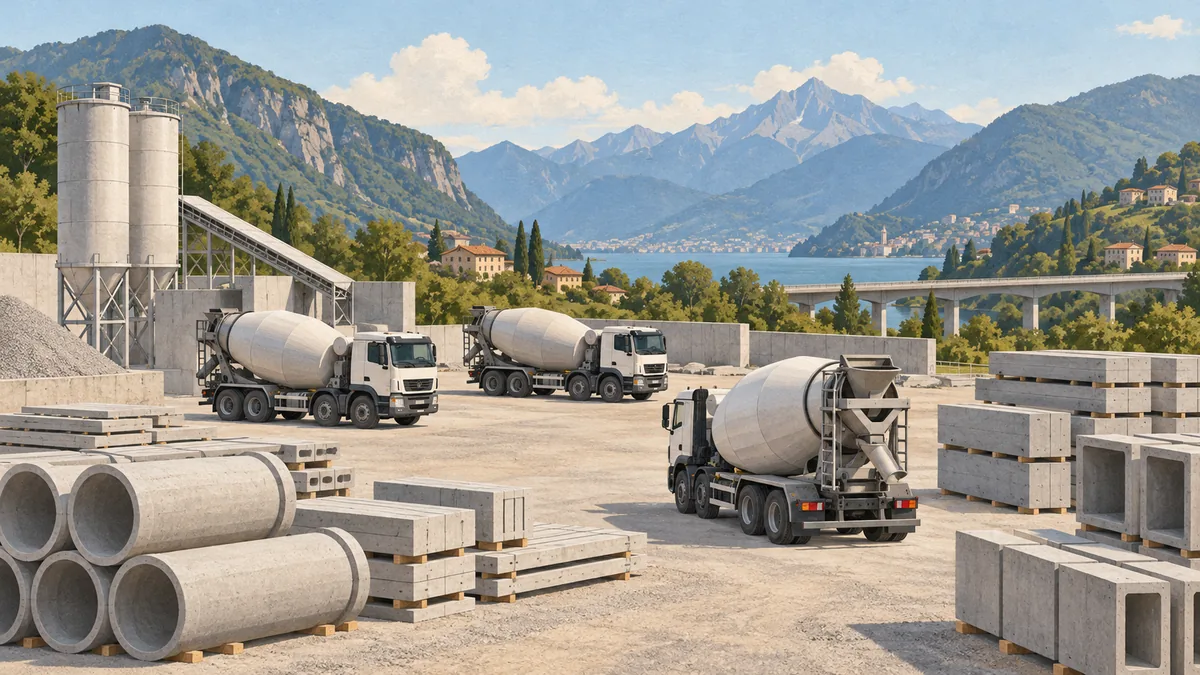
988'700 tonnes of cement in the third quarter Supplies up 1% on the same period More than 98% of the volume is low-clinker 32% by rail
Context
TL;DR
- 988'700 tonnes of cement in the third quarter
- Supplies up 1% compared with the same period
- More than 98% of the volume is low-clinker
- 32% by rail, 68% by road
Key facts
- Quantities in the third quarter → 988'700 tonnes
- Change from the same period last year → 1%
- First nine months → 2,8 million tonnes
- Low-clinker cement → over 98%
- Portland cement → 1%
- Rail transport → 32%
- Road transport → 68%
- Industry association → Cemsuisse
988'700 tonnes of cement were delivered in Switzerland in the third quarter, 1% more than in the same period last year. The news was reported by Keystone-ATS and reflects a slight increase in the flow of supplies.
Moderate growth, with demand still present
Over the first nine months, growth stood at a similar 1%, for a total of 2,8 million tonnes. The quarterly and cumulative figures therefore describe the same trend: quantities delivered increased, without the source reporting a larger change.
Cemsuisse, the industry association, writes in a statement that “Swiss quality cement continues to be in high demand.” On the path toward the goal of net-zero emissions, the association adds, the sector shows a strong propensity for innovation and makes significant investments to reduce the CO2 released by its products.
In recent years, demand for more environmentally friendly types of cement has continued to grow. Today, low-clinker types account for over 98% of the total volume delivered. Portland cement, used exclusively until the 1990s, represents only a marginal 1% share.
Cemsuisse presents the composition of supplies as a dual result: the sector makes an important contribution to the domestic supply of cement and concrete and supports the Confederation’s climate policy objectives.
From a logistics perspective, the tables published by the organization founded in 1881 indicate that 32% of deliveries in the January–September period took place by rail, compared with 68% by road. The rail share also fell by more than two percentage points in the comparison reported. Cemsuisse links this figure to problems with single-wagonload transport, which force companies to resort to trucks. Director Stefan Vannoni expresses the sector’s regret, while the organization reports that it has already repeatedly flagged the shortcomings of rail freight transport to the competent authorities.
Operational details
What the data indicate for the Swiss system
Volume, product and transport are three different dimensions
To read the press release without confusing the levels, it is helpful to separate the quantity delivered, the type of cement and the means used to distribute it. These are three indicators present in the same picture, but they describe different aspects of the industry's activity.
The first figure concerns volumes. The increase is described as slight and concerns the third quarter; the cumulative figure for the first nine months follows the same 1% change. For a Swiss reader, this signals that demand remains active during the period under consideration. The scope of observation is cement supplies.
The second figure concerns the composition. The clear predominance of cements with a low clinker content, exceeding 98%, and the marginal presence of 1% Portland show what type of product makes up the delivered volume. Cemsuisse links this development to demand for more environmentally friendly solutions, innovation and investments to reduce CO2 emissions. The connection with the Confederation's climate policy is explicit in the press release, not an interpretation added from outside.
The third dimension is logistics. With 68% of supplies by road and 32% by rail, road transport was the prevailing channel in the January-September period. The explanation provided by the sector concerns the difficult conditions of single-wagon transport: companies are forced to use trucks. The problem identified is not attributed to the quality of the cement or to demand, but to the organization of freight transport by rail.
For those following the national economy, the operational point is therefore to distinguish an indicator of domestic supply from a logistics indicator. Cemsuisse maintains that the industry contributes to the domestic availability of cement and concrete and to climate targets. Those who want to set this reading alongside other economic topics can consult the guide to costo della vita in Svizzera, without confusing the supply-chain figure with a change in household costs.
Recommended tools
For an updated estimate, use the net salary calculator and the CHF-EUR exchange comparator.
Useful tools to protect your net income
To reduce FX leakage, compare CHF-EUR exchange options and banks for cross-border workers.
Key points
How to use the data in concrete terms
A five-step reading
To turn the press release into useful information, the reader can follow a sequence based on the categories used in the source.
1. Start with the period. Separate the third quarter from the total for the first nine months and do not overlap the two scopes. The first is used to read the quarterly trend; the second captures the cumulative figure indicated by Cemsuisse.
2. Establish the measure. Record the quantity in tonnes and the percentage change associated with each period. This keeps the increase in supplies linked to the correct figure and prevents it from being confused with the transport share or the composition of the cement.
3. Check the product. Look for the distinction between types with a low clinker content and Portland cement. This separation makes it possible to assess demand for materials described as more environmentally friendly, without attributing the same meaning to all types of cement.
4. Verify the logistics. Put rail and road in separate columns and read together the passage on the conditions of single-wagon transport. The source indicates that these conditions are precisely what drive companies to use trucks. To orient yourself regarding mobility services available in Switzerland, you can consult section mezzi pubblici.
5. Follow the stated responsibility. The press release is from Cemsuisse; the statements reported are attributed to director Stefan Vannoni; the shortcomings of rail freight transport have been reported to the competent authorities. This attribution keeps the organization’s point of view separate from the reference to the Confederation’s objectives.
The same framework helps track any updates without introducing extraneous data: volume, period, composition and delivery method remain separate. The reference to climate-policy objectives should also be read as the association’s position and argument, while the data on supplies describes the quantities reported in the press release.
To link the economic data to your personal situation, use calcolatore stipendio.
Source: swissinfo.ch
Frequently Asked Questions
- How many tonnes of cement were delivered in the third quarter, and what is the change compared with the previous year?
- In the third quarter, 988'700 tonnes of cement were delivered, 1% more than in the same period of the previous year, according to Cemsuisse data reported by Keystone-ATS.
- What is the composition of the cement types delivered, and how does it relate to the climate targets?
- More than 98% of the delivered volume consists of cements with a low clinker content, while Portland cement accounts for only 1%; Cemsuisse emphasizes that this development reflects the demand for more environmentally friendly solutions, the sector's investments to reduce CO2 emissions and its contribution to the Confederation's climate policy objectives.
- How was the cement transported, and what problems were reported regarding the railway?
- In the January–September period, 32% of deliveries were made by rail and 68% by road; the rail share decreased by more than two percentage points compared with the previous year, due to the difficult conditions affecting single-wagonload transport, which are prompting companies to use trucks, a situation that Cemsuisse has already reported to the competent authorities several times.
Related articles
- All articles: Housing and rent
- Aumento tassi ipotecari terzo trimestre 2024 Svizzera
- On trimestre record con forte crescita in Asia, ma giù in borsa
- Frontalieri in Ticino: i dati del primo trimestre 2026
- Svizzera indifesa: ritardo difesa missilizia e IVA
- Vaccini antinfluenzali in Svizzera: il 40% arriva in ritardo