Axpo: solar plant on agricultural land in Aargau
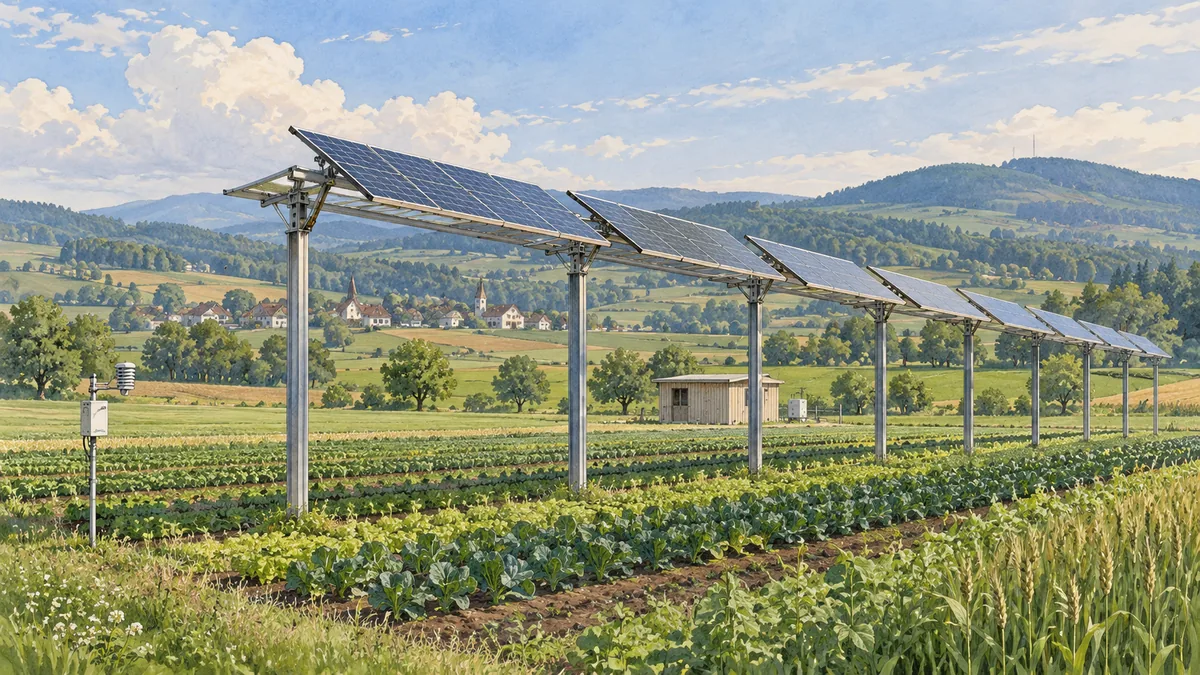
Axpo is building a solar plant in Suhr The planned capacity is 600 kWp The modules will occupy 1,2 hectares out of 2,8 FiBL will study crops, water
Context
TL;DR
- Axpo is building a solar installation in Suhr
- The planned capacity is 600 kWp
- The modules will occupy 1,2 hectares out of 2,8
- FiBL will study crops, water and biodiversity
Key facts
- Location → Suhr, canton of Aargau
- Power → 600 kilowatts peak (kWp)
- Experimental area → 2,8 hectares
- Modules → 1,2 hectares, approximately three metres, adjustable according to the season
- Energy → Emmi will purchase it all and use it in Suhr
Axpo has begun construction in Suhr, in the canton of Aargau, of a solar plant on arable land. The project has a precise objective: to show whether agricultural use and electricity production can coexist on the same area.
An area divided between energy and agriculture
The plant will have a power output of 600 kilowatts peak, indicated by the abbreviation kWp. The experimental area measures 2,8 hectares, but the modules will be installed on 1,2 hectares. They will be positioned approximately three metres above the ground and can be oriented according to the season.
The area underneath will not be taken away from cultivation: it will continue to be used for agriculture. This is the operational focus of the experiment, because the project maintains both the productive function of the field and the energy function of the modules in the same space.
The comparison entrusted to FiBL
Axpo, the canton of Aargau and FiBL, the Research Institute of Organic Agriculture based in Frick, are collaborating on the project. The institute will assess the effects of the modules on yields, water balance and biodiversity.
The results from the area equipped with the modules will be compared with those obtained in a nearby field without panels. Emmi will purchase all the solar energy generated and use it directly at its plant in Suhr.
Axpo will be responsible for both the construction and operation of the plant; the farmer who already managed the field will continue to cultivate it. FiBL will handle the field research, Axpo the technical aspects, the farmer the cultivation and Emmi the use of the electricity. In Suhr, the project thus brings cultivation, business activity and electricity generation together on the same area.
Operational details
The practical value of the project lies not only in the 600 kWp. It lies in the fact that the same area is being studied as an agricultural field and as a surface for solar modules. For those following energy transformations in Switzerland, the question remains concrete: how do crops, water balance and biodiversity change when modules are installed above part of the land?
Three indicators, one comparison
| Indicator | What the trial involves |
|---|---|
| Yields | Study of the influence of the modules on yields |
| Water balance | Verification of the influence of the modules on the water balance |
| Biodiversity | Observation of the influence of the modules on biodiversity |
The nearby field without modules serves as a benchmark. This makes it possible, in terms of the experimental design, to separate the effects of the presence of the modules from those linked to cultivation. However, it does not anticipate the result: the project indicates which aspects will be studied, not what the outcome will be.
The distribution of the surfaces is also a fact to be read carefully. The modules cover 1,2 hectares of the total 2,8; the surface beneath them remains agricultural. The experiment therefore does not describe a complete replacement of the field with panels, but a coexistence to be observed through data on yields, water and biodiversity. The possibility of orienting the modules depending on the season is another variable stated by the project.
At the industrial level, the electricity already has a recipient: Emmi will purchase all of it and use it directly at the Suhr plant. The chain is also clear in terms of responsibilities: Axpo builds and manages, the farmer continues to cultivate, and FiBL studies the effects. These are useful elements for following any updates without confusing production, research and use of the energy.
For an overview of everyday expenses in Switzerland, one can consult costo della vita in Svizzera. calcolatore stipendio, on the other hand, concerns the individual situation and does not replace the data that will be collected in the field.
Recommended tools
For an updated estimate, use the net salary calculator and the CHF-EUR exchange comparator.
Useful tools to protect your net income
To reduce FX leakage, compare CHF-EUR exchange options and banks for cross-border workers.
Key points
To follow the construction without confusing power, agriculture and research, the reader can use a reading procedure based on the data communicated for Suhr. There is no need to turn the project into a forecast: it is best to check, point by point, what is measured and who has which responsibility.
Five checks for reading updates
1. Locate the experiment. The reference is Suhr, in the canton of Aargau, and the total area measures 2.8 hectares. This establishes the scale of the project. 2. Separate the areas. The modules are planned over 1.2 hectares, while the underlying area continues to be used for agriculture. This data avoids confusing the experimental area with the equipped area. 3. Verify the module arrangement. The installation is planned at approximately three metres in height, and the orientation may change according to the season. These are the physical characteristics declared for the trial. 4. Look for the three results observed by FiBL: yields, water balance and biodiversity. The comparison should be read together with the data from the nearby field without solar modules. 5. Correctly assign the tasks. Axpo builds and manages the installation; FiBL conducts the study; the farmer continues to cultivate the land, and Emmi purchases all the energy to use at the Suhr facility.
This sequence makes it possible to read any update using a simple framework. Data on power concerns the expected electricity production; data on yields, on the other hand, concerns the continuation of agricultural use. The water balance and biodiversity complete the environmental part of the research, while the field without modules provides the comparison indicated by the project.
Construction has already begun, but the available text mainly describes the trial setup and the distribution of roles. Therefore, anyone following the news should keep three aspects separate: the structure of the installation, cultivation beneath the modules and FiBL's comparative study. The destination of the energy should also be considered separately: the indicated buyer is Emmi, and the energy is used directly at the Suhr facility.
To deepen your own economic outlook in Switzerland, use the calcolatore stipendio.
Source: swissinfo.ch
Frequently Asked Questions
- Where is Axpo's solar plant being built?
- The facility will be built in Suhr, in the canton of Aargau, on an experimental area of 2,8 hectares. The solar modules will cover 1,2 hectares, will be installed at about three meters and can be oriented according to the season. The underlying land will continue to be used for agriculture.
- What will FiBL study?
- FiBL will study the influence of the solar modules on yields, water balance and biodiversity. The results will be compared with those from a nearby field without solar modules. The comparison is part of the experimental design chosen to verify the coexistence of agricultural use and electricity production.
- Who will manage the plant and who will use the energy?
- Axpo will be responsible for the construction and operation of the plant. The farmer who managed the field will continue to cultivate the land. Emmi will purchase all of the solar energy produced and use it directly at its facility in Suhr. The project is being carried out together with the canton of Aargau and FiBL.