AI and semiconductors drive trade, WTO revises growth
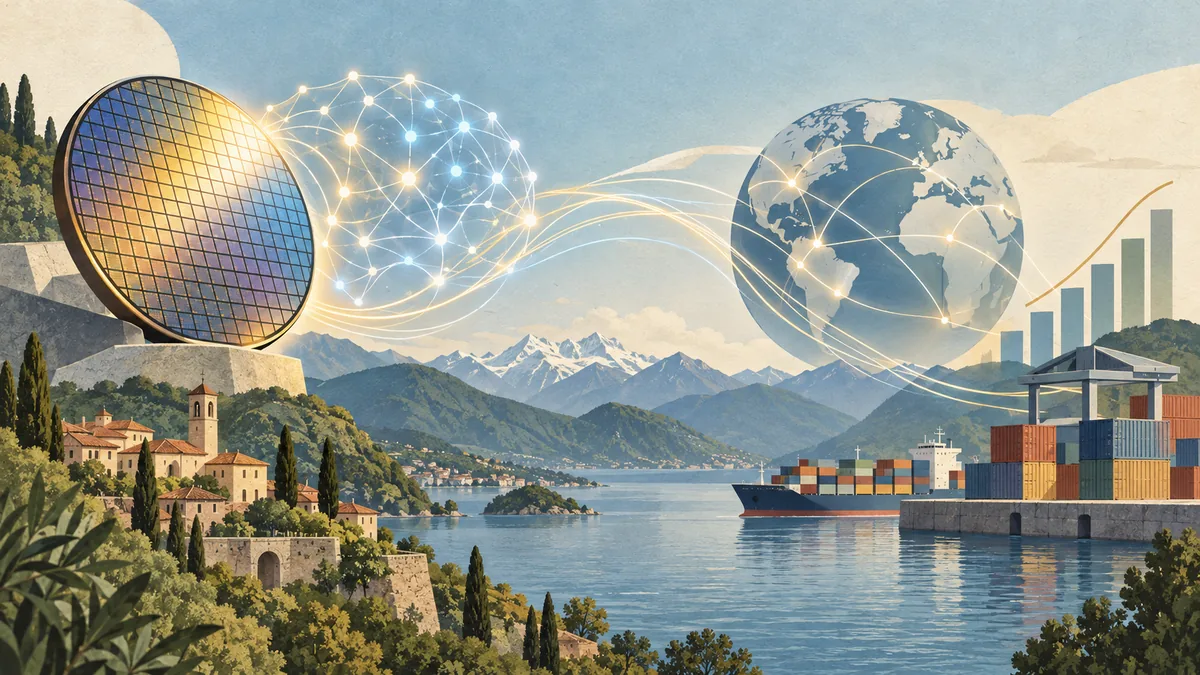
Semiconduttori e server: commercio in crescita del 67%
Context
TL;DR
- Semiconductors and servers: trade up 67%
- AI fueled 47% of global growth
- WTO estimate: from 1,9% to 3,9% for the year
- World trade forecast to grow 4,1% in 2027
Key facts
- AI-related goods → semiconductors and servers
- Trade in these goods → 67% compared with the same period in 2025
- Share of global growth → 47%
- WTO forecast → from 1,9% to 3,9%
- First six months of 2026 → merchandise trade grew by 3,5%
- Energy → oil -24%; liquefied natural gas -47%; global decline of 6% and 1%
- AI investment in 2027 → growth of at least 30%
- 2027 forecasts → trade 4,1%; GDP 2,6% this year and 2,9% next year
WTO updates the forecast
Trade in artificial intelligence-related goods recorded a 67% increase this year compared with the corresponding period in 2025. Semiconductors and servers contributed 47% of the expansion of the global market, prompting the World Trade Organization (WTO), based in Geneva, to raise its annual growth forecast from 1,9% to 3,9%.
Director-General Ngozi Okonjo-Iweala outlined the revision in a note released on Thursday. She acknowledged the multilateral trading system's ability to adapt to turbulence, while warning that the shock had hit some countries harder than others.
From the trade surprise to energy
Merchandise trade grew by 3,5% in the first six months of 2026, exceeding expectations set in March. Chief economist Robert Staiger attributed the figure to the resilience of trade despite the war in the Middle East.
“We were surprised that the war in the Middle East did not reduce global trade as much as we thought,” said chief economist Robert Staiger.
The energy trend was different: exports of crude oil from the Middle East fell by 24%, while those of liquefied natural gas declined by 47%. Thanks to increased supplies from other regions, the global decline remained at 6% and 1%, respectively.
The main driver remains artificial intelligence. Staiger said that the increase in trade in semiconductors and servers was greater than expected: a figure below 30% had been expected. For 2027, investment in AI infrastructure is expected to grow by at least 30%. Okonjo-Iweala nevertheless deplored the fact that access to these technologies is not equal for all states.
Regional prospects diverge: Asian exports are expected to post the largest increase, at 9,9%, ahead of those from the northern part of the American continent and Africa. Europe is expected to see a decline of 0,1%, while the Middle East could suffer a contraction of almost 18%.
Operational details
From the global forecast to a Swiss perspective
For those who live or work in Switzerland, the explicit connection in the news is the WTO's Geneva headquarters. However, the source does not provide a figure for Switzerland: it discusses the global market, energy supplies from the Middle East, exporting regions and GDP prospects. The figure must therefore be read as an international indicator, not as an automatic change in salary, the cost of living or employment in the country.
Three distinctions to keep in mind
The first concerns timing. The 3,5% describes the first six months of 2026; the 4,1% is a WTO forecast for world trade in 2027. The revision from 1,9% to 3,9%, on the other hand, concerns the estimate for the year. Putting these values on the same footing would produce an incorrect comparison between an already recorded figure and a forecast.
The second concerns the subject. The 67% measures the increase in trade in AI-related goods, while the 47% indicates how much that dynamic fueled growth in the global market. The 3,5% concerns trade in goods as a whole. These are related indicators, but not interchangeable.
| Interpretation | Source data | Limitation for the Swiss public |
|---|---|---|
| Time horizon | 3,5% in the first six months of 2026 | not a Swiss figure |
| Forecast | 4,1% growth in world trade in 2027 | not a forecast for the cantons |
| Regions | Asia 9,9%; Europe contraction of 0,1%; Middle East nearly 18% decline | not a breakdown of Swiss exports |
The third concerns geography. Asia, Europe and the Middle East have different prospects; the source does not translate those figures into Swiss exports. It does not report a decision by the Federal Council or the cantons, nor data from SECO, UST/BFS or BNS/SNB. It does not announce changes to the cost of living. For this reason, the note does not allow an effect on taxes, incomes or daily expenses to be inferred.
For a personal check, comparison with costo della vita in Svizzera can be a separate step: it does not replace WTO data and does not derive from them a figure for a salary or a family.
Useful tools to protect your net income
To reduce FX leakage, compare CHF-EUR exchange options and banks for cross-border workers.
Key points
How to read and use the note
The most solid procedure for a Swiss reader is to separate the information into four steps, without turning a global forecast into a national announcement.
Four practical steps
1. Set the period. Mark separately the comparison of AI-related trade with the same period in 2025, the first six months of 2026, and the forecasts for 2027. The note presents results and expectations: keeping them distinct prevents an assumption from being read as an already-acquired result.
2. Classify the indicator. Place AI-related goods, merchandise trade, energy, investment in AI infrastructure, regional exports, and GDP into different categories. Percentages referring to different things should neither be added nor compared without indicating what they refer to.
3. Check the geography. A value for the global market, a decline in the Middle East, or growth in Asia does not automatically describe Switzerland. The text mentions Geneva as the headquarters of the WTO, but does not provide a Swiss series to substitute for the global or regional data.
4. Separate source and decision. Attribute the revision to the WTO, the surprise at the resilience of trade to Robert Staiger, and the assessment of access to technologies to Ngozi Okonjo-Iweala. Statements relating to 2027 should be marked as forecasts.
After this verification, the general picture can be compared with one's own situation. busta paga svizzera helps read the income already indicated, while costo della vita in Svizzera offers a separate comparison; neither tool changes the WTO's percentages.
The final step is to relate the comparison to one's own income and taxes with calcolatore stipendio/imposte.
Source: rsi.ch
Frequently Asked Questions
- What was the increase in trade in artificial intelligence-related goods in the first half of 2026 compared with the same period in 2025?
- According to the WTO note, trade in AI-related goods increased by 67% in the first half of 2026 compared with the same period in 2025. This increase was driven mainly by semiconductors and servers, which were the driving force behind the growth observed in the global technology sector.
- By how much did the WTO revise its forecast for world trade growth for the current year?
- The World Trade Organization raised its forecast for global trade growth from 1.9% to 3.9%. The revision was announced by Director-General Ngozi Okonjo-Iweala and reflects the positive impact of trade in AI goods on the international economy.
- What are the WTO's forecasts for world trade and GDP in 2027?
- For 2027, the WTO forecasts global trade growth of 4.1%. Regarding gross domestic product, the organization estimates an increase of 2.6% for the current year (2026) and 2.9% for the following year (2027). These outlooks are presented together with forecasts for regional exports and investment in AI infrastructure.