Lucerne, quality and school development closer together
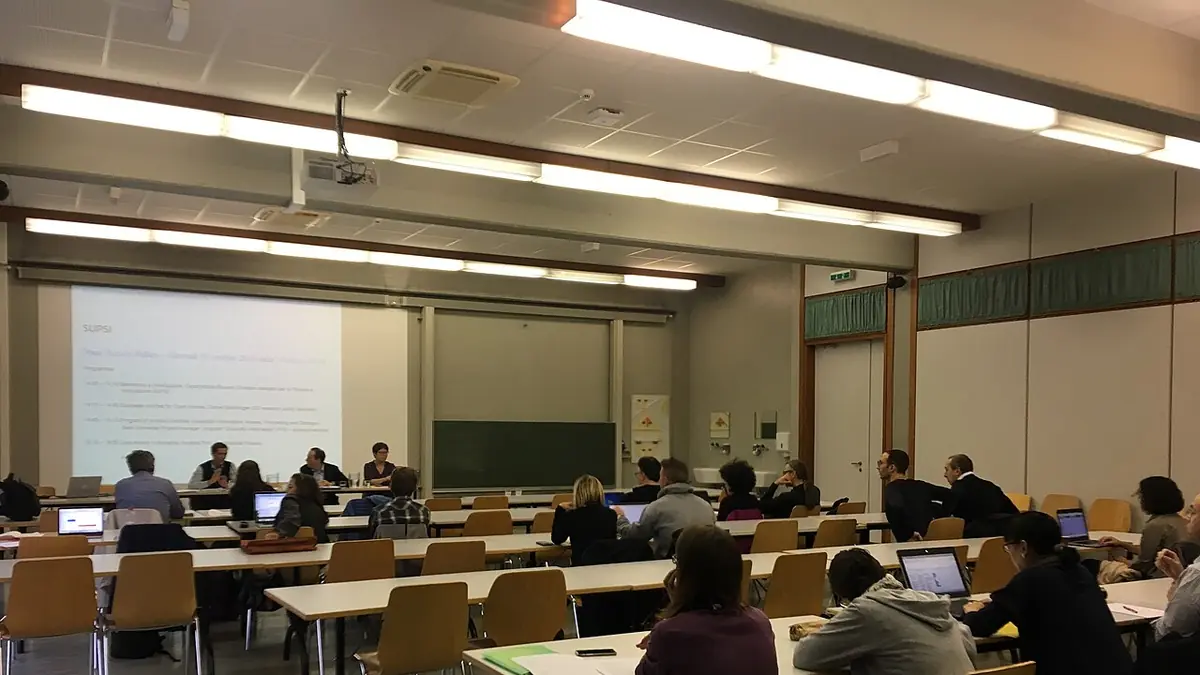
Lucerne’s grammar schools review the QM framework: the 2026/27 school year will serve to put the link with school and teaching development into practice.
Context
TL;DR
- Lucerne's upper-secondary schools revise the QM framework
- The conference took place on August 27 and 28, 2026
- The 2026/27 school year lays the groundwork for possible pilot projects
- The focus is the link between quality and school development
Key facts
- Project → revision of the QM conceptual framework
- Conference → August 27 and 28, 2026
- Represented groups → Gymnasialbildung, school leadership and teaching staff
- Next phase → 2026/27 school year
On August 27 and 28, 2026, the conference of the quality managers of Lucerne’s grammar schools focused on the revision of the QM conceptual framework, referred to in the project by the title «Überarbeitung QM-Rahmenkonzept». The starting question was how to link school and teaching development more closely with quality management.
The conference was prepared and held by the project’s development group. The Dienststelle Gymnasialbildung, school leadership and teaching staff were represented within it; the work also received external support. The group thus brought together representatives of gymnasial education, schools and teachers, with the external support indicated in the source.
The stated objective of the revision is a closer connection between pedagogical practice, school development and quality work. To achieve this, the project focuses on integrated, topic-oriented quality development and assurance, based on elements already known from the concept of quality management. The source does not present the project as an isolated modification of the QM system: it describes it as an attempt to strengthen the connection between these areas.
The transition to 2026/27
During the meeting, the topic was addressed in groups made up of representatives from several schools and in groups within the individual schools. Each school examined a development project already underway. This links the overall revision to the concrete work that the schools had already begun, without indicating what the individual projects were.
The next temporal reference is the 2026/27 school year. For the schools, this phase will serve to make the connection between school development, teaching development and quality management more concrete; possible pilot projects are planned for the same period. The report does not indicate how many there will be, which schools will host them or what results they will be required to produce.
For those who live or work in the Canton of Lucerne, the source therefore offers a schedule of the work within the grammar schools. It does not cover taxes, salaries or insurance and does not report financial figures; for a separate salary calculation, calcolatore stipendio can be consulted.
Operational details
What the new approach means
The practical implications described by the source are primarily organizational. The QM framework is being revised to bring three elements into dialogue: pedagogical practice, school development, and work on quality. The source does not announce a single measure already implemented in all upper-secondary schools; instead, it describes work that combines exchange among schools, internal analysis, and external support.
The starting point identified by the source is the development project already under way at each institution. This gives rise to a useful distinction for understanding the next steps. On the one hand, there is the common level, where representatives of several schools address the same topic; on the other, there is the internal level, where each school links its own project to the future quality framework. The source does not say that the projects are identical, nor does it describe their contents.
What is already defined and what remains open
The role of the 2026/27 school year is defined: to make concrete the link between school and teaching development and quality management and, where appropriate, to carry out pilot projects. The operational details, however, remain open in the available text: the number of pilot projects, a ranking, a monthly schedule, indicators, expected results, or a procedure for the public are not specified. However, the available text contains no indication that describes the announcement as the entry into force of a new service or a new obligation.
For teachers, school leaderships, and the offices involved, the information to follow is the link between the project already under way and the revised QM framework concept. For other readers, the distinction prevents confusing a development phase with a final decision: the source speaks of making things concrete and of possible pilot projects, not of a model already applied everywhere.
Financial aspects also remain outside the scope of the report. Salaries, allowances, or costs for families are not specified; anyone wishing to examine a Swiss payslip separately can use the guide to busta paga svizzera.
Recommended tools
For an updated estimate, use the net salary calculator and the CHF-EUR exchange comparator.
Useful tools to protect your net income
To reduce FX leakage, compare CHF-EUR exchange options and banks for cross-border workers.
Key points
How to follow the process
To correctly read the upcoming updates, the first step is to establish the specified period: the 2026/27 school year. This is the phase in which schools will need to make concrete the link between school development, teaching development and quality management, with the possibility of working on pilot projects. The source does not provide a more precise date within that year.
A four-step check
1. Distinguish the general project from the individual school project. The review concerns the QM-Rahmenkonzept; each school, however, has examined its own development project already underway. 2. Look for the reference to the three connected areas: pedagogical practice, school development and quality work. These are the elements explicitly identified as the objective of the review. 3. Check whether the update refers to work between multiple schools, internal activities or external support. The conference used all these forms of work, but the source does not assign them a separate schedule. 4. Do not attribute to the pilots details that have not been published in the available text. The number of projects, the schools involved, the content and the expected results remain unspecified.
For each subsequent communication, three questions can be noted: does it concern the review of the framework, the development project of the individual school or a possible pilot? The source keeps these levels distinct: the framework is under review, each school has an ongoing project and the 2026/27 year is intended for implementation and possible tests. If a communication does not clarify the level, the available text does not allow it to be completed with details of one's own.
Those who work in Lucerne's grammar schools or follow their development can use this distinction to interpret future communications without confusing the review phase with the application of a definitive model. Those instead looking for tax or salary data will not find them in this news item: the text concerns school quality and teaching development, not amounts or contribution procedures.
The project development group, Dienststelle Gymnasialbildung, the school leaderships and the teaching staff are the representatives mentioned in the source; no public contact address, form or document to submit is indicated. For a separate in-depth look at earned income in Switzerland, use calcolatore stipendio.
Source: nau.ch
Frequently Asked Questions
- What did the Lucerne grammar schools discuss on August 27 and 28, 2026?
- The conference of quality managers discussed the revision of the QM conceptual framework, referred to as "Überarbeitung QM-Rahmenkonzept". The central question concerned how to more closely link school development, teaching development and quality management. The meeting was prepared and conducted by the project development team, with representatives of the Dienststelle Gymnasialbildung, the directorates and the teachers, as well as external accompaniment.
- What is the objective of the review of the QM framework?
- The stated aim is to integrate more pedagogical practice, school development and quality work. The project provides for an integrated and theme-focused development and quality assurance, oriented to known elements of the quality management concept. At the conference, the theme was addressed both in compositions between several schools and within individual schools.
- What will happen in the 2026/27 school year?
- Schools will use 2026/27 to realise the link between school development, teaching development and quality management. During this period, any pilot projects are planned. The source does not indicate their number, the schools involved, the contents, a more precise calendar or the expected results. However, each school has already reviewed its own ongoing development project.