Strengthened Controls at Chiasso-Brogeda: Border Security in Ticino (cross-border guide)
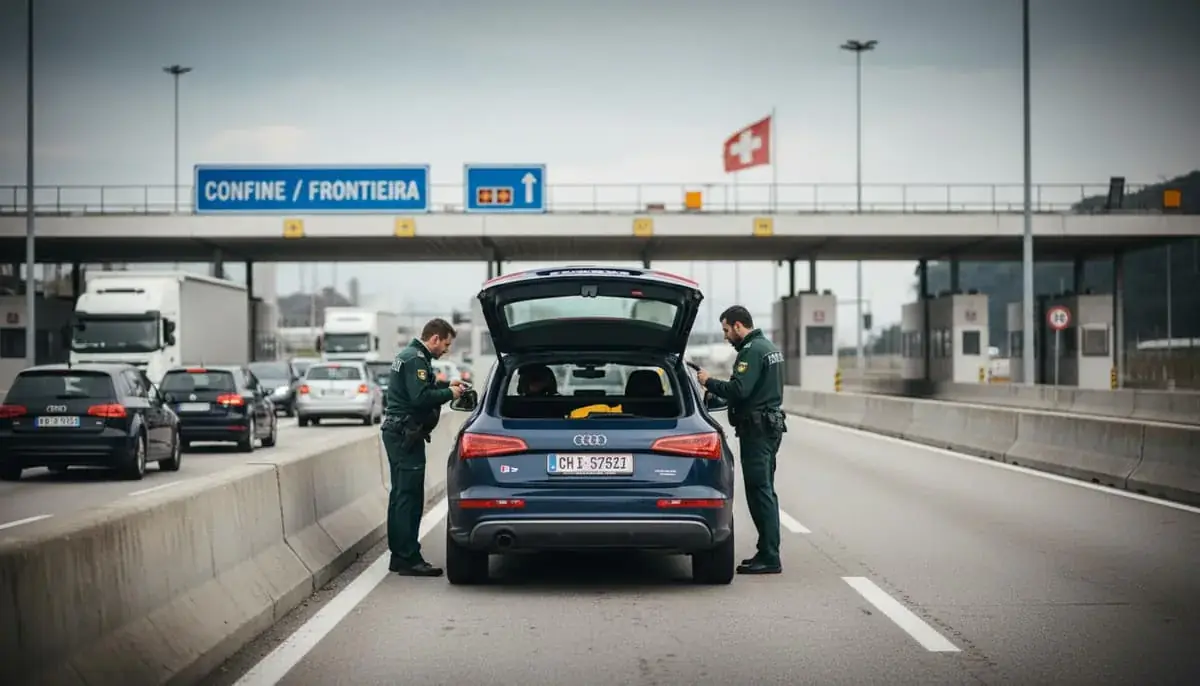
A Turkish-Moroccan couple was stopped at Chiasso-Brogeda with over 5 kg of heroin, highlighting the constant vigilance of border authorities protecting Ticino.
Context
TL;DR
- Turkish-Moroccan couple arrested at Chiasso-Brogeda with 5kg heroin
- Heroin hidden in false bottom under seat
- Arrests highlight constant border control efforts
Key facts
- Cosa: Arrest of Turkish-Moroccan couple for heroin trafficking
- Quando: Late February 2026
- Dove: Chiasso-Brogeda motorway crossing, Ticino
- Chi: 51-year-old Moroccan driver and 28-year-old Turkish woman
- Importo: Over five kilograms of heroin
- Scadenza: Detention at 'Bassone' prison in Como
- Regole: Declaration of amounts equal to or exceeding 10,000 Swiss francs
- Data notizia: February 27, 2026
The news of a Turkish-Moroccan couple being stopped at the Chiasso-Brogeda motorway crossing, with a load of over five kilograms of heroin cleverly hidden in a false bottom under a seat, is not just a simple local news item. It's a tangible reminder of the constant and meticulous control activity that the Guardia di Finanza (Italian Financial Police) and the Swiss Federal Office for Customs and Border Security (FOCBS) carry out daily on one of Europe's busiest arteries, crucial for thousands of cross-border commuters.
…
Operational details
The arrest of the Turkish-Moroccan couple at Chiasso-Brogeda, on charges of international drug trafficking and their subsequent detention at the 'Bassone' prison in Como, highlights the serious legal implications that can arise from cross-border infractions. For cross-border commuters, although drug trafficking is an extreme event far removed from their daily lives, the episode serves as a reminder of the severity and pervasiveness of customs controls and the consequences of any violation, even less serious ones, of current regulations.
…
Key points
The Chiasso-Brogeda incident, while dramatic, offers concrete insights for the thousands of cross-border commuters who daily cross the Ticino border. The main lesson is the importance of awareness and diligence. Every vehicle, every person, is potentially subject to controls, and carelessness can be costly, even without illicit intentions. It is advisable to adopt a series of precautions to ensure a smooth and trouble-free transit, avoiding situations that could generate suspicion and delays.
💡 Practical Tips for Cross-Border Commuters:
…
What this page covers
Strengthened Controls at Chiasso-Brogeda: Border Security in Ticino is presented here as a practical resource rather than a thin summary. A Turkish-Moroccan couple was stopped at Chiasso-Brogeda with over 5 kg of heroin, highlighting the constant vigilance of border authorities protecting Ticino. The static SEO content adds the missing context users need to understand who is affected, what may change in practice, and why the topic matters for people living in Italy and working in Ticino.
Many visits start from Google, not from the homepage, so the page needs enough substance on first load to explain the scenario clearly. That means giving readers more than a short excerpt: it should show the business, tax, salary, and day-to-day implications that normally drive real decisions for cross-border workers.
Why this matters
For cross-border workers, a single update often sits at the intersection of several systems: Swiss payroll rules, Italian tax consequences, commuting costs, health coverage, and administrative deadlines. Relevant themes on this page include brogeda, chiasso, controls, security, strengthened, authorities. Without that wider framing, a page can look too thin even when the topic itself is important.
This page therefore expands the intent behind the article: what changed, why readers should care, which profiles are most exposed, and what additional checks are worth running before acting on the information. That improves both user comprehension and the page's search quality signals.
What to verify now
A useful first step is to compare the article with your own profile: place of residence, job location, old or new frontier-worker tax regime, family situation, salary level, and any remote-work arrangement. Small differences in those inputs can produce very different outcomes, especially on net income and compliance.
It is also worth validating the topic against the calculators, guides, and job pages linked across Frontaliere Ticino. When readers connect the article to real numbers such as withholding tax, IRPEF top-up, insurance costs, exchange-rate exposure, or commuting expenses, they can tell whether the update is informational or requires action.
Practical impact for cross-border workers
The practical value of an article for this audience is not just the headline. What matters is the likely effect on monthly cash flow, annual planning, documents to prepare, and choices about salary, insurance, work arrangement, or relocation. The page is structured to keep that practical lens visible from the start.
If the topic creates downstream questions around deadlines, forms, deductions, hiring, or policy changes, readers should not have to leave with only a vague summary. This static content is designed to bridge that gap and make the page useful enough to stand on its own while still connecting naturally to deeper tools and guides.
Useful next steps
The best next step is to use the linked calculators, guides, FAQs, and job search pages to test the topic against your exact case. That turns a single article into a practical decision flow, which is the core value users expect from Frontaliere Ticino.
If you have specific questions about how this topic affects your personal situation — salary, taxation, health insurance, pension planning, or transport — the platform's interactive calculators can give you precise quantitative answers using official 2026 fiscal parameters, without the need for external consultations.
Frequently Asked Questions
- What happens if I exceed the limits on importing cash between Switzerland and Italy without declaring?
- Exceeding the limits (10,000 francs or equivalent) without declaring can lead to administrative penalties, hefty fines and criminal prosecution for money laundering, even without criminal intent.
- What is the limit on the import of tobacco between Switzerland and Italy for a cross-border commuter?
- The tobacco import limit varies, but generally for a cross-border commuter who is not a professional importer, it is recommended not to exceed 800 cigarettes or 400 cigarillos per month for personal use, without having to declare. However, it is always advisable to check the latest updates on the websites of the Swiss FOCBS and the Italian Customs Agency.
- What are the alcohol import limits for a cross-border commuter between Switzerland and Italy?
- Up to 1 litre of wine, 0.5 litres of strong spirits or 5 litres of beer per person are allowed to be imported into Switzerland, provided that the total value does not exceed 10,000 francs. Beyond these thresholds, it is mandatory to declare the product and you risk a fine of up to 20% of the excess value.
- What should I do if I am stopped for a customs check at the Chiasso border crossing?
- During a check at the Chiasso border crossing, customs personnel may ask to see your identity documents, work permit, registration certificate and vehicle insurance. It is advisable to cooperate, open the trunk and declare any valuable goods. In the event of refusal or hostile behavior, you may be subject to prolonged detention and an administrative sanction.
- What penalties does a cross-border commuter risk if he transports unauthorised meat across the border?
- The transport of undeclared fresh or processed meat is prohibited for health reasons. If a cross-border commuter is caught with meat over the permitted quotas (e.g. 1 kg of fresh meat for personal use), the goods are seized and a fine of up to 30% of the commercial value is applied, as well as possible criminal penalties for violation of phytosanitary regulations.