Public transport posts record revenue: what's next for commuters? (cross-border guide)
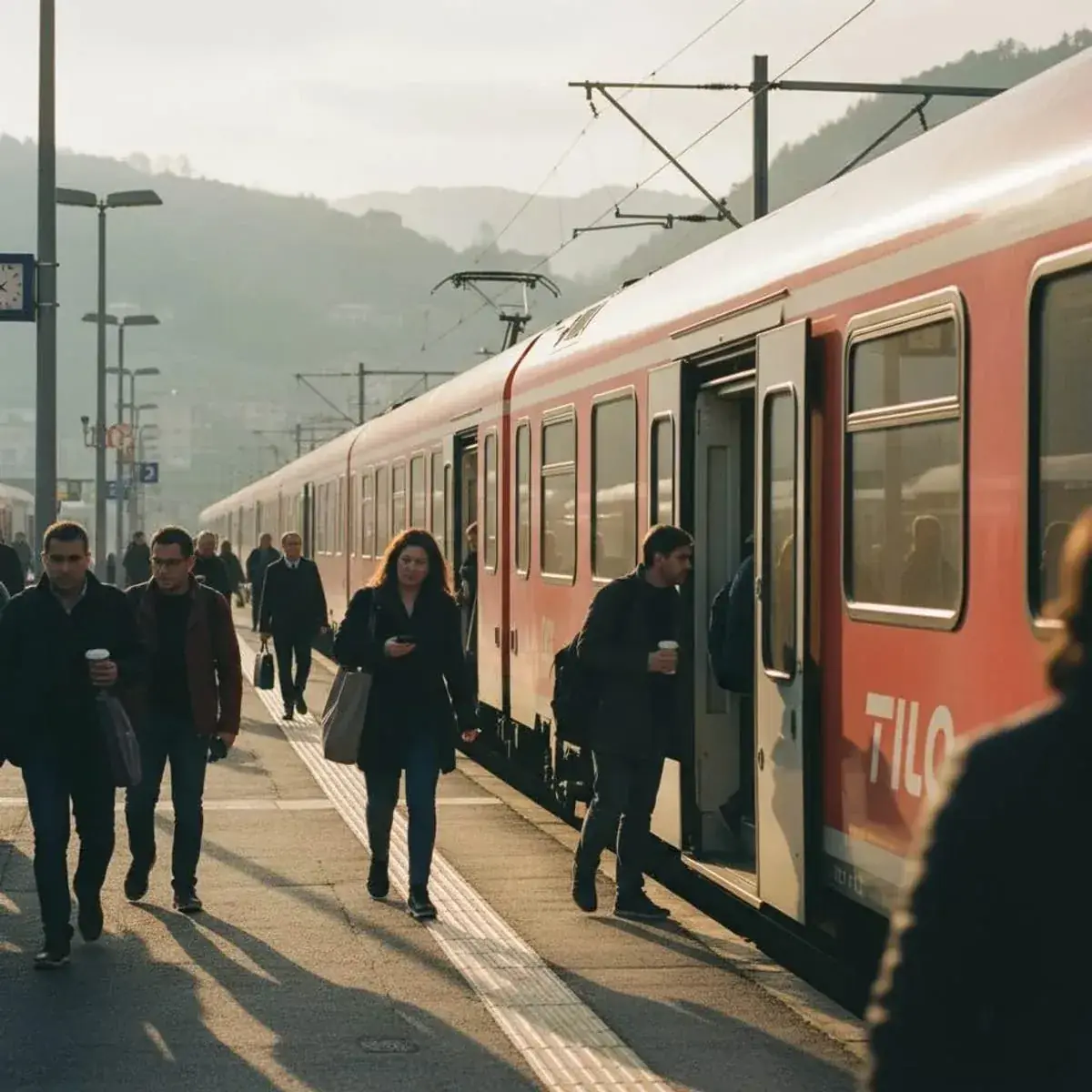
Revenue for Swiss public transport exceeds 7 billion francs. An analysis of the impact on cross-border workers in Ticino: from pass costs to crowding on TILO trains.
Context
TL;DR
- Swiss public transport revenue up 4.6% to 7.04 billion francs.
- 295 million tickets sold, 71% individual, 31% revenue from them.
- General Abonnement (GA) travelcard generates 20% of total revenue.
- Regional fare communities contribute over 2.5 billion to total revenue.
Key facts
- Revenue increase: 4.6% increase to 7.04 billion francs.
- Tickets sold: 295 million transport tickets sold.
- Individual tickets: 71% of tickets sold, 31% of revenue.
- General Abonnement: Generates 20% of total revenue.
- Regional fare communities: Contribute over 2.5 billion to total revenue.
- Cross-border workers: Thousands cross borders daily, contributing to growth.
- Overcrowding: TILO lines often at capacity during peak hours.
- Future prospects: Debate on fare adjustments and infrastructure investments.
The public transport sector in Switzerland is running at full steam. Data released Tuesday by Alliance SwissPass is clear: revenue reached 7.04 billion francs, a 4.6% increase over the previous year. This is a sign of excellent health, fueled by the sale of 295 million transport tickets. Of this impressive figure, 4.46 billion comes from the national Direct Service, while 2.58 billion is generated by regional fare communities, such as our own Arcobaleno in Ticino.
…
Operational details
Single tickets, Arcobaleno or GA? The cross-border worker's dilemma
The increase in demand presents commuters with a strategic choice. While single tickets dominate in terms of the number of transactions, for a cross-border worker traveling daily between Lombardy and Ticino, a travel pass remains the most logical solution.
The success of regional fare communities, which contribute over 2.5 billion to total revenue, highlights the key role of products like the Arcobaleno pass. This tool is specifically designed for those who travel within a defined area, offering a fixed and predictable cost. Its popularity is one of the driving forces behind the growth recorded at the national level.
📊 Revenue breakdown:
- Individual tickets: ~31%
- General Abonnement (GA): ~20%
- Community and daily passes: the remaining share
The increase in passengers, while positive for the finances of transport companies, has a downside: overcrowding. The TILO lines, particularly the S10 (Bellinzona-Chiasso-Como) and S50 (Bellinzona-Lugano-Varese), are often at capacity during peak hours. This constant growth in users makes investments in infrastructure and rolling stock even more urgent to ensure an efficient and comfortable service, a crucial challenge for the future of cross-border mobility.
Key points
More passengers: what are the prospects for fares and services?
A financially healthy sector like Swiss public transport opens up two opposing scenarios. On one hand, higher revenues could translate into new investments to upgrade lines, increase train frequency, and improve comfort. On the other, such strong demand could justify future fare adjustments in the eyes of operators. The debate on the cost of public transport in Switzerland is always very heated, and this data will certainly add fuel to the fire.
For the cross-border worker, the choice of transport remains a complex economic and logistical equation. The car offers flexibility but involves costs for fuel, maintenance, road tax, and insurance, not to mention the time lost in congested traffic near the border crossings. The train, on the other hand, offers a more predictable cost but requires adapting to schedules and potential overcrowding.
💡 Practical advice: It is essential to periodically analyze your travel costs. Don't just look at the price of the pass: consider all the factors involved. Sometimes, a mix of solutions (e.g., car to the border and then train) can be the best choice. To objectively compare the real costs between using a private car and a public transport pass, you can use our commuter transport calculator. This tool will help you make an informed decision based on your routes and habits.
Source: RSI, 11.07.2024
Frequently Asked Questions
- What is the total turnover achieved by the public transport sector in Switzerland and what is the contribution of regional tariff communities?
- The total turnover is 7.04 billion francs, an increase of 4.6% compared to the previous year. Regional tariff communities, such as Arcobaleno, contribute to more than CHF 2,58 billion.
- What is the impact of overcrowding in TILO trains on investment prospects for infrastructure?
- Overcrowding increases the urgency of investments in infrastructure and rolling stock to ensure efficiency and comfort, representing a crucial challenge for the future of cross-border mobility.
- How can I check if the Arcobaleno subscription is more convenient than the single ticket for my daily trips between Ticino and Lombardy?
- You can use the commuter transport calculator on nav:transport, by entering your usual routes. The AG Arcobaleno costs about 300-400 francs per month, but offers discounted fares on regional trains and buses. For those who travel often, the average savings is 30-40% compared to individual tickets.
- What are the tax advantages for border guards using public transport subscriptions in Switzerland?
- The general subscription (AG) to Swiss public transport is deductible from taxes up to a maximum of CHF 3,000 per year. For border guards, this deduction reduces the tax burden, especially if you opt for solutions like AG or Arcobaleno, which also cover cross-border routes.
- What is the risk of overcrowding on TILO trains and how does it affect the choice of travel time?
- The S10 and S50 lines are often at the limit of capacity in peak hours (7:00-9:00 and 17:00-19:00). The trains of 17:30 are the most crowded. In order to avoid discomfort, borderers can opt for less frequent trains, such as those of 6:00-7:00 or after 20:00, with a reduction of the risk of finding seats.