Varese: mushroom guide to reduce accidents in the woods
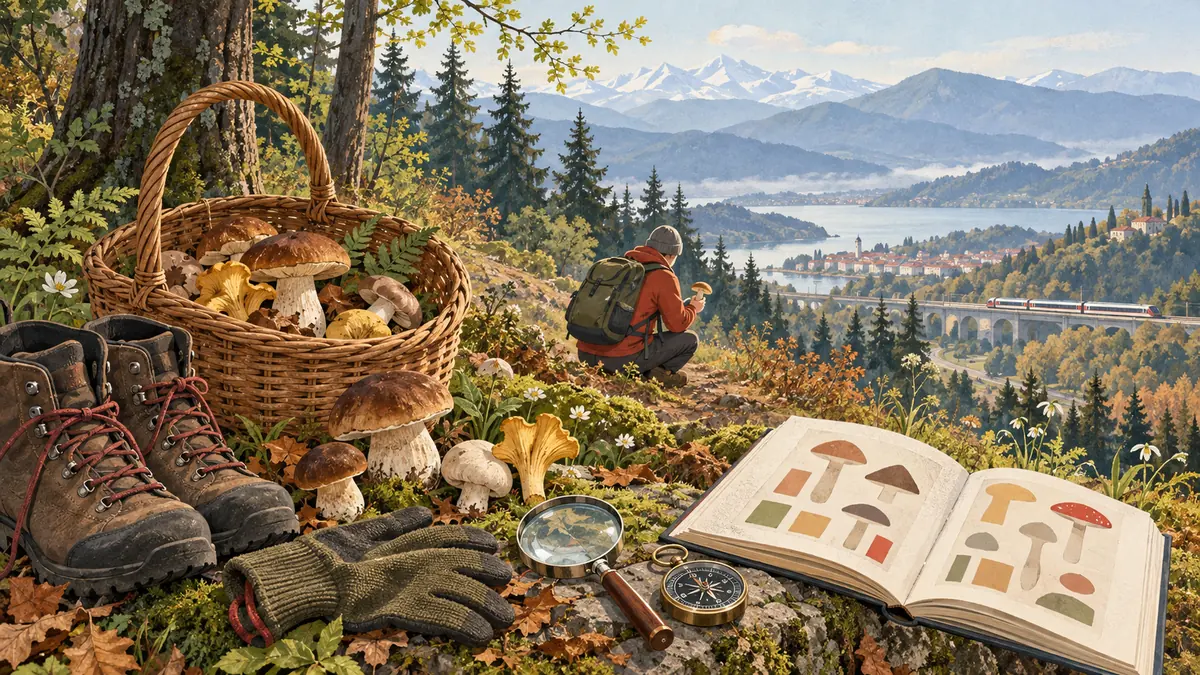
The Prefect urges a campaign on the risks in the woods The handbook is entitled «Safe Mushroom Hunting» The request involves Municipalities, schools, Communities
Context
TL;DR
- The Prefect calls for a campaign on risks in the woods
- The handbook is titled «Safe mushroom foraging»
- The request involves municipalities, schools, Mountain Communities and ATS
- CNSAS sets out rules for preparation and self-protection
Key facts
- Promoter → Prefect of Varese Salvatore Pasquariello
- Measure → circular for an awareness campaign
- Vademecum → «Safe to look for mushrooms»
- Elaboration → National Alpine and Speleological Rescue Corps (CNSAS)
- Recipients → Mayors, President of the Province, Territorial School Office, Mountain Communities and ATS Insubria
The Prefect of Varese, Salvatore Pasquariello, sent a circular to the Mayors, the President of the Province, the Territorial School Office, the Mountain Communities and the ATS Insubria, inviting them to start an awareness campaign covering the entire province of Varese without delay.
The initiative is linked to the increase in injuries and deaths in the Varese area. The communication indicates as its objective the fight against the succession of accidents and injuries with tragic consequences in the woods and mountains of the province. To achieve this, the Prefecture invites institutions to widely distribute the handbook "Safe to look for mushrooms", developed by the National Alpine and Speleological Rescue Corps, the CNSAS.
The document collects rules and good practices to be adopted before entering the vegetation. Its content therefore concerns both the preparation of the exit and the behavior to be followed during searches, with specific attention to self-protection in impervious, uncomfortable and often isolated environments.
An institutional network across the territory
The circular lines up the subjects called upon to support the diffusion of the message. Mayors are asked to inform citizens directly. The involvement of the Territorial School Office brings the campaign to schools, while the Mountain Communities and the President of the Province are part of the territorial network indicated by the Prefect.
Students are assigned the role of "educational vehicle" towards families and the elderly. The choice broadens the audience of the handbook beyond those who usually frequent the woods and entrusts the school with the task of transmitting safety instructions.
The ATS Insubria staff and mycologists are instead called to dialogue with citizens on the edibility of mushrooms and on the self-protection to be adopted during research. The campaign thus combines the safety of the excursion and the control of the harvest.
«Caution is needed»
The phrase summarizes the Prefect's message regarding the sequence of accidents and deaths recalled in the circular. The Alpine Rescue handbook becomes the common tool with which the institutions involved can report the same indications to the various audiences in the province of Varese.
Operational details
Preparation and safety in the woods
The CNSAS handbook places preparation first: searching for mushrooms requires long walks in inaccessible, uncomfortable and often isolated places. Before leaving, it is therefore necessary to know precisely the area to be explored and the dangers it may present.
Terrain, training and weather
Knowledge of the terrain must be accompanied by good hiking skills and adequate physical training. The search is not described as a walk without difficulties: the undergrowth may require prolonged travel and the route may take place far from the most popular paths.
Alpine Rescue also recommends constant consultation of weather reports. Attention must focus in particular on sudden changes in the weather, which are among the elements to be evaluated before entering the vegetation and during the exit.
The combination of undergrowth and humidity, if on the one hand favors the growth of fungi, on the other makes slips more likely. It is therefore necessary to choose clothing with long trousers and bright colours, useful to make it easier for rescuers to identify you.
Footwear and balance
Rubber boots are among the riskiest items, because they do not ensure stability to the foot. According to Alpine Rescue data, 70% of people involved in fatal accidents wore them; the handbook therefore recommends not using them.
However, mountain boots are a must. The document also recommends a walking stick, which is useful for maintaining balance and saving energy while walking. The choice of equipment is presented as a part of prevention, together with physical preparation and knowledge of the area.
Orientation and emergency calls
When you go off the beaten path, you should have topographic maps, a compass or GPS devices with you. Among the measures suggested by the handbook there is also the installation on the smartphone of two applications useful in emergency situations.
The 112 Where are U app allows you to contact the 112 Single Response Center through the services of the Police Force, Fire Brigade and Medical Rescue. Furthermore, it also allows you to be located via a silent call.
To complete the indications there is GeoResQ, an application supported by the CNSAS and the CAI with the patronage of the Civil Protection. The service allows you to send an alarm directly to the Alpine Rescue Service containing your geolocalized position and the traced route. Together, the two applications provide distinct channels for locating and calling for help and complete orientation guidance.
Key points
From foraging to mycological inspection
The handbook also addresses what happens before and after foraging. Before setting out, it is necessary to check local regulations, verifying the permitted hours, quantity limits and any need for a foraging permit. These are guidelines on how to properly organize the outing before even entering the woods.
Rules while foraging
Mushrooms must be cleaned immediately of soil and leaves. The material collected should then be placed in rigid, well-ventilated containers, such as traditional straw baskets. The handbook links this choice to two needs: protecting the mushrooms and promoting the dispersal of spores.
The container, therefore, is not a secondary detail of foraging. The recommendation concerns how the harvest is stored while the search continues and accompanies the verification of local rules on quantities, hours and permits.
The check before consumption
The next stage concerns identification. Many poisonous or deadly species are extremely similar to edible ones. For this reason, it is essential to have the entire harvest checked by mycological experts before consuming it.
The experts operate free of charge at the Mycological Inspection Offices of ATS Insubria. The reference to ATS Insubria completes the role assigned by the circular to healthcare personnel and mycologists: dialogue with citizens must not stop at the edibility of mushrooms, but must also include self-protection during searches in the woods.
The campaign requested by the Prefect thus operates on two interconnected levels. On one hand, it disseminates the rules for preparing the outing, moving around safely and asking for help; on the other, it accompanies the harvest through to inspection of the material. Visiting the Mycological Inspection Offices before consumption is indicated as necessary precisely because the appearance of mushrooms is not enough to distinguish edible species from dangerous ones.
The circular entrusts mayors with directly informing citizens and schools with involving students as «educational vehicles» for families and older people. In this way, the handbook can reach both those who regularly forage and those who still need to learn the basic rules for venturing into the woods and mountains of the province of Varese.
Source: varesenews.it
Frequently Asked Questions
- Who promoted the safety campaign for mushroom hunters in the province of Varese?
- The Prefect of Varese Salvatore Pasquariello sent a circular to Mayors, President of the Province, School Office, Mountain Communities and ATS Insubria to disseminate the CNSAS handbook.
- What are the main tips of the 'Safe to look for mushrooms' handbook for clothing?
- Avoid rubber boots (worn by 70% of fatalities), use hiking boots, long trousers, bright colors and a walking stick for balance.
- What emergency applications does Alpine Rescue recommend for those who go for mushrooms?
- 112 Where are U to contact the Central Unica 112 with location also in silent call, and GeoResQ of the CNSAS/CAI for direct alarm to the Alpine Rescue with GPS position.
- Where to have the harvested mushrooms checked before consumption?
- At the Mycological Inspectorates of ATS Insubria, where expert mycologists work free of charge to verify the edibility of the crop.
- What role do schools play in the awareness campaign?
- Students act as an 'educational vehicle' to convey safety rules to families and the elderly, broadening the audience beyond the regulars of the woods.
Related articles
- All articles: Family and school
- Incidente a Ispra: soccorso un giovane di 19 anni
- Ridurre i tempi di ripristino dopo incidente A2 Mezzovico
- 15 milioni di franchi per la campagna 'No a una Svizzera da 10 milioni'
- Gavirate: scontro tra auto in zona nordlacuale, uomo ferito
- Trasferirsi in Svizzera: guida per italiani non frontalieri