Cross-border workers: Distance from the border redefines taxes
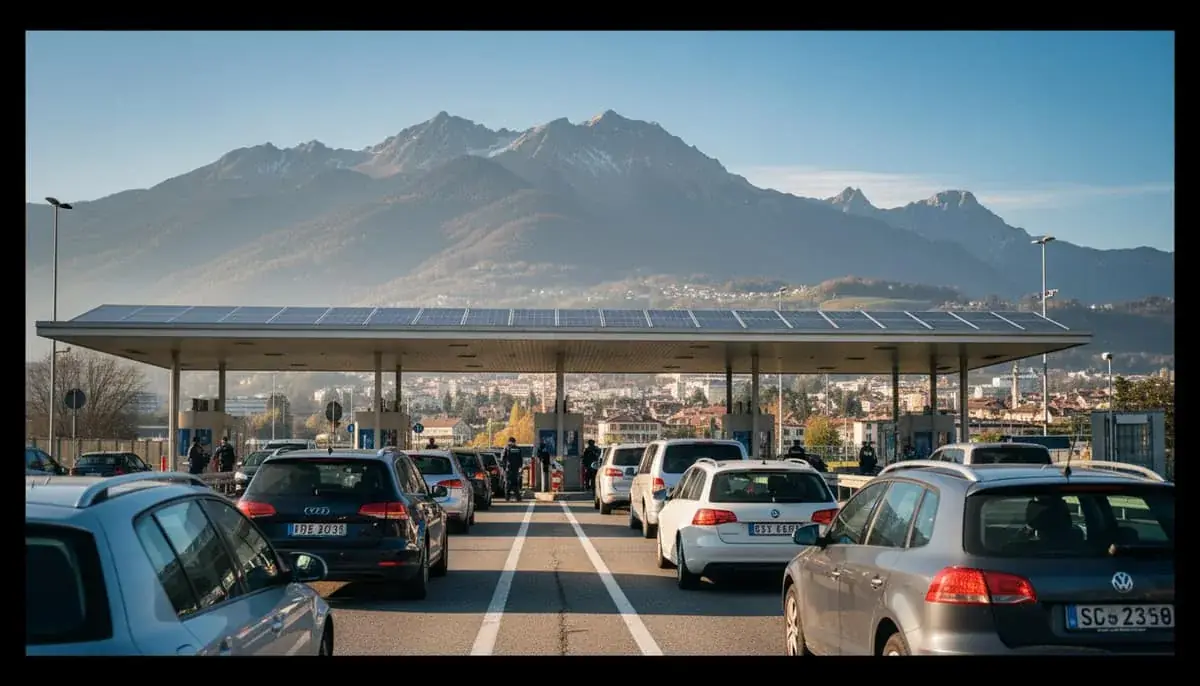
The new 2023 Italy-Switzerland tax agreement introduces the 20 km rule, reclassifying 72 Italian municipalities. However, 'older' cross-border workers find themselves in a grey area, losing tax advantages.
Context
TL;DR
- Misinto workers lost tax benefits due to unclear border rules.
- Misinto is 17,088 meters from Switzerland, qualifying as a border municipality.
- New tax agreement defines border municipalities within 20 km of the border.
Key facts
- Distance from border: 17,088 meters
- Tax loss: €150,000
- Municipality refund loss: €20,000
- New tax agreement date: July 17, 2023
- Border municipality definition: Within 20 kilometers of the border
- New border municipalities: 72 Italian localities
- Old cross-border workers: Pay taxes only in Switzerland until retirement
- New cross-border workers: Pay taxes in both Italy and Switzerland
The issue of cross-border municipalities has always been a sensitive topic for thousands of workers who cross the border daily to reach Canton Ticino. A recent case, reported by tvsvizzera.it on February 28, 2026, highlights how just a few kilometers can make the difference between a favorable tax regime and significant financial loss. A striking example is the case of a worker from Misinto, in the province of Monza, who worked in a Ticino factory for twenty years without being recognized as a cross-border worker, paying taxes in Italy. Only after her husband's insistence, who verified the exact distance from the border, did it emerge that Misinto is less than 20 kilometers from Switzerland, precisely 17,088 meters away.
This discovery revealed that the woman could have lost about €150,000 in tax benefits, while her municipality of residence missed out on at least €20,000 in refunds. Matteo Piuri, the mayor of Misinto, took the matter to heart, driven by a sense of fairness and the awareness that many of his fellow citizens were commuting to neighboring municipalities already recognized as border areas for tax purposes. He wrote to the Military Geographical Institute of Florence to obtain the official measurement and subsequently contacted the Ministry of Economy and Finance, the Revenue Agency, and other authorities, initially encountering a 'deafening silence.' Only after repeated efforts did the Lombardy Revenue Agency provide an interpretation of the rule, which finally clarified Misinto's status. This situation has caused, and continues to cause, significant confusion and uncertainty regarding the tax treatment of the individuals concerned on the Italian side, demonstrating how complex and fragmented cross-border regulations are, with direct impacts on salaries and the quality of life of our readers. The stakes are high, especially in a Canton Ticino where discussions on wage dumping are increasingly heated, as evidenced by recent votes to counter the phenomenon. Tax advantages for cross-border workers are a key element for the competitiveness of the Ticino labor market, and clarity on the rules is essential to maintain a sustainable balance.
Operational details
The root of this longstanding confusion lies in a definition of 'border municipality' that has never been unequivocal. The previous 1974 bilateral agreement between Switzerland and Italy did not go into detail, leaving the Cantons of Ticino, Valais, and Grisons free to use their own lists. As Giordano Macchi, director of the Tax Division of the Department of Finance and Economy (DFE) of Canton Ticino, explained, tracing the origin of these lists is a challenging task. It seems that at the time, they were based on a list related to grazing rights and cross-border livestock movement, derived from the 1953 Convention, which already mentioned 'cross-border workers' and included a list of 'border municipalities.' Thus, in the 1970s, these cantonal lists, although not mentioned in the 1974 agreement, were tacitly accepted by the Italian authorities, becoming de facto practice and almost law. Andrea Puglia, a union representative of OCST, confirms that 'each Canton prepared its own list to fill a gap. These unilateral lists, although not mentioned in the 1974 agreement, were shared with the Italian authorities without any objections from their side.'
The mention of the 20 kilometers, which today is the decisive criterion, did not appear in the 1953 Convention, where there was a generic reference to 'border zones' with an approximate extension of ten kilometers, except for exceptions. The first formal appearance of the 20 kilometers came in a 2017 resolution of the Italian Revenue Agency, but as Puglia explains, it was merely 'a synthetic expression, echoing the 'common understanding' used for almost fifty years to describe the municipalities present in the three cantonal lists.' Only with the new tax agreement on cross-border workers, which came into force on July 17, 2023, did the definition become explicit and binding: a border municipality is located within 20 kilometers of the border. This led to the inclusion of 72 new Italian localities, including Misinto, in the coveted category and the new official list. However, the dispute is not over: municipalities finally recognized as 'border' do not automatically fall into the tax category of 'old cross-border workers' (those working in Switzerland since 2018 and paying taxes only in the Confederation). This means that the worker from Misinto, despite having worked in Ticino for twenty years, is considered a 'new cross-border worker,' having to pay taxes in Italy as well, with a significant impact on her net salary.
Useful tools for your case
To verify your within/over 20 km tax scenario, use the net salary calculator and the tax return guide.
Key points
The distinction between 'old' and 'new' cross-border workers, with the entry into force of the new tax agreement on July 17, 2023, has created two categories of workers with profoundly different tax treatments. 'Old cross-border workers' will continue to pay taxes exclusively in Switzerland until retirement, while 'new cross-border workers' will have part of their income taxed in Italy as well. For unions, this situation creates an evident injustice, especially for those, like the worker from Misinto, who have worked in Ticino for decades believing they were under a more favorable tax regime. The OCST and other organizations have proposed applying retroactivity for these cases, but the Cantons have so far refused, arguing that the original lists were not official. This decision has direct consequences on the purchasing power of thousands of families, influencing housing and work choices along the Italy-Switzerland border.
💡 Practical tip: If you live in one of the 72 Italian municipalities recently recognized as 'border' or have doubts about your tax status, it is crucial to act immediately. Verify your position with the Italian Revenue Agency and consult a tax expert specialized in cross-border law. This will allow you to fully understand the implications of the new agreement and evaluate any legal or administrative actions. Transparency and legal certainty are essential to protect your interests. The Misinto case demonstrates that knowledge of the rules and proactivity can make a big difference. To help you navigate this complex landscape, Frontaliere Ticino provides useful tools. Want to know if your municipality is among the border ones and what IRPEF rates apply to you? Check out our Interactive Border Municipality Map for all the necessary information and to ensure you don't miss any tax advantages. The source of this analysis is tvsvizzera.it, published on February 28, 2026.
Frequently Asked Questions
- How do you calculate the 20 kilometers to determine a border municipality?
- You use a computer to check the distance from the border, such as the net salary calculator provided by the website.
- What is the difference between 'old' and 'new' frontierers in terms of taxation after 17 July 2023?
- Old frontierers (who have been working in Switzerland since 2018) only pay taxes in Switzerland until retirement. The 'new frontierers' (including those of newly recognized municipalities as border) pay taxes both in Switzerland and in Italy.
- How can I check if my town of residence is within 20 km of the border?
- You can use tools such as the online distance calculator by entering your nearest address and border location, so as to determine if your municipality is within 20 km required for the borderline regime.