ATA opposes the A2 Mendrisio‑Melano expansion
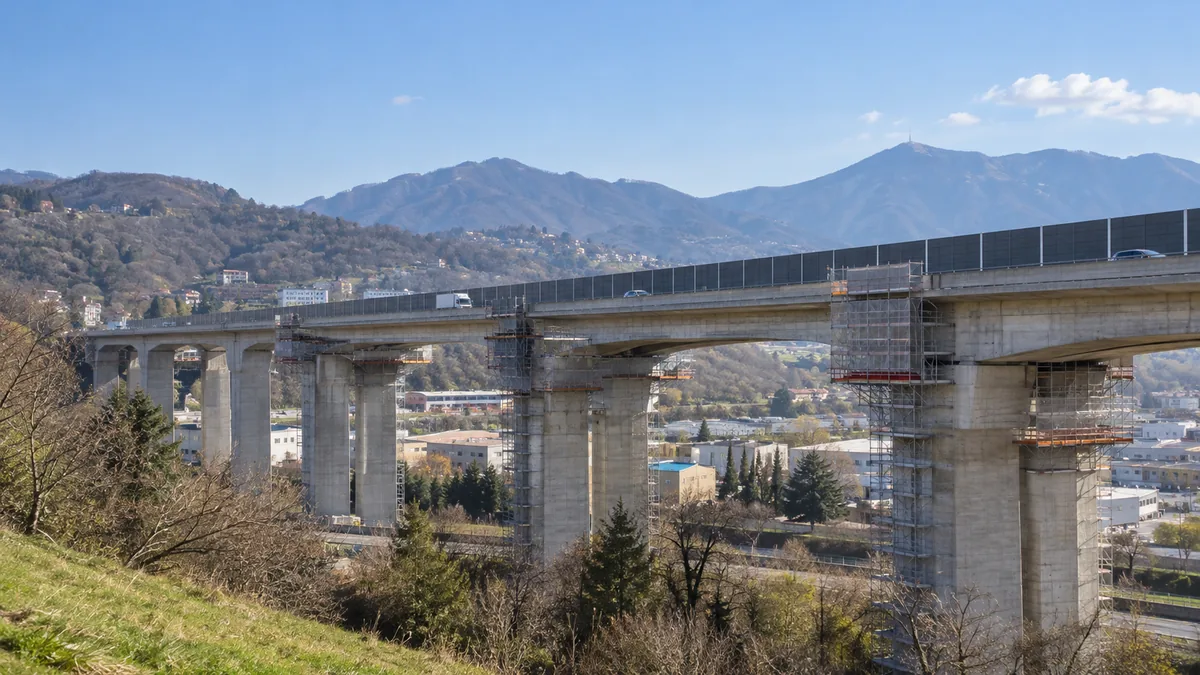
ATA opposes the expansion of the A2 between Mendrisio and Melano The project includes the Lenaccio viaduct and noise barriers PoLuMe envisages a third lane
Context
TL;DR
- The ATA opposes the expansion of the A2 between Mendrisio and Melano
- The project includes the Lenaccio viaduct and noise barriers
- PoLuMe provides for a dynamic third lane during periods of heavy traffic
- The association calls for new checks on noise and traffic
Key facts
- Who → ATA, Ticino section
- Where → A2 motorway between Mendrisio and Melano
- Measures → widening of the Lenaccio viaduct and noise barriers
- Issue → emergency lane used as a dynamic third lane
- Horizon → 2050
- Recipient → DATEC
- Reference → Article 8 of the Noise Pollution Control Ordinance
ATA's opposition
The planned measures include widening the Lenaccio viaduct and installing noise barriers. ATA disputes the assessments of the noise impact and the expected effects of increasing the motorway's capacity.
The issue of the dynamic third lane
According to the association, the official documentation would not classify the measure as a substantial modification of the motorway. ATA disputes this interpretation, since the future PoLuMe project envisages using the emergency lane as a dynamic third lane during peak traffic hours. In its view, this solution would significantly increase the infrastructure's capacity and, consequently, traffic volumes. For the association, the measure should therefore be considered a substantial modification under Article 8 of the Noise Pollution Control Ordinance, with the consequences provided for environmental assessments.
Noise, traffic and monitoring
The second front concerns noise emissions. ATA believes that the project's calculations are incorrect because they do not take into account the future construction of PoLuMe within the 2050 time horizon. It argues that the calculations omit both the use of the emergency lane as a dynamic third lane and the increase in traffic during certain time periods.
The association also disputes the report on the cantonal road: it would not include the data used to calculate its noise emissions, making it impossible to verify the traffic scenarios. The concerns also extend to noise protection, because the expansion of the road surface in use could reduce the effectiveness of the noise barriers. ATA therefore believes that a new assessment of the noise protection measures is needed.
The association identifies a tunnel as an alternative solution and calls for a new assessment of the increase in traffic. Finally, it fears that the increased motorway capacity will induce some users to return to cars, weakening the results achieved in recent years through the Canton's expansion of public transport.
Operational details
Why the third lane changes the interpretation of the project
For those travelling along the A2 between Mendrisio and Melano, the ATA's objection shifts attention from the visible work to the role that the stretch could assume during periods of heavy traffic. The viaduct and the noise barriers are elements of the project; the dynamic lane, on the other hand, is the element that, according to the association, changes capacity and traffic scenarios.
Capacity is also an environmental variable
If the emergency lane is used as a dynamic third lane, the motorway is not assessed only in terms of its expanded surface area. The traffic volumes that the increase in capacity could generate also enter into the assessment. The ATA maintains that this phenomenon is also recognised by the Federal Roads Office (USTRA). For a user of the stretch, the practical issue therefore concerns not only the presence of the noise barriers, but also how the projected traffic is calculated during the different time periods.
The assessment for 2050 becomes the point of comparison between the scenario contained in the project and the one contested by the ATA. If PoLuMe, the third lane and increased traffic are missing from the calculations, the association believes that the picture does not represent the future situation made possible by the intervention. The same logic applies to the cantonal road: without the data used to calculate noise emissions, the scenarios could not be verified.
Mobility and alternatives
The ATA's position combines the environment and modal choice. In its view, the increase in capacity could encourage a return to car use and undermine the results of the expansion of public transport carried out by the Canton in recent years. The proposed alternative is a tunnel, but the source does not describe its characteristics or route: its precise effect on traffic therefore cannot be determined.
The comparison remains between two interpretations: the official documentation, which does not consider the intervention a substantial modification, and the ATA's request to apply Article 8 OIF, redo the noise assessment and verify the effectiveness of the barriers. The consequence indicated by the source is a broader environmental assessment, not an outcome that has already been decided.
Key points
How to follow the dossier
To read the dossier concretely, it is useful to separate what is already described in the project from the requests contained in the objection. The source documents the submission to DATEC, but does not report a subsequent decision. The informational task therefore consists in checking which assumptions enter into the assessments.
Five points to check
1. Distinguish works and operations. On one side are the Lenaccio viaduct and the noise barriers; on the other, the use of the emergency lane as a third dynamic lane. 2. Check the time horizon. The assessment should be read in relation to 2050 and the future construction of PoLuMe. 3. Look for the data on the cantonal road. According to ATA, the report does not include those used for noise emissions; this is the point to verify in order to reconstruct the scenarios. 4. Assess the barriers in the expanded scenario. The effectiveness of the walls must be considered in light of the greater road surface used and the dynamic lane. 5. Compare mobility and alternatives. The dossier compares motorway capacity, the risk of a return to car use, the expansion of public transport by the Canton and the proposal for an alternative tunnel.
ATA's central request is twofold: to review the traffic forecasts and carry out a new assessment of the effectiveness of the noise protection measures. The reference invoked is Article 8 of the Noise Abatement Ordinance, while the addressee of the objection is DATEC. USTRA appears in the dossier in connection with recognition of the phenomenon of increased traffic linked to greater capacity.
This method avoids confusing a physical widening with the operational effect of the dynamic lane. It does not, however, make it possible to indicate schedules, diversions or works, because the source does not describe them. To follow the evolution of traffic conditions, consult traffic history and queues at border crossings.
Source: tio.ch
Frequently Asked Questions
- Why does the ATA consider the project a substantial modification?
- ATA maintains that the use of the emergency lane as a third dynamic lane (PoLuMe) would significantly increase the motorway's capacity and, consequently, traffic volumes. In its view, this falls within the definition of a substantial modification under Article 8 of the Ordinance on Noise Pollution, requiring a new environmental assessment.
- What physical interventions are planned in the expansion project?
- The project provides for the widening of the Lenaccio viaduct and the construction of noise barriers along the section of the A2 motorway between Mendrisio and Melano. These interventions constitute the visible part of the project.
- What is the ATA’s main request to DATEC?
- ATA calls on the Federal Department of the Environment, Transport, Energy and Communications (DATEC) to carry out new assessments of noise impact, including the future third dynamic lane and PoLuMe by 2050, to review traffic forecasts and to reassess the effectiveness of noise barriers. It also proposes studying an alternative tunnel.
Related articles
- All articles: Transport and traffic
- Progetto MeMe per la riduzione del rumore dell'autostrada A2
- Rinnovo delle concessioni e ampliamento dell'offerta: i piani di SNL per il 2026
- Incidente sul Viadotto Brogeda: Traffico Bloccato
- Como, al via i lavori per l'area camper da 26 posti
- Petizione contro i tagli a USI e SUPSI: già 500 firme